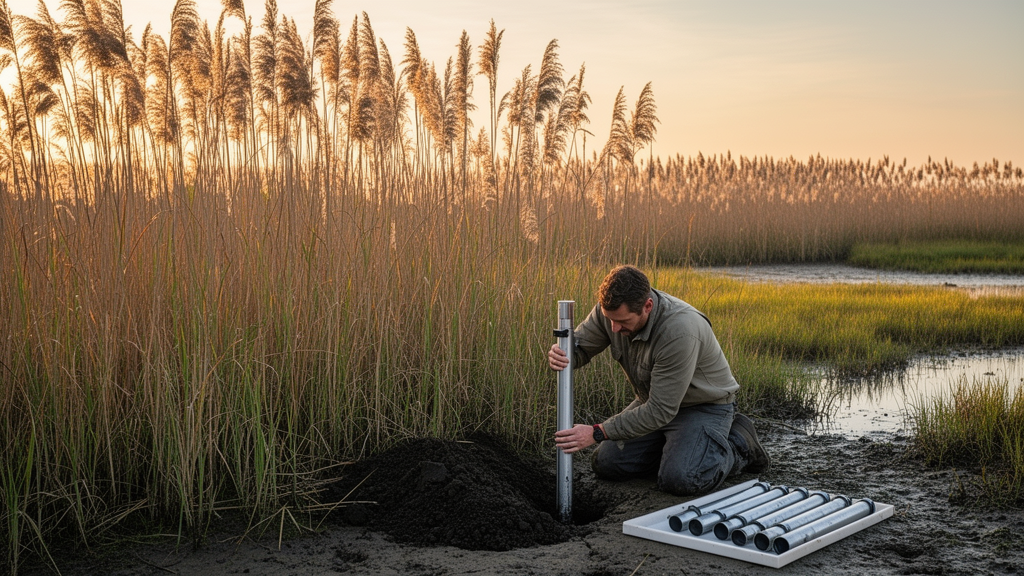
An invasive strain of the common reed Phragmites australis appears to restructure the bacterial communities living in the soils of a northeastern U.S. salt marsh, even where the total number of microbial types and the amounts of soil carbon and nitrogen remain unchanged. That is the central finding of a new open-access study published in Environmental Microbiome, based on soils collected from a brackish salt marsh at the mouth of the Quinnipiac River in Connecticut.
Coastal salt marshes of the northeastern United States are increasingly affected by invasion of the non-native Phragmites lineage, which can alter sediment characteristics, nutrient dynamics and belowground microbial communities, yet the extent to which these vegetation-associated changes influence microbial composition and predicted ecological functions has remained incompletely understood.
The team quantified soil physicochemical properties, characterized bacterial communities using high-throughput 16S rRNA amplicon sequencing with an amplicon sequence variant (ASV) workflow, and evaluated predicted microbial functions with FAPROTAX, a tool that infers ecological roles from taxonomic data.
Several soil properties differed between the two vegetation types. Total nitrogen and soil organic carbon stocks did not differ significantly, but Phragmites soils showed higher bulk density, and Sporobolus soils had higher carbon-to-nitrogen ratios. Soil pH differed between vegetation types and seasons.
When it came to microbial diversity, the picture was one of similarity in quantity but difference in composition. Alpha diversity, measured as observed richness and as Shannon and Simpson indices, was similar between vegetation types. However, community composition differed significantly based on Bray–Curtis dissimilarity in a PERMANOVA test, with a p value below 0.001.
The overlap between the two soil communities was strikingly small. The two vegetation types shared only 6,104 ASVs, amounting to 15.2 percent of the total community, while 15,452 ASVs, or 38.4 percent, were unique to Phragmites soils and 18,674 ASVs, or 46.4 percent, were unique to Sporobolus soils. Multivariate ordination further showed that community structure was significantly associated with vegetation type and with measured soil physicochemical gradients, particularly pH, bulk density, the carbon-to-nitrogen ratio, soil carbon and total nitrogen.
Predicted functional annotation pointed to divergent biogeochemical signatures. Taxa associated with nitrification were significantly more abundant in Phragmites soils, whereas taxa associated with sulfate respiration were significantly more abundant in Sporobolus soils. No significant differences were detected for cellulolysis, fermentation, methanogenesis or nitrogen fixation.
The authors caution that these are predicted functions, not measured process rates. In their conclusions, they note that although invasion by Phragmites australis was not associated with changes in overall bacterial alpha diversity or in bulk soil carbon and nitrogen stocks, the analysis suggests it was associated with substantial shifts in microbial community composition and predicted functional potential, with implications suggested for nitrogen and sulfur cycling in northeastern salt marshes. They call for future studies integrating metagenomics, functional gene quantification, direct measurements of biogeochemical process rates and long-term environmental monitoring to determine whether these predicted functional differences translate into measurable changes in ecosystem functioning.
The study was published on 3 October 2026 as an open-access research article, and the version shared at publication is a peer-reviewed, accepted manuscript that is citable and carries a permanent DOI, subject to further edits before the final Version of Record.
Subject of Research: Soil microbial community composition and predicted functions in soils invaded by Phragmites australis in a Northeastern U.S. salt marsh
Article Title: Phragmites australis invasions linked to shifts in soil microbial community composition and functional potential in a Northeastern U.S. salt marsh
Article References: Negi, R., Sanchez, J., & Kahara, S. (2026). Phragmites australis invasions linked to shifts in soil microbial community composition and functional potential in a Northeastern U.S. salt marsh. Environmental Microbiome. https://doi.org/10.1186/s40793-026-00966-9
Image Credits: AI Generated
DOI: 10.1186/s40793-026-00966-9
Keywords: Phragmites australis, salt marsh, soil microbiome, 16S rRNA sequencing, FAPROTAX, nitrification, sulfate respiration, invasive species, Connecticut, Quinnipiac River, biogeochemical cycling, Environmental Microbiome
Cite Scienmag News
Violet Maxwell. (October 29, 2026). Invasive Phragmites reshapes salt marsh soil microbes without changing diversity. Scienmag. https://scienmag.com/invasive-phragmites-reshapes-salt-marsh-soil-microbes-without-changing-diversity/
Violet Maxwell. "Invasive Phragmites reshapes salt marsh soil microbes without changing diversity." Scienmag, 29 October 2026, https://scienmag.com/invasive-phragmites-reshapes-salt-marsh-soil-microbes-without-changing-diversity/. Accessed 30 October 2026.
Violet Maxwell. "Invasive Phragmites reshapes salt marsh soil microbes without changing diversity." Scienmag. October 29, 2026. https://scienmag.com/invasive-phragmites-reshapes-salt-marsh-soil-microbes-without-changing-diversity/