


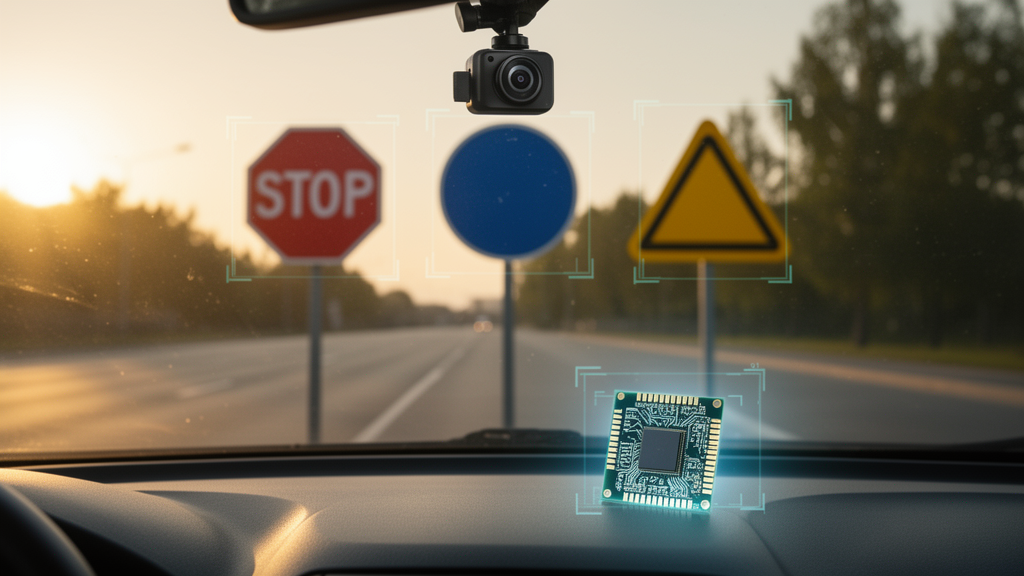
Self-driving cars and advanced driver-assistance systems live or die by their ability to read the road, and few skills matter more than recognizing traffic signs. A missed stop sign or a misread speed limit can translate directly into a dangerous maneuver. Yet teaching a machine to detect every sign it might encounter has long demanded something in short supply: enormous, painstakingly labeled datasets spanning thousands of sign categories, lighting conditions, weather states, and national design standards. A research team from Bangladesh now reports a way to sidestep that bottleneck, presenting a neural network architecture called FUSED-Net that learns to detect traffic signs from as little as a single labeled example per class.
The work, published in PLOS One, addresses a problem known in machine learning circles as few-shot object detection, or FSOD. Conventional object detectors are data-hungry by design. They learn to recognize objects by adjusting millions of internal parameters across tens of thousands of training images, and their performance collapses when the examples available for a new category can be counted on one hand. For traffic signs, the problem is especially acute. While major economies have well-curated benchmark datasets, many countries lack comprehensive collections of their own signage, and curating large-scale datasets for diverse traffic sign detection remains impractical for most research groups and transportation authorities.
FUSED-Net, developed by Md. Atiqur Rahman, Nahian Ibn Asad, Md. Mushfiqul Haque, Md. Bakhtiar Hasan, Sabbir Ahmed, and Md. Hasanul Kabir, is built on a well-established backbone: Faster R-CNN, a two-stage detector that first proposes candidate regions in an image and then classifies and refines them. What sets the new approach apart is what the team does around that backbone. The architecture integrates four key components, each targeting a different failure mode of learning from scarce data: unfrozen parameters, pseudo-support sets, embedding normalization, and domain adaptation. Together, they allow the model to extract far more signal from a handful of images than standard few-shot pipelines manage.
The first and arguably most consequential design choice is that FUSED-Net keeps all of its parameters unfrozen during training. Many few-shot methods deliberately freeze large portions of a pretrained network, updating only a small classification head or a handful of adaptation layers. The logic is defensive: with only a few examples, letting the whole network update risks catastrophic forgetting, in which the model overwrites its general knowledge while memorizing the new samples. The team found the opposite strategy pays off for traffic signs. By allowing every parameter to continue learning, the network can reshape its entire feature hierarchy to fit the target domain, adapting not just its final decisions but the visual primitives those decisions rest upon.
The second component, the pseudo-support set, tackles the scarcity of target-domain data head-on. In few-shot object detection, the model is typically given a small set of support images, each containing a labeled example of the class to be detected, and must then find instances of that class in entirely new query images. FUSED-Net augments this meager support set synthetically, generating additional pseudo-examples through data augmentation. These augmented samples effectively multiply the evidence available for each class, compensating for the scarcity of target domain data and giving the detector a richer, more varied notion of what a given sign looks like under different distortions and viewpoints.
Embedding normalization addresses a subtler statistical problem. When a model learns from very few examples, the feature representations it extracts for images of the same class can vary wildly, a phenomenon known as high intra-class variance. That variance makes it hard for the network to decide whether a newly detected region truly belongs to the class in question. By normalizing the embeddings, the feature vectors the network produces before classification, FUSED-Net standardizes these representations, pulling members of the same class closer together in feature space and reducing the noise that few-shot learning would otherwise amplify.
The fourth pillar is domain adaptation, achieved by pre-training the model on a diverse traffic sign dataset before fine-tuning on the target domain. Traffic signs differ dramatically across countries in color schemes, shapes, language, and pictogram conventions, and a model trained exclusively on one nation’s signage tends to falter on another’s. Pre-training on a broad, varied collection gives the network a general visual vocabulary of sign-like objects, which it can then specialize quickly and reliably to the specific signage of a new region, even when only a few labeled examples of that region’s signs exist.
The team evaluated FUSED-Net on the Bangladesh Traffic Sign Dataset, or BDTSD, a benchmark reflecting signage that mainstream datasets rarely cover. The results were striking. Measured by mean average precision, the standard metric for detection accuracy, FUSED-Net achieved improvements of 2.4 times, 2.2 times, 1.5 times, and 1.3 times over state-of-the-art few-shot object detection models in the 1-shot, 3-shot, 5-shot, and 10-shot scenarios respectively. The pattern is telling: the scarcer the data, the larger the advantage, exactly where few-shot methods are supposed to struggle most and where real-world deployment often finds itself.
The architecture also proved its mettle on the cross-domain few-shot object detection benchmark, a harder test in which the support examples and the query images come from different visual domains. FUSED-Net delivered superior performance across multiple settings of this benchmark, suggesting that its combination of full parameter updating, synthetic support augmentation, and normalized embeddings generalizes beyond a single dataset or signage system. For autonomous vehicles and driver-assistance systems being deployed in countries whose roads were absent from the training corpora of major AI labs, that cross-domain robustness may prove to be the technology’s most valuable property.
The implications extend well beyond traffic signs. The core insight, that a detector can be made dramatically more data-efficient by unfreezing its entire parameter set, inflating its support evidence through augmentation, and standardizing its internal feature space, is applicable to any domain where labeled data is expensive and categories are numerous: medical imaging, wildlife monitoring, industrial inspection, and satellite analysis among them. The researchers have released their source code along with links to download the datasets on GitHub, inviting other teams to build on the approach. As autonomous systems spread to roads that were never part of Silicon Valley’s training data, techniques like FUSED-Net may determine whether the machines can keep up with the world’s visual diversity, one example at a time.
Subject of Research: Few-shot object detection for traffic sign recognition with limited training data
Article Title: FUSED-Net: Detecting traffic signs with limited data
Article References: Rahman, M. A., Asad, N. I., Haque, M. M., Hasan, M. B., Ahmed, S., & Kabir, M. H. (2026). FUSED-Net: Detecting traffic signs with limited data. PLOS One, 21(10), e0359293. https://doi.org/10.1371/journal.pone.0359293
Image Credits: AI Generated
DOI: 10.1371/journal.pone.0359293
Keywords: FUSED-Net, few-shot object detection, traffic sign recognition, Faster R-CNN, domain adaptation, embedding normalization, pseudo-support sets, BDTSD dataset, autonomous driving, computer vision, deep learning, PLOS One
Cite Scienmag News
Blake Davidson. (October 8, 2026). FUSED-Net Learns to Spot Traffic Signs From Just a Handful of Examples. Scienmag. https://scienmag.com/fused-net-learns-to-spot-traffic-signs-from-just-a-handful-of-examples/
Blake Davidson. "FUSED-Net Learns to Spot Traffic Signs From Just a Handful of Examples." Scienmag, 8 October 2026, https://scienmag.com/fused-net-learns-to-spot-traffic-signs-from-just-a-handful-of-examples/. Accessed 8 October 2026.
Blake Davidson. "FUSED-Net Learns to Spot Traffic Signs From Just a Handful of Examples." Scienmag. October 8, 2026. https://scienmag.com/fused-net-learns-to-spot-traffic-signs-from-just-a-handful-of-examples/


