

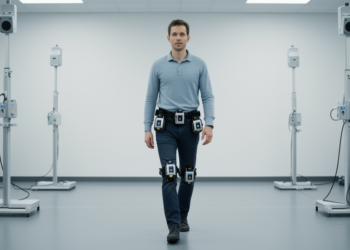
Four sensors predict lower-limb joint moments with subject-specific calibration
A four-sensor deep-learning system estimated five lower-limb joint moments during walking and stair tasks, with 10 seconds of unlabeled walking ...
A four-sensor deep-learning system estimated five lower-limb joint moments during walking and stair tasks, with 10 seconds of unlabeled walking ...

Adversarial domain adaptation raised normal-case specificity on robotic echocardiograms from 65.7% to 89.3% without using robotic pathological cases, but validation ...
A study combining source relevance with unlabeled cross-dataset stability selected 48 wearable-signal features and improved MHEALTH-to-PAMAP2 activity classification.
A new iScience study introduces CSCC-PAG, a deep learning framework that combines domain-specific pre-training with self-supervised domain adaptation to improve ...
Researchers in South Korea developed a domain-adaptive deep learning framework that lets smartphones detect abnormal lung sounds in children despite ...
A semi-supervised adversarial autoencoder detects gait phases in real time for post-stroke exoskeleton control, reaching 93.79% accuracy with only 10% ...
Researchers have adapted Meta's Segment Anything Model for medical imaging by combining low-rank fine-tuning, Mamba-based adapters, and a prompt-free decoder, ...
Researchers at Los Alamos National Laboratory used CORAL domain adaptation to train acoustic resonance spectroscopy models on synthetic data that ...
Researchers have developed a semi-supervised, domain-adaptive intrusion detection algorithm that combines mutual-information-maximizing adversarial networks with uncertainty-aware pseudo-labeling to detect attacks ...
Researchers have developed AdaTent++, a test-time adaptation framework that routes each unlabeled frame through reliability-gated paths to improve traffic sign ...

Embark on a thrilling journey of discovery with Scienmag.com—your ultimate source for cutting-edge breakthroughs. Immerse yourself in a world where curiosity knows no limits and tomorrow’s possibilities become today’s reality!