


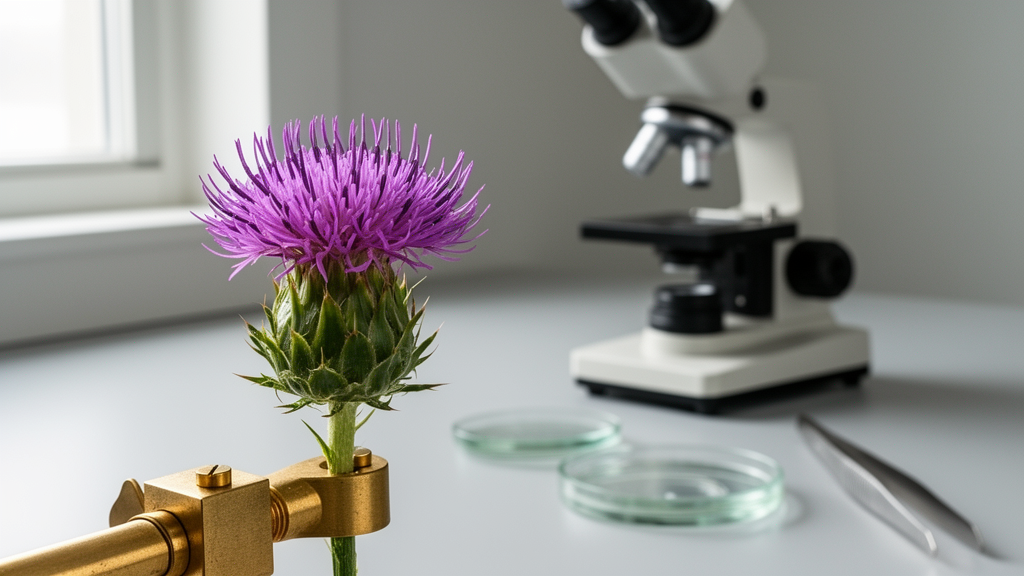
Deep in the mountains of southwestern Türkiye grows a knapweed that exists nowhere else on Earth. Centaurea kirmacii, a spiny member of the enormous daisy family Asteraceae, was only formally described to science in 2018, and until now almost nothing was known about what lies beneath its surface — the hidden architecture of its roots, stems, leaves, pollen grains and fruits. A new study published in Plant Biosystems has peeled back that microscopic veil, and the results offer some of the strongest anatomical and micromorphological evidence yet for why this endemic plant deserves its status as a distinct species.
The research, led by Zehra Sinem Yılmaz of the Izmir Institute of Technology and Ege University, together with Aylin Eşiz Dereboylu, Ulaş Uğuz and Serdar Gökhan Şenol of Ege University, took a deliberately broad approach. Rather than relying on the visible shape of flowers and leaves alone — features that can be deceptively similar among closely related knapweeds — the team examined thin sections of the root, stem, leaf and petiole under light microscopy, and then turned to scanning electron microscopy to capture the exquisite surface detail of pollen grains and cypselae, the one-seeded fruits characteristic of the daisy family. The work was supported by a grant from the Scientific and Technological Research Council of Türkiye, TÜBİTAK.
Centaurea is one of the largest and most taxonomically challenging genera in the Asteraceae, with hundreds of species spread across the Mediterranean and western Asia. Türkiye is a particular hotspot, and many of its knapweeds are narrow endemics confined to single mountain ranges. Within this sprawling group, C. kirmacii belongs to section Pteracantha, a lineage defined in part by its winged, spiny involucral bracts. Distinguishing species within such sections is notoriously difficult because convergent evolution has repeatedly produced similar spines, leaf shapes and flower heads in unrelated lineages — a phenomenon botanists call morphological homoplasy. That is precisely why the authors turned to characters that are less visible to the eye but often more reliable indicators of true evolutionary relationships.
The anatomical survey produced a suite of diagnostic characters. The leaf epidermis is uniseriate, meaning it consists of a single layer of cells, and the stem bears simple, ovate leaves with a well-developed chlorenchyma — the photosynthetic tissue just beneath the surface. Perhaps most striking are the secretory canals embedded in the root cortex, ducts that channel resins or other secondary metabolites through the plant. The petiole, the stalk that connects leaf to stem, shows a distinctive internal structure that sets C. kirmacii apart from its closest relatives. Each of these features, on its own, might seem like a minor footnote; taken together, they form a consistent anatomical fingerprint.
The palynological results are equally telling. Under the scanning electron microscope, the pollen of C. kirmacii revealed itself to be tricolporate — each grain carries three germination pores, each surrounded by a furrow and a pore, the standard aperture type across much of the daisy family. The grains are prolate-spheroidal in shape, meaning they are slightly elongated along one axis but close to spherical, and their surface ornamentation is described as perforate-scabrate: a sculptured landscape dotted with tiny holes and fine, wart-like projections. In palynology, these seemingly arcane descriptors carry real weight, because pollen wall architecture is strongly constrained by genetics and often varies meaningfully between species and sections.
Pollen shape, the authors note, provides useful supplementary evidence for comparisons within section Pteracantha. In a genus where gross morphology can mislead, the dimensions and sculpturing of pollen grains act as an independent line of evidence — one that can confirm or challenge hypotheses built from external appearance alone. The tradition of using pollen to untangle Asteraceae relationships stretches back decades, and this study plugs C. kirmacii into that comparative framework for the first time.
The fruit tells its own story. The cypsela of C. kirmacii is elongated-lanceolate to ovoid, and it bears a pappus — the modified calyx that acts as a parachute for wind dispersal — that is simple, relatively long and persistent. Pappus architecture is one of the classic characters used to delimit Centaurea species and sections, and the combination observed here adds another distinguishing trait to the species’ profile. For a plant that survives in a restricted Mediterranean habitat, a persistent and well-formed dispersal apparatus has obvious ecological implications, influencing how far its seeds can travel and where the next generation can establish.
Why does all this microscopic detail matter beyond the herbarium? The answer lies in the ongoing effort to build an accurate phylogeny — an evolutionary family tree — for Centaurea as a whole. Molecular studies have repeatedly shown that sections defined purely on visible morphology sometimes lump together species that are not each other’s closest relatives. Anatomical and micromorphological datasets provide independent characters that can be mapped onto molecular trees, testing whether the traditional groupings hold up. By expanding the comparative character dataset for section Pteracantha, the new study gives systematists fresh traits to score, and gives conservation biologists a firmer basis for recognizing C. kirmacii as a genuinely distinct evolutionary entity rather than a variant of a widespread relative.
There is also a broader message about Mediterranean biodiversity. The Mediterranean Basin is one of the world’s recognized biodiversity hotspots, and its mountainous terrain has produced extraordinary numbers of narrow endemics — species with ranges so small that a single road, quarry or climate shift could erase them. Narrow endemics like C. kirmacii are often described decades after botanists first notice them, and their biology is frequently documented even later. Studies like this one, which combine classical anatomy with modern electron microscopy, show how much hidden diversity remains to be characterized even in comparatively well-studied regions such as Türkiye, and how much of that characterization depends on careful, patient work at the microscope.
The findings, published as volume 160, article 283 of Plant Biosystems, ultimately do something deceptively simple: they give a rare Turkish knapweed a complete microscopic identity. From the secretory canals threading through its root cortex to the perforate-scabrate landscape of its pollen walls, every character described adds to a growing dossier that will inform systematic revisions, phylogenetic analyses and conservation assessments for years to come. For a species found only in the hills of southwestern Anatolia, that level of documentation is not academic luxury — it is the foundation on which its future protection will be built.
Subject of Research: Anatomical and palynological characterization of the endemic Turkish knapweed Centaurea kirmacii
Article Title: Pollen morphology and anatomical features of southwest Turkish endemic Centaurea kirmacii (Asteraceae): a micromorphometric approach
Article References: Yılmaz, Z. S., Eşiz Dereboylu, A., Uğuz, U., & Şenol, S. G. (2026). Pollen morphology and anatomical features of southwest Turkish endemic Centaurea kirmacii (Asteraceae): a micromorphometric approach. Plant Biosystems, 160(5), Article 283. https://doi.org/10.1007/s44473-026-00305-3
Image Credits: AI Generated
DOI: 10.1007/s44473-026-00305-3
Keywords: Centaurea kirmacii, Asteraceae, plant anatomy, palynology, pollen morphology, scanning electron microscopy, endemic species, Türkiye, section Pteracantha, cypsela morphology, plant systematics, Mediterranean biodiversity
Cite Scienmag News
Alan Morgan. (October 8, 2026). Microscope Secrets of a Rare Turkish Knapweed Could Rewrite Its Family Tree. Scienmag. https://scienmag.com/microscope-secrets-of-a-rare-turkish-knapweed-could-rewrite-its-family-tree/
Alan Morgan. "Microscope Secrets of a Rare Turkish Knapweed Could Rewrite Its Family Tree." Scienmag, 8 October 2026, https://scienmag.com/microscope-secrets-of-a-rare-turkish-knapweed-could-rewrite-its-family-tree/. Accessed 8 October 2026.
Alan Morgan. "Microscope Secrets of a Rare Turkish Knapweed Could Rewrite Its Family Tree." Scienmag. October 8, 2026. https://scienmag.com/microscope-secrets-of-a-rare-turkish-knapweed-could-rewrite-its-family-tree/


