


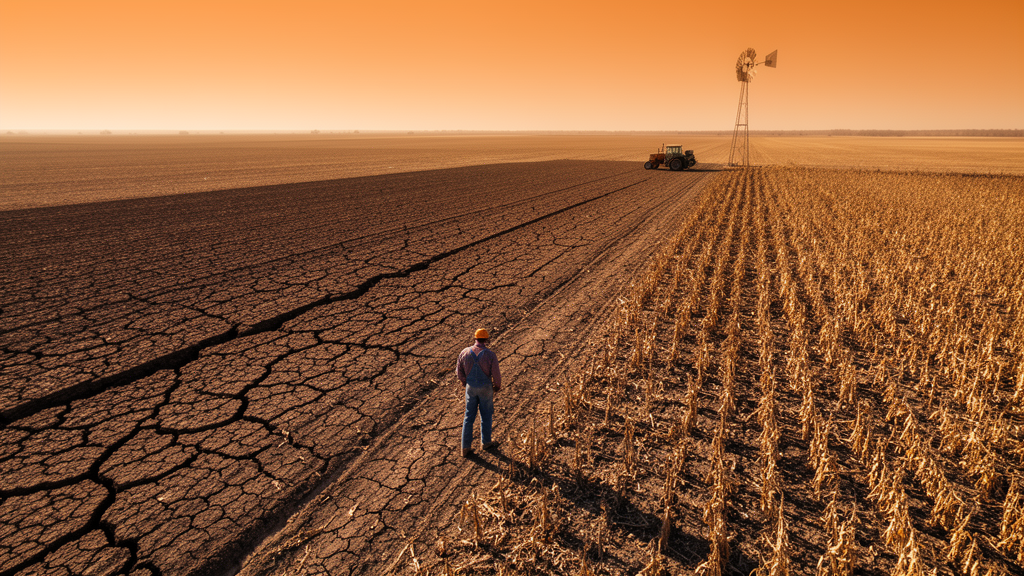
The water that crops depend on most is not the rain that falls from the sky but the moisture held in the soil beneath them, and a new global study warns that this hidden reservoir is on track for a dramatic decline. An international research team led by Sogol Moradian of Atlantic Technological University in Sligo, Ireland, together with colleagues at the University of Galway and the University of Oulu, has produced one of the most comprehensive projections to date of soil moisture droughts across the planet, and the picture it paints for the world’s farmland is sobering. By mid-century, under a high-emissions future, the global average drought exposure of agricultural land rises sharply, with South America, southern Europe, South Asia and parts of North America emerging as the regions where drying is most pronounced and where adaptation efforts are most urgently needed.
The study, published in npj Sustainable Agriculture, tackles a long-standing weakness in drought science. Most drought assessments rely on indices built from precipitation or temperature, which describe the climatic drivers of drought but say little about the actual water available to plant roots. Agricultural drought, by contrast, is fundamentally a soil moisture phenomenon: it occurs when water held in the root zone falls below the levels crops need to sustain growth and yield. By working directly with bias-corrected soil moisture outputs from seventeen climate models in the Coupled Model Intercomparison Project Phase 6, or CMIP6, the team shifted the analytical focus from the atmosphere to the ground itself, capturing the variable that matters most to farmers.
Methodologically, the framework is built on careful statistical ground. The researchers used the Global Land Data Assimilation System, specifically the GLDAS-Noah v2.1 dataset produced by NASA, as their reference. This product integrates observational forcing, reanalysis data and satellite assimilation to deliver a globally consistent, gap-free simulation of soil moisture at a resolution of 0.25 degrees, making it a reliable benchmark against which climate model outputs can be judged. Because satellite-only soil moisture products suffer from cloud interference, retrieval uncertainties and sensor limitations, the physically based GLDAS record offers the temporal continuity that a global drought assessment demands. The team aggregated soil layers in both the reference data and the model outputs to represent total root-zone storage, ensuring that the two datasets described comparable conditions relevant to crops.
Raw climate model output is notoriously prone to systematic bias, arising from simplified assumptions, imperfect parameterisations and structural errors in how physical processes are represented. To address this, the researchers applied a linear scaling bias correction, adjusting each model’s monthly soil moisture values by the ratio of the GLDAS reference mean to the model mean over the 2000 to 2014 baseline period. Crucially, this approach corrects the systematic mean bias while preserving the temporal structure of each simulation, so the historical trends and relative anomalies simulated by the models remain intact. When the seventeen models were evaluated across a suite of performance metrics, including bias, correlation, the index of agreement, the Kling-Gupta efficiency and root mean square error, the bias-corrected multi-model ensemble mean outperformed every individual model, and it was therefore selected for the drought projections.
With corrected soil moisture in hand, the team computed the Standardised Soil Moisture Index, or SSMI, using a non-parametric formulation based on the empirical Gringorten plotting position rather than a fitted parametric distribution. This choice matters in a warming world. Parametric distributions assume that the statistical properties of soil moisture remain stationary, yet under climate change those properties evolve continuously, and a fixed distribution fitted to historical data can distort future drought estimates. The non-parametric approach makes no such assumption, ranking each month’s soil moisture against the full empirical record and converting those probabilities into a standardised index. Negative SSMI values flag dry conditions, classified from abnormally dry down to exceptionally dry, while positive values indicate wet conditions. A Kolmogorov-Smirnov test confirmed that the empirical distribution adequately described both the reference and the corrected ensemble data, lending statistical confidence to the classification.
The projections, spanning 2015 to 2050 under two Shared Socioeconomic Pathways, reveal a clear intensification of drought characteristics toward mid-century. SSP2-4.5 represents a middle-of-the-road future in which emissions stabilise and radiative forcing reaches 4.5 watts per square metre by 2100, while SSP5-8.5 describes a high-emissions world of rapid, carbon-intensive growth pushing forcing to 8.5 watts per square metre. Under both scenarios, the number of land pixels classified in the severe to exceptional drought categories increases over time, and mean SSMI values decline steadily, with the deterioration most pronounced under SSP5-8.5. Continental analyses show strong and consistent drying signals in South America and Europe, gradual downward trajectories in Asia and North America, and pronounced interannual swings in Australia, reflecting that continent’s acute climate sensitivity and its potential for both extreme wet spells and prolonged dry ones.
One of the study’s more counterintuitive findings concerns drought frequency. Globally, the average number of drought events actually declines slightly under the high-emissions scenario, from roughly 9.1 events to 8.6 over the projection period, yet total drought duration remains essentially unchanged at around 68 months. The explanation is that individual droughts last longer under SSP5-8.5, so fewer distinct events fit into the same window. Rather than many short dry spells, the future favours fewer but more protracted episodes of soil moisture deficit, a shift that is arguably more dangerous for agriculture, since persistent multi-season deficits deplete reservoirs, exhaust soil water reserves and push crops past critical physiological thresholds in ways that brief droughts do not.
To translate these hazard projections into agricultural consequences, the team developed a Drought Exposure Index that combines normalised drought frequency, total duration and mean intensity through a geometric mean, then overlays the result on global cropland data from the Land Cover Climate Research Data Package. The index ranges from zero to one, with higher values signalling greater exposure. The results expose stark regional disparities: the highest exposure values cluster over major croplands in South Asia, southern Africa, South America, southern Europe and parts of the United States. Under SSP2-4.5 the global mean index reaches 0.71, but under SSP5-8.5 it climbs to 0.78 by 2050, a substantial rise in exposure attributable to the emissions pathway alone. Asia, which holds 34 percent of the world’s agricultural area, followed by South America with 22 percent, face the largest absolute areas of drought-affected cropland, with the affected share trending upward in every continent through 2050.
The implications reach well beyond hydrology. Soil moisture droughts of the kind projected here directly threaten food security, and the authors frame their findings against the Sustainable Development Goals on Zero Hunger, Climate Action and Life on Land. Recent history illustrates the stakes: the Millennium Drought that gripped Australia from 1997 to 2010, the simultaneous droughts of 2010 in the Amazon, southwestern China and Russia, the Texas-Mexico and East African droughts of 2011, and the United States summer droughts of 2012 and 2016 all devastated harvests, economies and livelihoods. The new projections suggest that events of this character will become longer and more widespread, particularly in the very regions that feed growing populations.
The study also charts a path forward. Climate-resilient farming practices such as precision irrigation, conservation tillage and drought-resistant crop varieties can improve soil moisture retention, while agroforestry and regenerative agriculture strengthen soil structure and water-holding capacity. On the water side, managed aquifer recharge, rainwater harvesting and smart irrigation systems can stretch supplies through dry periods, and transboundary cooperation becomes essential where rivers cross borders. The authors argue that drought risk must be embedded in national adaptation plans, supported by improved monitoring networks, early warning systems and climate-informed decision tools, and that advances in remote sensing, data assimilation and machine learning will sharpen future assessments. They are candid about the limitations that remain, including the simplicity of linear bias correction, uncertainties in land cover change and the difficulty of separating human influences from natural variability. Even so, by pinpointing where soil moisture droughts and croplands will collide hardest, the research gives policymakers a map of where every adaptation dollar will matter most.
Subject of Research: Global projections of soil moisture droughts and agricultural drought exposure under climate change scenarios
Article Title: Projecting global soil moisture droughts under climate change: characteristics, agricultural exposure, and adaptation insights
Article References: Moradian, S., Gharbia, S., Sonny, F., Torabi Haghighi, A., & Olbert, A. I. (2026). Projecting global soil moisture droughts under climate change: characteristics, agricultural exposure, and adaptation insights. npj Sustainable Agriculture, 4(1), Article 80. https://doi.org/10.1038/s44264-026-00144-x
Image Credits: AI Generated
DOI: 10.1038/s44264-026-00144-x
Keywords: soil moisture, agricultural drought, CMIP6, climate change, SSP scenarios, Standardised Soil Moisture Index, GLDAS, bias correction, drought exposure, food security, climate adaptation, water management
Cite Scienmag News
Alan Morgan. (October 8, 2026). Global Farmland Faces Longer, Deeper Soil Droughts by 2050, Climate Models Warn. Scienmag. https://scienmag.com/global-farmland-faces-longer-deeper-soil-droughts-by-2050-climate-models-warn/
Alan Morgan. "Global Farmland Faces Longer, Deeper Soil Droughts by 2050, Climate Models Warn." Scienmag, 8 October 2026, https://scienmag.com/global-farmland-faces-longer-deeper-soil-droughts-by-2050-climate-models-warn/. Accessed 8 October 2026.
Alan Morgan. "Global Farmland Faces Longer, Deeper Soil Droughts by 2050, Climate Models Warn." Scienmag. October 8, 2026. https://scienmag.com/global-farmland-faces-longer-deeper-soil-droughts-by-2050-climate-models-warn/


