


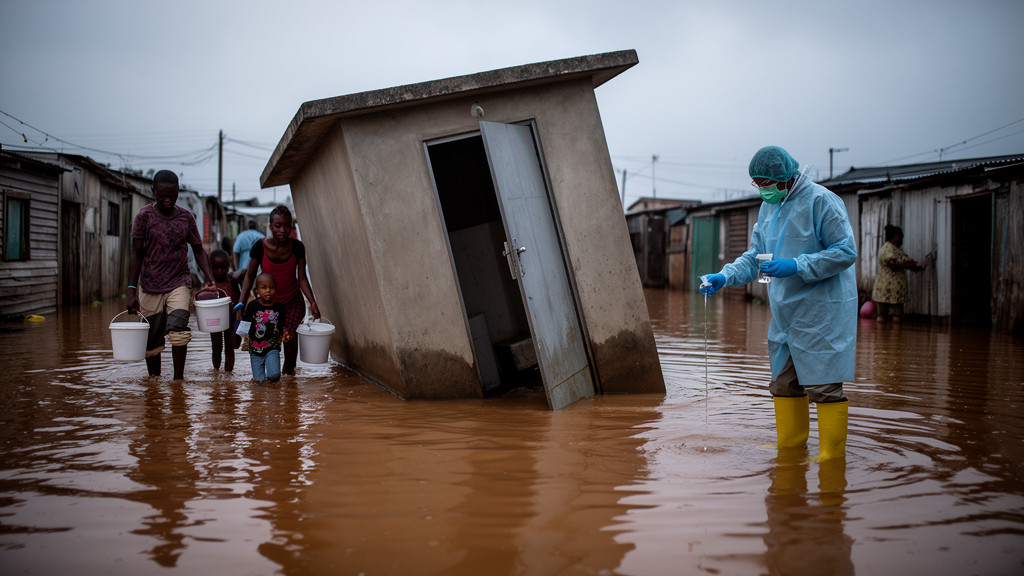
Every time extreme rainfall drowns a city, the water finds its way into the most vulnerable corners of the urban landscape, and some of the most consequential damage happens underground and behind the doors of shared latrines. In the dense informal settlements that house a growing share of the world’s urban population, flooding does not merely soak belongings and block roads. It can inundate pit latrines, collapse toilet superstructures, push fecal sludge into yards and alleyways, and flush pathogens into the wells, streams, and storage containers that families depend on for drinking water. A new essay published in PLOS Climate by Fred Tusabe, Sarah Lebu, and Musa Manga argues that these flood-driven sanitation failures deserve to be treated as a central pillar of epidemic preparedness in low- and middle-income countries, using cholera as the clearest illustration of what happens when climate extremes collide with fragile sanitation systems.
The authors’ central framing is deceptively simple: sanitation functionality during floods is not a secondary concern to be addressed after the emergency passes, but a core component of how cities should prepare for epidemics. Climate change is intensifying rainfall extremes and urban flooding across many regions, and the public health consequences are sharpest where sanitation and drainage infrastructure is weakest. In an informal settlement, a single heavy storm can overwhelm onsite sanitation and fecal sludge management systems that were already operating at or beyond capacity. Pit latrines fill with floodwater, overflow, or collapse outright, and the fecal material they contained disperses into the household environment. What follows is a dramatic increase in fecal exposure, the pathway through which enteric pathogens, including Vibrio cholerae, find new hosts.
The technical logic of this exposure pathway is worth unpacking, because it explains why cholera risk can spike so rapidly after a flood. Cholera transmission is exquisitely sensitive to the dose of ingested bacteria, and flooding effectively multiplies the number of routes by which fecal contamination reaches human mouths. When latrines overflow, contamination spreads into soil and standing water; when households rely on intermittent piped supply or unsafe sources such as shallow wells and untreated surface water, the contaminated environment translates directly into contaminated drinking water. Waterborne transmission can then be amplified by person-to-person spread within crowded households, where space for isolation and hygiene is limited. The result is a setting in which a sanitation failure that lasts days can seed a transmission chain that persists for months, particularly in settlements where drainage is poor and floodwater lingers.
Lusaka, Zambia, serves as the essay’s illustrative case, and it is a revealing one. Like many rapidly growing cities in sub-Saharan Africa, Lusaka contains large informal settlements where most residents rely on onsite sanitation, pit latrines and septic tanks that must be emptied and their contents safely managed, rather than sewerage. When heavy rains strike, these containment systems are vulnerable in predictable ways: pits flood and overflow, latrine structures collapse in saturated ground, and fecal sludge that cannot be collected and treated because roads are impassable and treatment capacity is limited simply accumulates in the environment. Lusaka has experienced prolonged cholera epidemics in precisely these fragile water and sanitation conditions, and the essay draws lessons from those outbreaks about what it takes to interrupt transmission and, crucially, what it takes to prevent it from returning.
One of the most important lessons is that emergency response tools work, but only up to a point. During cholera epidemics, health authorities can deploy oral cholera vaccine campaigns, establish oral rehydration treatment points, distribute chlorine tablets for household water treatment, and intensify hygiene promotion. These measures can suppress transmission and save lives, and the experience of prolonged epidemics in fragile settings shows that they are indispensable. Yet the essay is emphatic that emergency response is not a substitute for durable services. Transmission can be pushed down temporarily while the underlying conditions, unsafe water, unreliable sanitation, and inadequate fecal sludge management, remain intact. When the emergency machinery stands down, the same vulnerabilities are waiting for the next heavy rain, and the cycle can repeat with each new flood season.
That repetition is captured in the essay’s discussion of feedback loops that sustain exposure and delay recovery. Flood-driven sanitation failure is not a one-off event that the environment simply absorbs. Inundated latrines contaminate the soil and shallow groundwater that households draw on, meaning that exposure continues long after floodwater recedes. Damaged sanitation facilities are often slow to repair in settlements where households have limited resources and responsibility for shared toilets is unclear, so people may resort to open defecation or unsafe shared facilities for extended periods. Intermittent water supply compounds the problem, because storing water in containers creates new opportunities for contamination, and rationing limits the water available for handwashing and cleaning. Each of these loops can keep fecal exposure elevated for weeks or months, sustaining the conditions under which cholera and other enteric diseases flourish and making recovery slower and more expensive than prevention would have been.
Building on recent calls for climate-resilient sanitation, the essay lays out a set of priorities that translate the concept into practice. The first is flood-resilient containment and fecal sludge services: designing latrines and septic systems that can withstand inundation, elevating or sealing containment where flooding is recurrent, and ensuring that sludge collection and treatment can continue or rapidly resume after a flood. The second concerns shared sanitation facilities, which are common in informal settlements and often fail not because of engineering but because of governance. The authors highlight the need for clear responsibility, along with cleaning and maintenance systems, so that shared toilets remain functional and hygienic rather than becoming points of concentrated exposure. These may sound like mundane management details, but in dense settlements a single poorly maintained shared block serving dozens of households can become an amplifier of transmission during a flood.
The remaining priorities extend from infrastructure to institutions and information. Routine maintenance and supply-chain reliability matter because sanitation systems fail quietly when spare parts, emptying services, and treatment chemicals are unavailable, and floods stress those supply chains at exactly the moment demand peaks. Community-engaged early warning and response is equally critical: residents of informal settlements are the first to know when latrines are flooding or water sources are turning turbid, and systems that channel that knowledge into rapid action, whether pre-emptive sludge emptying, water treatment distribution, or health surveillance, can intervene before contamination becomes an epidemic. Finally, the essay calls for monitoring systems that link service and environmental indicators to health outcomes, so that data on latrine functionality, water quality, and flood extent can feed directly into public health decision-making rather than sitting in separate silos managed by different agencies.
The broader significance of this argument lies in how it reframes the relationship between climate adaptation and infectious disease control. Much of the policy conversation about climate and health focuses on heat, vector-borne disease, and extreme weather mortality, while sanitation is often treated as a development sector with its own separate funding streams and institutions. The essay’s framing collapses that separation: in LMIC cities, a flood-resilient latrine is epidemic preparedness, and a reliable fecal sludge treatment plant is a cholera vaccine of sorts, working continuously and invisibly before any outbreak begins. As rainfall extremes intensify and informal settlements continue to grow, the authors’ message is that the durability of public health in these cities will be decided not only in clinics and laboratories but in the pits, pipes, and shared toilets that determine whether a storm remains a nuisance or becomes the first chapter of an epidemic.
Subject of Research: Flood-driven sanitation failure and cholera risk in urban informal settlements of low- and middle-income countries
Article Title: Flooding-driven sanitation failure and enteric disease risk in urban informal settlements: Cholera as an illustrative case for climate-resilient sanitation in low- and middle-income countries
Article References: Tusabe, F., Lebu, S., & Manga, M. (2026). Flooding-driven sanitation failure and enteric disease risk in urban informal settlements: Cholera as an illustrative case for climate-resilient sanitation in low- and middle-income countries. PLOS Climate, 5(9), e0001082. https://doi.org/10.1371/journal.pclm.0001082
Image Credits: AI Generated
DOI: 10.1371/journal.pclm.0001082
Keywords: cholera, sanitation, flooding, informal settlements, climate resilience, urban health, fecal sludge management, water quality, Lusaka, Zambia, enteric disease, epidemic preparedness
Cite Scienmag News
Sloane Callahan. (October 8, 2026). When Floods Break the Latrine: Cholera and the Case for Climate-Resilient Sanitation. Scienmag. https://scienmag.com/when-floods-break-the-latrine-cholera-and-the-case-for-climate-resilient-sanitation/
Sloane Callahan. "When Floods Break the Latrine: Cholera and the Case for Climate-Resilient Sanitation." Scienmag, 8 October 2026, https://scienmag.com/when-floods-break-the-latrine-cholera-and-the-case-for-climate-resilient-sanitation/. Accessed 8 October 2026.
Sloane Callahan. "When Floods Break the Latrine: Cholera and the Case for Climate-Resilient Sanitation." Scienmag. October 8, 2026. https://scienmag.com/when-floods-break-the-latrine-cholera-and-the-case-for-climate-resilient-sanitation/


