


Forest restoration has become one of the defining environmental commitments of the decade, with more than 350 million hectares of land pledged for recovery by 2030 under initiatives such as the Bonn Challenge and the UN Decade on Ecosystem Restoration. Yet a fundamental question has lingered beneath the optimism: when a forest is restored in one place, does deforestation simply move somewhere else? A new study published in Nature Sustainability provides the most comprehensive answer yet for sub-Saharan Africa, and its findings are strikingly double-edged. Analyzing nearly 130,000 restoration sites covering around 6.8 million hectares, an international research team led by Xinran Miao of the University of Cambridge found that some restoration approaches genuinely reduce tree loss far beyond their boundaries, while others push it into neighboring landscapes, sometimes dramatically.
The concept at the heart of the study is known as leakage, the displacement of land-use pressures from areas under intervention to areas outside them. Negative leakage occurs when restoration replaces productive farmland or timber plantations, or when it reduces landowner earnings, prompting people to compensate by clearing trees elsewhere. Positive leakage is the opposite: when restored landscapes supply fuelwood, fodder and other resources, or generate employment and financial incentives, pressure on surrounding natural forests can actually decline. Until now, most evidence on restoration effectiveness has focused narrowly on outcomes inside project boundaries, leaving these off-site dynamics largely unmeasured, even though they can fundamentally alter whether a project delivers net climate and biodiversity benefits.
To close that gap, the researchers assembled a geospatial database of restoration activities across sub-Saharan Africa by combining four sources, including the TIST Restoration Program, the World Bank’s Sustainable Land Management Program in Ethiopia, the Restor platform, and boundaries of nature-based carbon offset projects. The final dataset contained 129,982 polygons established between 1996 and 2023, spanning 27 countries, which the team grouped into 19,229 clusters based on geographic proximity. Natural regeneration, whether passive or assisted, accounted for the largest share at 56.1 percent of the restored area, with a marked surge of roughly 3.9 million hectares after 2015. Intensively managed active restoration covered 40.2 percent, growing steadily at about 0.2 million hectares per year, while agroforestry contributed just 3.8 percent. Kenya, Ethiopia and Cameroon together held over 85 percent of the total restored area.
The analytical design was rigorous. The team generated buffer zones of 5 and 10 kilometers around each restoration cluster and tracked annual tree cover loss using the Hansen Global Forest Change dataset within project areas and their surroundings, comparing them against carefully constructed counterfactuals. They employed two complementary control approaches: one using areas earmarked for restoration but not yet treated, and another using statistically matched never-restored plots with comparable biophysical and socio-economic conditions, including slope, elevation, population density, travel time to markets, distance to roads, baseline tree cover and agricultural suitability. A heterogeneity-robust difference-in-differences model, the estimator developed by Callaway and Sant’Anna, then isolated the causal effect of restoration on tree loss dynamics over time, a method chosen because conventional two-way fixed effects models can produce biased estimates when treatment timing is staggered and effects vary across groups.
The results for natural regeneration were unambiguously encouraging. Ten years after restoration began, tree loss within restored areas had fallen by up to 6.8 percentage points relative to yet-to-be-treated controls, and by 2.3 percentage points against matched controls. More remarkably, the benefits spilled outward: tree loss dropped by 6.5 to 8.7 percentage points in the 5-kilometer buffers and by up to 9.1 percentage points in the 10-kilometer buffers, depending on the counterfactual used. Active restoration showed a similar pattern, with reductions of roughly 3 to 5 percentage points within project areas and up to 6 percentage points in surrounding buffers over ten years. These findings suggest that well-implemented restoration of native woody ecosystems can generate landscape-scale gains that current project-level accounting systematically overlooks.
Agroforestry told a very different story. Beginning around five to six years after establishment, tree loss increased both within agroforestry projects and in the surrounding landscape, a signature of negative leakage. After ten years, tree loss had risen by 7.9 percentage points within project areas and 7.5 percentage points in the 10-kilometer buffers under the yet-to-be-treated comparison. The likely mechanisms are biophysical and economic. As trees mature, shading and root competition can reduce crop yields on what remains actively farmed land, prompting farmers to clear nearby forest or fallow land to compensate. Commercially oriented systems such as cocoa, coffee and rubber can also inflate land values and shift labor toward clearing for short-term gain, particularly where land tenure is unclear or compensation inadequate. This contrasts sharply with Southeast Asia, where agroforestry has been shown to reduce deforestation, likely because it is embedded in long-standing community forestry systems with stronger tenure arrangements.
The timing of these effects differed revealingly among approaches. Natural and assisted regeneration tended to reduce deforestation within one to two years, probably because protection measures such as fencing and fire management take effect immediately and community engagement builds early momentum. Agroforestry’s negative leakage emerged only after about six years, when trees grew large enough to compete with crops. This delay matters for policy: short-term monitoring windows, typical of many funding cycles, would miss the problem entirely. The authors also caution that most sites in their dataset are young, averaging 6.7 years since implementation, so long-term ecological performance remains uncertain and extrapolation to longer timescales should be treated carefully.
Country-level analysis revealed enormous heterogeneity, with leakage estimates ranging from minus 7.8 to plus 7.1 percentage points. Kenya and Tanzania showed consistent positive leakage across all restoration approaches, with active restoration in Tanzania reducing tree loss by as much as 11.6 percentage points at the 5-kilometer scale. Rwanda, Cameroon, Madagascar and Nigeria also showed positive leakage under active restoration. On the other side, Ethiopia saw tree loss rise by 5.6 percentage points within actively restored areas, Ghana showed negative leakage in its 10-kilometer buffers under both natural regeneration and active restoration, and South Africa recorded a striking 52.4 percentage point increase in tree loss within actively restored sites. In Uganda and the Democratic Republic of Congo, outcomes split by approach, with active restoration delivering gains while agroforestry increased tree loss. The contrast between struggling collective agroforestry schemes in the DRC, where poverty pushed farmers to prioritize their own plots, and Kenya’s successful Vi Agroforestry program, which improved household incomes and fuelwood access, illustrates how tenure security, incentive structures and participation modes can determine whether leakage reinforces or undermines local resilience.
The implications reach directly into carbon markets and restoration finance. Because certification standards typically quantify benefits only within project boundaries, they risk underestimating the true value of natural regeneration and active restoration, whose spillover benefits extend to surrounding high-conservation-value habitats, while simultaneously overestimating the net climate value of agroforestry projects that displace tree loss outward. The authors argue that leakage safeguards must be integrated into restoration planning, carbon standards and incentive schemes, alongside landscape-scale land-use zoning, cross-sector coordination between agriculture and forestry, secure land tenure and long-term monitoring funded over decadal timescales. With agroforestry covering 60 million hectares under AFR100 commitments and supporting 1.2 billion people worldwide, getting these safeguards right is not an academic nicety but a prerequisite for restoration that genuinely delivers on its climate and biodiversity promises.
Subject of Research: Leakage effects of forest restoration approaches on tree cover loss in sub-Saharan Africa
Article Title: Restoration-driven positive and negative leakage in sub-Saharan Africa
Article References: Miao, X., Morton, O., Bousfield, C. G., Werden, L. K., Thomas, S. M., Crowther, T. W., Ryan, C. M., & Edwards, D. P. (2026). Restoration-driven positive and negative leakage in sub-Saharan Africa. Nature Sustainability. https://doi.org/10.1038/s41893-026-01936-2
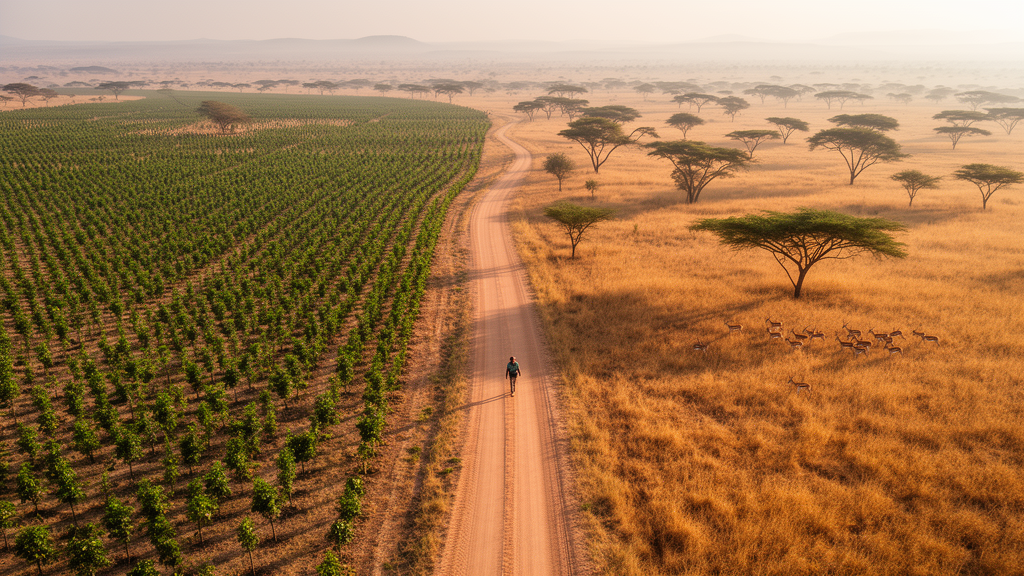
Image Credits: AI Generated
DOI: 10.1038/s41893-026-01936-2
Keywords: forest restoration, leakage, sub-Saharan Africa, natural regeneration, agroforestry, tree cover loss, carbon markets, AFR100, difference-in-differences, land tenure, Nature Sustainability, biodiversity
Cite Scienmag News
Sloane Callahan. (October 8, 2026). Tree Planting Can Backfire: Restoration’s Hidden Spillover Effects Mapped Across Africa. Scienmag. https://scienmag.com/tree-planting-can-backfire-restorations-hidden-spillover-effects-mapped-across-africa/
Sloane Callahan. "Tree Planting Can Backfire: Restoration’s Hidden Spillover Effects Mapped Across Africa." Scienmag, 8 October 2026, https://scienmag.com/tree-planting-can-backfire-restorations-hidden-spillover-effects-mapped-across-africa/. Accessed 8 October 2026.
Sloane Callahan. "Tree Planting Can Backfire: Restoration’s Hidden Spillover Effects Mapped Across Africa." Scienmag. October 8, 2026. https://scienmag.com/tree-planting-can-backfire-restorations-hidden-spillover-effects-mapped-across-africa/


