


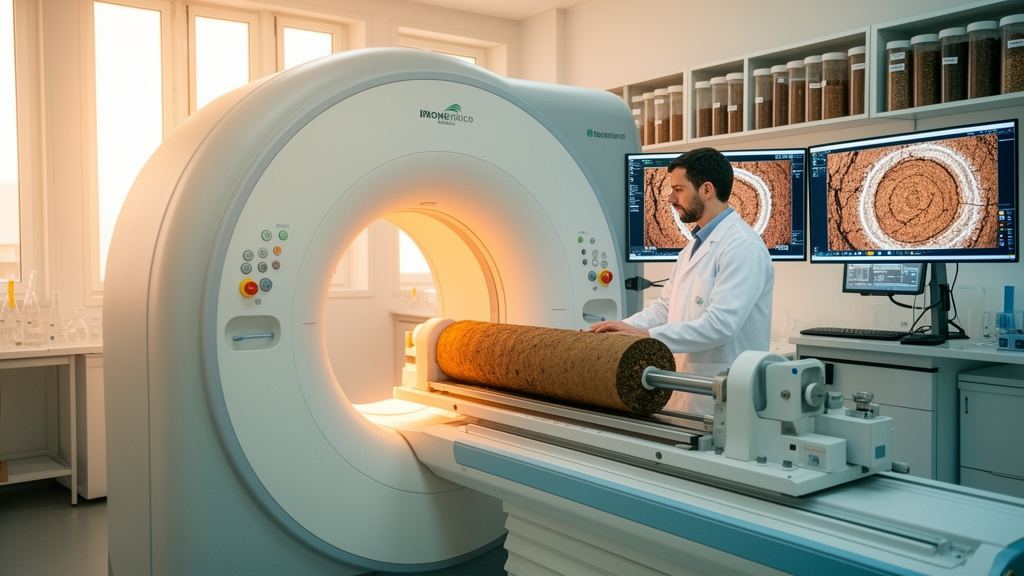
When Brazilian researchers published the first study using computed tomography to peer inside soil in 1985, they were working with first-generation scanners that took agonizingly long to acquire a single image and resolved features only at the millimeter scale. Four decades later, a sweeping bibliometric review of the country’s scientific output reveals a research field that has grown from a handful of pioneering experiments into a mature, internationally connected discipline capable of mapping the hidden architecture of tropical soils at the micrometer scale. The review, published in Discover Soil by José V. Gaspareto and Luiz F. Pires of the State University of Ponta Grossa, traces the methodological evolution of gamma-ray and X-ray computed tomography in Brazilian soil science from 1985 to 2025 and delivers a striking verdict: the field has reached a relatively mature stage, with sustained growth, increasing methodological diversity, and expanding contributions to sustainable agriculture, water management, and climate science.
The story begins with a landmark paper by researchers at the Brazilian Agricultural Research Corporation, EMBRAPA, who used computed tomographic scanning to conduct static and dynamic three-dimensional studies of water in soil. That 1985 study, which has since accumulated 100 citations, marked the first application of the technique in Brazil and established a temporal benchmark against which all subsequent work can be measured. In those early decades, most Brazilian studies relied on non-commercial scanners built in-house, because acquiring radioactive sources for gamma-ray tomography was considerably cheaper than purchasing X-ray systems. First-generation equipment meant long acquisition times and millimeter-scale resolution, and between 1987 and 1993 only a single article using the technique appeared in journals indexed in the Web of Science. Much of the early output circulated in Portuguese-language bulletins, conference proceedings, and regional journals that remained largely invisible to the international community.
The turning point came in the early 2000s, when the number of indexed publications began a steady climb. The review identified a strong linear correlation between time and publication volume, with a correlation coefficient of 0.81, and several recent years produced ten or more articles apiece. The year 2025 set the record with thirteen publications, a signal that the field is currently undergoing rapid expansion. Over the full forty-year period, the 134 articles selected for detailed analysis accumulated 2,596 citations, averaging roughly nineteen citations per article. Citation peaks in 2005, 2011, 2017, and 2019 trace the growing influence of Brazilian work, with the late-2010s surge reflecting an accelerated rate of knowledge adoption and a larger, more active research network than in any previous era.
To build this picture, the authors searched the Web of Science Core Collection using keywords combining tomography, soil, and Brazil, retrieving 265 raw records. After removing one record with a date discrepancy and applying a rigorous two-stage screening process, they retained 134 studies for comprehensive analysis. The screening excluded work relying on other imaging techniques such as electrical resistivity tomography or nuclear magnetic resonance, studies focused on rocks, sediments, or construction materials, and papers lacking sufficient technical detail on tomography workflows. The methodological care extended to open-access classification: automated metadata were manually verified against publisher websites to confirm license structures, guarding against temporal shifts in journal policies. The result is one of the most transparent accounts of a national research field’s development available in the soil science literature.
The quality indicators that emerged from the analysis are remarkable for a field built largely on public funding from a middle-income country. Of the fifty unique journals represented, sixty percent fall into the first or second quartile of the Journal Citation Reports, and the same proportion holds when measured by total article volume. Elsevier published the majority of the articles, fifty-seven of the 134, and Elsevier journals also captured sixty-three percent of all citations. Soil and Tillage Research led all venues with nineteen percent of publications, followed by Applied Radiation and Isotopes, Revista Brasileira de Ciência do Solo, Geoderma, Agriculture-Basel, and the International Journal of Geomechanics. Access models were nearly evenly split: among the 107 articles with verified access metadata, fifty-one percent appeared under open-access licenses of various colors, while forty-nine percent remained subscription-based, a balance the authors interpret as a transitional phase in scientific publishing.
Behind these numbers lies a distinctive institutional and financial structure. Public universities and agricultural research organizations produced the vast majority of the work, and two federal agencies anchored the funding landscape: the National Council for Scientific and Technological Development, CNPQ, provided thirty percent of reported funding, while CAPES, which supports graduate scholarships and negotiates national journal-access agreements, contributed twenty percent. State foundations such as FAPESP, the research company EMBRAPA, and international partners including the United Kingdom’s BBSRC filled out a multi-level funding architecture. Notably, ninety-six percent of the articles were published in English, underscoring a deliberate orientation toward international visibility, though the authors caution that the scarcity of Portuguese-language publications may limit accessibility for local stakeholders such as farmers and regional policymakers.
International collaboration emerged as a defining feature of the field’s most influential work. While seventy-six percent of articles were authored solely by Brazilian researchers, co-authorship with scientists in Canada, the United States, the United Kingdom, China, Italy, and Germany appeared disproportionately among the most-cited papers. A co-authorship network analysis built with VOSviewer revealed a highly interconnected structure organized into distinct clusters: a historical pioneering cluster anchored by early developers such as Crestana, Cruvinel, and Cesareo, and central consolidation hubs involving researchers like Pires, Cássaro, Cooper, and Reichardt, alongside international collaborators including Mooney, Ghanbarian, and Heck. The network reflects decades of academic mentorship, researcher exchange, and multi-institutional partnership, and it documents the emergence of a new generation of Brazilian soil scientists carrying the technique forward.
Perhaps the most consequential applications of the technology concern Brazil’s vast Oxisols, the highly weathered tropical soils that cover roughly forty percent of the country’s agricultural land. Landmark studies quantified how long-term no-tillage systems preserve functional macropore continuity compared with intensive tillage. One influential analysis showed that no-tillage maintains a tri-modal pore size distribution across surface and subsurface layers, driven by complex pore shapes and enhanced connectivity, whereas intensively tilled soil was dominated by isolated, round-shaped pores. A complementary long-term trial found that no-tillage yielded macroporosity of 19.7 percent with superior pore-network connectivity and lower tortuosity, against 14.3 percent under intensive tillage, with a single continuous complex pore network accounting for ninety-seven percent of total macroporosity. These three-dimensional metrics carry direct implications for water infiltration, root growth, and the resilience of tropical agriculture under increasingly extreme moisture events.
The review also mapped the field’s alignment with the United Nations Sustainable Development Goals, using Clarivate’s automated classification scheme. Across 278 SDG occurrences in the corpus, climate action dominated with thirty-two percent, followed by zero hunger at twenty-three percent, life below water at twenty-two percent, and life on land at twenty-one percent. The strong showing of aquatic ecosystem goals reflects how soil processes such as nutrient leaching and sediment transport propagate downstream. The disciplinary spread is equally telling: agriculture leads with seventy-four articles, but physics, engineering, computer science, and chemistry all contribute substantially, and recent work increasingly integrates machine learning and deep learning for pore segmentation, neural-network-based contour identification, and synchrotron-based imaging of phosphorus transport and soil structural change.
Challenges remain, and the authors are candid about them. Access to high-resolution CT equipment and synchrotron facilities is still restricted to a limited number of research centers, and equipment cost, maintenance demands, and the need for specialized image-processing expertise continue to bottleneck broader adoption. The dedicated CT beamline at Brazil’s Sirius synchrotron light source, focused on agronomic studies, represents a major step toward democratizing access. Looking ahead, the review calls for standardized image acquisition and segmentation protocols, open databases of raw CT images and metadata to enable benchmarking and artificial intelligence applications, and deeper integration of tomography with process-based modeling. If those recommendations take hold, the next chapter of Brazilian soil tomography may prove even more transformative than the first four decades, positioning the country’s researchers at the forefront of global efforts to understand, protect, and sustainably manage the ground beneath our feet.
Subject of Research: Bibliometric review of four decades of gamma-ray and X-ray computed tomography research in Brazilian soil science
Article Title: Methodological evolution and global scientific impact of Brazilian soil computed tomography research
Article References: Gaspareto, J. V., & Pires, L. F. (2026). Methodological evolution and global scientific impact of Brazilian soil computed tomography research. Discover Soil, 3(1), Article 183. https://doi.org/10.1007/s44378-026-00340-8
Image Credits: AI Generated
DOI: 10.1007/s44378-026-00340-8
Keywords: computed tomography, soil science, X-ray microtomography, Brazil, soil pore architecture, synchrotron radiation, bibliometrics, no-tillage, Oxisols, sustainable agriculture, soil physics, sustainable development goals
Cite Scienmag News
Alan Morgan. (October 8, 2026). Four Decades of Seeing Inside Soil: How Brazil Built a Global Tomography Powerhouse. Scienmag. https://scienmag.com/four-decades-of-seeing-inside-soil-how-brazil-built-a-global-tomography-powerhouse/
Alan Morgan. "Four Decades of Seeing Inside Soil: How Brazil Built a Global Tomography Powerhouse." Scienmag, 8 October 2026, https://scienmag.com/four-decades-of-seeing-inside-soil-how-brazil-built-a-global-tomography-powerhouse/. Accessed 8 October 2026.
Alan Morgan. "Four Decades of Seeing Inside Soil: How Brazil Built a Global Tomography Powerhouse." Scienmag. October 8, 2026. https://scienmag.com/four-decades-of-seeing-inside-soil-how-brazil-built-a-global-tomography-powerhouse/


