


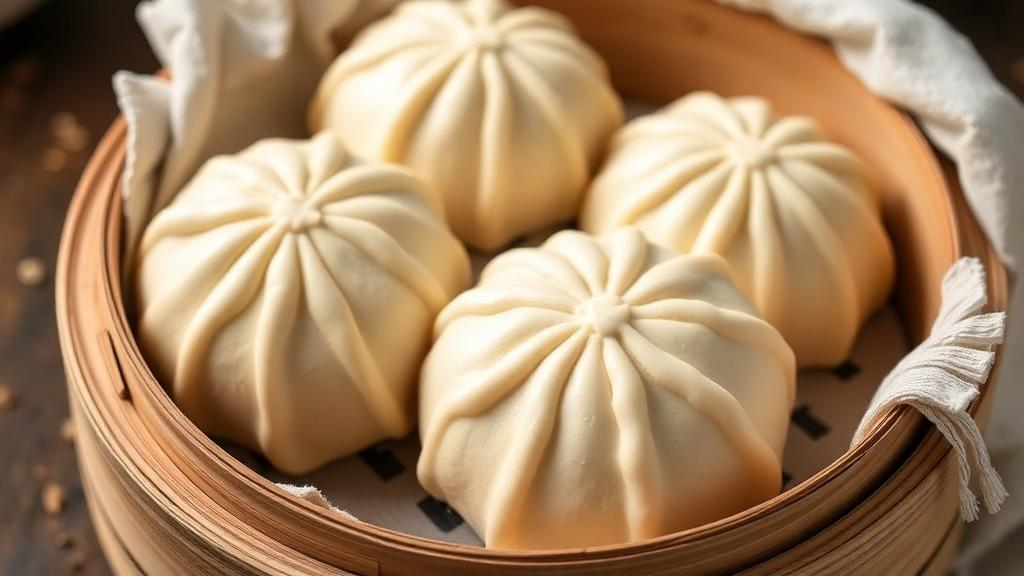
Whole-wheat flour has long carried a nutritional reputation that its texture struggles to match. The bran particles that make whole wheat so rich in fiber and micronutrients are also the particles that shred gluten networks, producing dense, crumbly doughs and baked goods that many consumers quietly avoid. Now a team of food scientists at Beijing Technology and Business University reports that a common soil bacterium may be able to fix the problem from the inside out. In a study published in npj Science of Food, the researchers show that fermenting whole-wheat dough with selected strains of Bacillus subtilis measurably improves the dough’s rheology, strengthens its protein architecture, softens the resulting steamed buns, and even shifts the volatile chemistry of the crumb away from stale, off-putting odors.
The central obstacle the team set out to address is a familiar one in cereal science. When bran is milled into flour, its sharp, fibrous particles physically interrupt the continuous protein films that gluten proteins normally form during mixing and resting. The result is a weakened network with fewer cohesive junctions, less elasticity, and poorer gas retention. In products like Chinese steamed buns, or mantou, where a light, springy, uniformly porous crumb is the benchmark of quality, that weakness translates directly into lower specific volume, higher hardness, and a shorter shelf appeal. Whole-wheat versions of these staples routinely underperform their refined-flour counterparts on nearly every textural metric.
Fermentation has been used for millennia to modify dough properties, but the choice of microorganism matters enormously. The Beijing group, led by Maosi Fan and corresponding authors Yingli Liu and Jing Wang, applied four distinct strains of Bacillus subtilis to whole-wheat dough and then subjected both the dough and the finished steamed buns to an unusually comprehensive battery of measurements. Rheological testing, intermolecular force analysis, microscopy, pasting behavior assays, texture profiling, and volatile metabolomics were all brought to bear on the question of what, precisely, the bacteria were doing to the flour matrix during fermentation.
The rheological results were among the clearest signals. Fermented dough showed reduced apparent viscosity alongside increased creep recovery, a combination that describes a dough which is easier to deform under stress but better able to spring back afterward. In practical terms, that is exactly the behavior a baker or steamed-bun producer wants: a mass that handles well during shaping, resists collapse, and recovers its structure as gas cells expand. The finding suggests that the bacterial fermentation did not simply soften the dough by degrading it, but rather reorganized the underlying network into something more pliable and more resilient at the same time.
To understand how that reorganization happened, the researchers examined the forces holding the protein network together. Protein fractions associated with hydrogen bonding and disulfide bonds increased after fermentation, while fractions held together by ionic and hydrophobic interactions decreased. This shift matters because hydrogen bonds and disulfide bridges are the connective tissue of a well-ordered gluten network. Disulfide bonds covalently link glutenin polymers into the long chains that give dough its elasticity, while dense hydrogen bonding between proteins and between proteins and starch granules provides the cohesive, continuous matrix that traps fermentation gases. A network rebuilt around these stronger, more cooperative interactions is structurally better suited to holding the open, even crumb that defines a good steamed bun.
Spectroscopic and microscopic evidence supported that interpretation. Fourier-transform infrared analysis indicated changes consistent with re-established hydrogen bonding and a higher degree of short-range order in the starch fraction, while microscopy revealed a more continuous protein phase threading through the dough. In an unfermented whole-wheat system, bran particles tend to sit as discontinuities in the protein matrix, creating weak points where cracks can initiate. After B. subtilis fermentation, the protein phase appeared to reconnect around and between those particles, effectively healing the damage that bran incorporation inflicts. The starch order findings are notable as well, since greater short-range molecular order in starch is generally associated with slower retrogradation and a crumb that stays softer for longer.
The textural consequences showed up clearly in the finished steamed buns. Fermented buns exhibited higher specific volume and higher porosity, meaning they rose taller and trapped more, and more evenly distributed, gas. At the same time, their hardness was reduced and the crumb structure was softer. Those are not trivial gains. Specific volume and crumb softness are the two attributes that most reliably separate a premium steamed bun from a disappointing one, and both are notoriously difficult to preserve when refined flour is replaced with whole wheat. The fact that a single biological intervention improved both at once is the study’s most commercially significant result.
Perhaps the most surprising dimension of the work is its effect on aroma. Whole-wheat products often carry off-flavors traced to lipid oxidation products and to compounds derived from lignin in the bran itself, and these odors are a major reason consumers cite for avoiding whole-grain foods. Using volatile metabolomics and relative odor activity values, the researchers found that fermented buns contained lower levels of these lipid-oxidation- and lignin-derived off-odorants, alongside elevated levels of aromatic alcohols, compounds generally associated with pleasant, yeasty, fermented fragrance profiles. In other words, the bacteria did not merely mask the undesirable smells; they appear to have shifted the underlying metabolic balance of the dough toward a more favorable volatile signature.
Multivariate analysis across all four strains identified one, designated SH, as the most effective performer, suggesting that strain selection is a critical variable rather than an afterthought. Different B. subtilis isolates produce different suites of enzymes, including proteases, amylases, and lipases, and the precise enzymatic cocktail a strain secretes will determine how aggressively it remodels proteins, starch, and lipids during fermentation. The SH strain’s dominance implies that the optimal outcome, a restructured protein network, ordered starch, softened crumb, and improved aroma, reflects a particular balance of enzymatic activity rather than fermentation intensity alone. That opens a practical path for producers: rather than accepting whatever ambient microbes happen to be present, manufacturers could inoculate dough with a characterized, food-grade strain chosen for these specific effects.
The study, supported by the National Natural Science Foundation of China, stops short of claiming that B. subtilis fermentation solves every challenge of whole-wheat processing, and the published version reports instrumentally measured properties rather than large-scale consumer trials. But the implications reach well beyond steamed buns. Whole-grain consumption is consistently linked to better dietary fiber intake and health outcomes, yet the textural penalties of bran have limited how much of it food manufacturers can incorporate without losing customers. A controlled bacterial fermentation that simultaneously restores gluten continuity, softens the crumb, and cleans up the aroma profile offers a low-cost, non-chemical route to closing that gap. If the strain-specific findings hold up at industrial scale, the humble soil bacterium Bacillus subtilis, already a workhorse of fermented foods across Asia, may become one of the most useful tools in the effort to make whole grains taste as good as they are for you.
Subject of Research: Bacillus subtilis fermentation to improve the structure, texture, and volatile flavor profile of whole-wheat dough and steamed buns
Article Title: Bacillus subtilis fermentation improves the structural, textural and volatile properties of whole-wheat dough and steamed buns
Article References: Fan, M., Lin, S., He, X., Gu, Y., Xu, L., Liu, K., Wei, X., Jiao, Y., Tang, W., Liu, Y., & Wang, J. (2026). Bacillus subtilis fermentation improves the structural, textural and volatile properties of whole-wheat dough and steamed buns. npj Science of Food. https://doi.org/10.1038/s41538-026-01172-0
Image Credits: AI Generated
DOI: 10.1038/s41538-026-01172-0
Keywords: Bacillus subtilis, whole-wheat dough, fermentation, steamed buns, gluten network, food rheology, volatile metabolomics, food texture, bran, starch order, food microbiology, cereal science
Cite Scienmag News
Alan Morgan. (October 8, 2026). Soil Bacterium Transforms Whole-Wheat Dough Into Softer, Better-Smelling Steamed Buns. Scienmag. https://scienmag.com/soil-bacterium-transforms-whole-wheat-dough-into-softer-better-smelling-steamed-buns/
Alan Morgan. "Soil Bacterium Transforms Whole-Wheat Dough Into Softer, Better-Smelling Steamed Buns." Scienmag, 8 October 2026, https://scienmag.com/soil-bacterium-transforms-whole-wheat-dough-into-softer-better-smelling-steamed-buns/. Accessed 8 October 2026.
Alan Morgan. "Soil Bacterium Transforms Whole-Wheat Dough Into Softer, Better-Smelling Steamed Buns." Scienmag. October 8, 2026. https://scienmag.com/soil-bacterium-transforms-whole-wheat-dough-into-softer-better-smelling-steamed-buns/


