


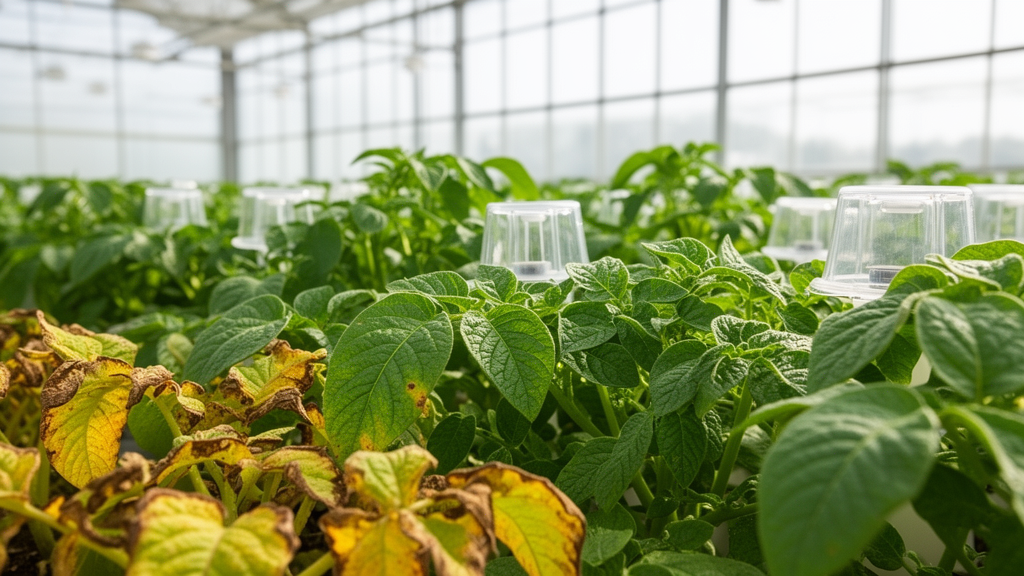
Rising atmospheric carbon dioxide is often described as a fertilizer for the world’s crops, and for good reason. Plants that use the C3 photosynthetic pathway, which includes staples such as wheat, rice, soybean and potato, typically respond to higher concentrations of atmospheric CO2 by fixing carbon more rapidly and building more biomass. Yet a growing body of evidence suggests that these gains may be fleeting. One of the most persistent concerns is that crops grown under elevated CO2 appear to age faster, with their leaves senescing earlier or more rapidly, cutting short the very photosynthetic engine that produced the extra growth in the first place. A new study published in BMC Plant Biology by Yan Yi and Katsuya Yano of Nagoya University now offers a detailed physiological explanation for why this happens in potato, one of the most important food crops on the planet, and the answer lies in the plant’s antioxidant defense system.
The researchers set out to disentangle two factors that have long been suspected of driving premature leaf aging under elevated CO2: the plant’s nitrogen status and the integrity of its antioxidant machinery. Nitrogen is central to the question because leaves rich in nitrogen tend to stay green and photosynthetically active for longer, while nitrogen-poor leaves often yellow and die sooner. Elevated CO2, meanwhile, is known to dilute nitrogen concentrations in plant tissue and to alter the balance of reactive oxygen species, the chemically reactive molecules that accumulate when photosynthesis runs hot and the plant’s detoxification systems fall behind. To separate these effects, the team grew potato plants under ambient CO2 and elevated CO2, and crossed each treatment with both low and high nitrogen supply, creating a factorial experiment capable of isolating the contribution of each variable.
The first major finding concerned timing. Elevated CO2 did not change when senescence began; the leaves of plants grown at high CO2 started to age on essentially the same schedule as those grown at ambient levels. What elevated CO2 did change was the pace. Once senescence was underway, it progressed more quickly in the high-CO2 plants, meaning the decline from green, productive canopy to yellowing foliage was compressed into a shorter window. Nitrogen told a different story. Increasing the nitrogen supply delayed the onset of senescence, keeping leaves green for longer at the front end, but it did nothing to slow the rate at which senescence advanced once it had started. In other words, nitrogen and elevated CO2 act on two distinct phases of the aging process, a distinction that could prove crucial for breeders and agronomists trying to protect yields in a high-CO2 future.
The growth data added an important layer of nuance. At 28 and 42 days after transplanting, the plants grown under elevated CO2 were indeed heavier, confirming the familiar stimulation of biomass accumulation that higher CO2 can deliver to C3 species. But by the final harvest, that advantage had vanished entirely. The early boost in dry weight was erased as the faster-moving senescence caught up with the high-CO2 plants, shortening their productive lifespan and preventing them from banking the extra carbon they had initially captured. This pattern, in which elevated CO2 delivers a transient growth benefit that evaporates by maturity, helps explain why field studies of crop responses to rising CO2 have produced such variable results, and it underscores that the timing of harvest or measurement can dramatically change the apparent size of the CO2 fertilization effect.
So what was happening inside the leaves to accelerate the aging process? The researchers focused on the ascorbate-glutathione cycle, a cornerstone of the plant antioxidant system. This cycle is a tightly coordinated biochemical loop in which the antioxidants ascorbate and glutathione shuttle electrons to neutralize hydrogen peroxide and other reactive oxygen species generated as byproducts of photosynthesis and metabolism. Enzymes such as ascorbate peroxidase, monodehydroascorbate reductase, dehydroascorbate reductase and glutathione reductase keep the cycle turning, regenerating the reduced forms of the antioxidants so that the detoxification process can continue indefinitely. When the researchers measured the activities of these enzymes, they found that elevated CO2 had reduced the activity of several of them, with the enzymes of the ascorbate-glutathione cycle showing particularly clear declines.
The damage was not limited to enzymes. The team also measured redox-related metabolites, the small molecules that participate in and reflect the oxidation-reduction state of the cell, and found that their profiles were altered under elevated CO2. Taken together, the enzyme and metabolite data pointed in a single direction: the antioxidant defense system of the high-CO2 plants was weakened, leaving the leaves with a reduced capacity to mop up reactive oxygen species and a tendency toward oxidative imbalance. This is a mechanistically coherent explanation for accelerated senescence. Reactive oxygen species are not merely toxic byproducts; at low levels they act as signaling molecules that trigger programmed developmental changes, including the controlled dismantling of cellular components that defines senescence. When antioxidant defenses falter, reactive oxygen species accumulate, the signaling threshold is crossed sooner, and the senescence program runs faster.
The nitrogen results sharpened the interpretation. Increasing nitrogen supply did improve leaf chlorophyll and protein contents at 42 days after transplanting, consistent with the well-established role of nitrogen in maintaining the photosynthetic apparatus and keeping leaves biochemically young. Yet the extra nitrogen did not prevent the decline in antioxidant enzyme activities under elevated CO2. This dissociation is the study’s most consequential insight. It means that the nitrogen-driven delay in senescence onset operates through a different mechanism than the CO2-driven acceleration of senescence progression. Adding fertilizer can buy a potato crop more time at the front end, keeping leaves green and photosynthetic for longer, but it cannot repair the underlying erosion of the antioxidant system that causes aging to proceed more rapidly once it begins. Farmers hoping to offset the effects of rising CO2 with nitrogen inputs alone may therefore be addressing only half of the problem.
The implications extend well beyond potato. As atmospheric CO2 concentrations continue to climb, the same physiological logic may apply to other C3 crops whose yields depend on sustaining canopy photosynthesis through the grain-filling or tuber-bulking period. If elevated CO2 systematically weakens ascorbate-glutathione cycle activity and pushes leaves toward oxidative imbalance, then breeding programs may need to look beyond photosynthetic capacity and biomass traits and instead select for robust antioxidant systems that can keep pace with the increased electron transport rates that high CO2 induces. The study also suggests that the interaction between CO2 and nitrogen is more subtle than a simple nutrient-dilution story, and that future experiments should measure senescence progression rates, not just onset dates, to capture the full picture of how crops will age in the atmospheres of the coming decades.
There are, of course, limits to what a single controlled-environment study can establish. The authors note that their findings identify an association between impaired antioxidant defense and accelerated senescence progression under elevated CO2, and the work was conducted under the specific conditions of their experiment, with two nitrogen levels and a defined CO2 contrast. Field conditions introduce additional variables, including fluctuating light, temperature, water status and soil nitrogen dynamics, any of which could modulate the relationship between antioxidant capacity and leaf aging. Nevertheless, the study provides a clear and testable framework: elevated CO2 accelerates the rate of senescence in potato through a weakening of the antioxidant system, while nitrogen availability governs when senescence starts but not how fast it runs. For a world that will need every bushel of potato and grain it can grow under a changing atmosphere, understanding that distinction may prove to be one of the most important agronomic insights of the decade.
Subject of Research: Physiological mechanisms of elevated CO2-induced leaf senescence and antioxidant defense in potato
Article Title: Elevated CO2-induced senescence in potato is associated with impaired antioxidant defense
Article References: Yi, Y., & Yano, K. (2026). Elevated CO2-induced senescence in potato is associated with impaired antioxidant defense. BMC Plant Biology. https://doi.org/10.1186/s12870-026-10088-6
Image Credits: AI Generated
DOI: 10.1186/s12870-026-10088-6
Keywords: potato, elevated CO2, leaf senescence, antioxidant defense, ascorbate-glutathione cycle, reactive oxygen species, nitrogen, oxidative stress, Solanum tuberosum, plant physiology, crop yield, climate change
Cite Scienmag News
Beatrice Stafford. (October 8, 2026). Rising CO2 May Speed Potato Leaf Aging by Weakening Antioxidant Defenses. Scienmag. https://scienmag.com/rising-co2-may-speed-potato-leaf-aging-by-weakening-antioxidant-defenses/
Beatrice Stafford. "Rising CO2 May Speed Potato Leaf Aging by Weakening Antioxidant Defenses." Scienmag, 8 October 2026, https://scienmag.com/rising-co2-may-speed-potato-leaf-aging-by-weakening-antioxidant-defenses/. Accessed 8 October 2026.
Beatrice Stafford. "Rising CO2 May Speed Potato Leaf Aging by Weakening Antioxidant Defenses." Scienmag. October 8, 2026. https://scienmag.com/rising-co2-may-speed-potato-leaf-aging-by-weakening-antioxidant-defenses/


