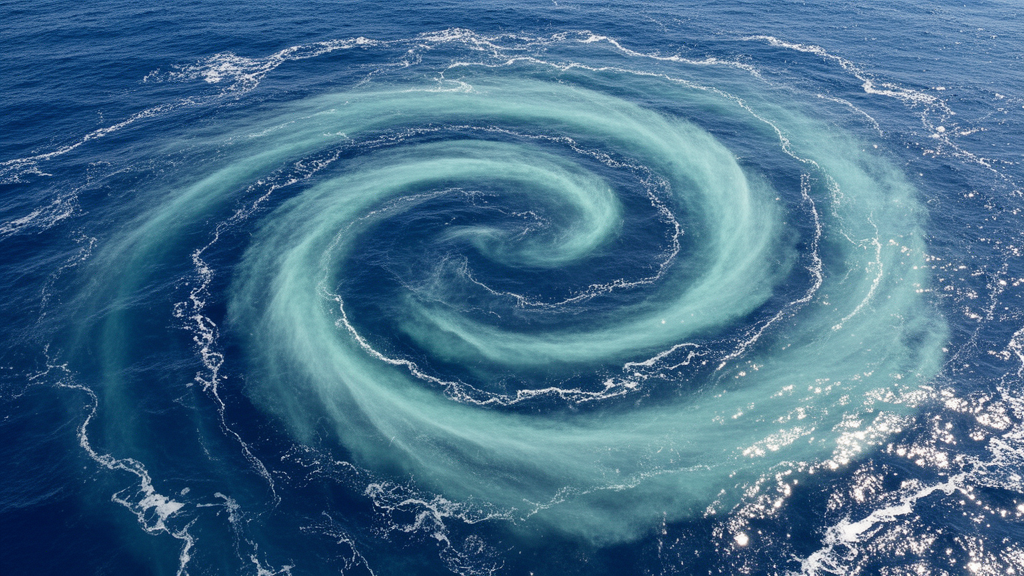
Ocean eddies are the swirling giants of the sea, some spanning hundreds of kilometers, and they carry heat, carbon, and energy across entire basins. Getting them right in numerical models is a central challenge of oceanography, and it turns out that the standard mathematical machinery used to blend satellite observations with model forecasts may be quietly sabotaging them. A new study published in Nonlinear Processes in Geophysics shows that when classic data assimilation schemes are applied directly to gridded fields, they can flatten, widen, and otherwise distort these coherent structures, and that a simple change of perspective, assimilating the eddy’s defining parameters instead of its pixel-by-pixel profile, can keep the physics intact while slashing the dimensionality of the problem.
Data assimilation, the science of merging observations with a dynamical model background, underpins modern weather and ocean forecasting. In its most common form, the method assumes that errors are Gaussian and that the update is linear: the analysis is a weighted average of the background state and the observations, with weights determined by their respective uncertainties. This works beautifully when the quantity being estimated behaves linearly. But an ocean eddy is not a linear object. Its height profile depends nonlinearly on where the eddy sits, and on how wide it is. When a model places an eddy slightly to the left and an observation places it slightly to the right, a linear average of the two fields does not produce a correctly positioned eddy. It produces a single, smeared-out blob sitting in the middle, lower in amplitude and broader in extent than either source.
Solène Dealbera of IMT Atlantique and her colleagues, working with partners at Shom and LEGOS in France, designed a deliberately minimal framework to expose exactly this failure mode and to test whether it can be avoided. They reduced an ocean eddy to its essence: a one-dimensional cross-section described by just three parameters, the peak amplitude, the peak position, and the radius of maximum velocity. The physical profile is generated by a Gaussian-shaped mapping from these parameters onto a grid of longitudes. With such a compact representation, the team could perform a single analysis step, the moment where background and observations are fused, in two different spaces: the familiar gridded space of 101 points, or the tiny three-dimensional parameter space.
The study’s first three experiments were tutorial-style tests in which exactly one parameter carried uncertainty. When only the amplitude was uncertain, the two approaches gave identical, perfect answers, because amplitude enters the profile equation linearly. The interesting physics appeared when position or radius carried the uncertainty. In the position experiment, the background and observation eddies were displaced symmetrically around the truth. The gridded analysis, forced to average two shifted profiles, produced a widened, flattened structure: a Gaussian fit to the result underestimated the amplitude by 23 percent and overestimated the radius by 29 percent, even though the position itself was recovered correctly. The root-mean-square error relative to the true profile reached 0.10 meters, while the parametric analysis, which simply averaged the parameter vectors, recovered the true amplitude, position, and radius exactly, with an RMSE of zero.
The radius experiment revealed a subtler pathology. Averaging two Gaussian profiles of different widths in grid space does not yield another Gaussian at all. The analyzed profile emerged as sub-Gaussian, with a narrower core and heavier tails than any true Gaussian of the same spread. The parametric analysis, by contrast, remained Gaussian by construction, since the update acted only on the three numbers defining the shape. These are not merely cosmetic differences. Because geostrophic currents are driven by the horizontal gradients of sea-surface height, and eddy kinetic energy scales with the square of those gradients, even moderate profile distortions translate into large physical errors. In the position experiment, the total eddy kinetic energy computed from the gridded analysis was reduced by 55 percent relative to the truth, while the parametric analysis matched the true value. In the radius experiment, the gridded energy deficit was 8 percent, against essentially no error in parameter space.
Recognizing that the tutorial experiments stack the deck in favor of the parametric method, since the uncertainty is generated in parameter space and then pushed forward to the grid, the team built a fourth, more balanced experiment. Here both the background and the observation began as noisy gridded profiles, with errors following an exponentially decaying spatial correlation, and the eddy parameters had to be recovered through a nonlinear least-squares fit before assimilation could proceed in parameter space. The fitting step introduces its own complications: the resulting parameter covariances are no longer diagonal, with a notable negative correlation of about minus 0.47 between amplitude and radius, reflecting the geometric fact that wider fitted profiles tend to have lower peaks. The fitted radius distribution also showed significant skewness and non-Gaussian tails, a reminder that the transformation between representations is genuinely nonlinear.
Even with this handicap, the parametric approach held its advantage. Across ten independent noise realizations, the gridded analysis consistently produced a widened, underestimated eddy, with an RMSE of 0.09 meters compared with 0.02 meters in parameter space, and parameter errors of 0.21 meters in amplitude and 1.94 kilometers in radius, versus 0.02 meters and 0.24 kilometers for the parametric analysis. The posterior spread also told different stories in the two spaces: the gridded analysis was spatially uniform and arguably overconfident, while the parametric analysis placed its largest uncertainty exactly where the eddy’s position was uncertain, a physically meaningful signature that gridded updates cannot easily reproduce.
The study also quantifies the computational stakes. A fixed Eulerian grid resolving a structure of radius r in a domain of size L to a given tolerance requires a number of degrees of freedom that grows with the d-th power of the resolution ratio, and an adaptive moving-mesh approach improves this only by a constant factor per tracked structure. The parametric representation, by contrast, needs just three parameters per eddy, independent of grid resolution. The analysis step in an ensemble formulation scales with the state dimension, so updating three numbers instead of a hundred or a million grid points is dramatically cheaper. The catch is a new preprocessing cost: every ensemble member must be fitted to extract its parameters, an expense that grows with grid resolution and solver iterations. Whether the parametric route wins overall therefore depends on the balance between a cheap analysis and an expensive extraction step, but in high-resolution settings with many grid points per structure, the trade-off looks increasingly favorable.
The authors are careful to frame the work as methodological and diagnostic rather than operational. The experiments involve a single analysis step, no sequential assimilation cycles, and no prognostic dynamics, and the conclusions apply strictly to these idealized configurations. The framework also depends on reliable parameter extraction, and its benefits depend on how many structures there are relative to the grid resolution. Still, the conceptual payoff is significant: the study connects the parametric transformation to the Rao-Blackwellization principle from statistical filtering, which seeks representations in which a problem becomes Gaussian-tractable, and identifies where that tractability breaks down, particularly in the non-Gaussian behavior of the fitted radius. Future directions include marginalized particle filters that handle the residual non-Gaussianity explicitly, and data-driven tools such as diffusion maps and transport maps that could relate gridded and parametric uncertainty without an explicit closed-form mapping.
For a field increasingly focused on mesoscale and submesoscale ocean dynamics, where eddies dominate lateral transport and air-sea exchange, the message is striking in its simplicity. The tools forecasters use every day are not wrong, but they are answering a slightly different question than the one oceanographers care about when the object of interest is a coherent, moving, deformable structure. By estimating what an eddy is, its height, its location, its size, rather than what it looks like on a grid, assimilation can preserve the physics that matters, from eddy kinetic energy budgets to transport estimates, and do so in a state space small enough to make the calculation almost trivial. The blob problem, it turns out, dissolves the moment you stop averaging pictures and start averaging objects.
Subject of Research: Data assimilation of coherent ocean eddy structures in parametric versus gridded representation spaces
Article Title: Data assimilation of coherent structures in parametric and gridded spaces: an idealized ocean eddy study
Article References: Dealbera, S., Raynaud, S., Granero Belinchon, C., Boussidi, B., Le Goff, C., & Tandeo, P. (2026). Data assimilation of coherent structures in parametric and gridded spaces: an idealized ocean eddy study. Nonlinear Processes in Geophysics, 33(3), 489-501. https://doi.org/10.5194/npg-33-489-2026
Image Credits: AI Generated
Keywords: data assimilation, ocean eddies, coherent structures, parameter space, gridded fields, ensemble Kalman filter, eddy kinetic energy, Gaussian profile, Rao-Blackwellization, ocean modeling, Nonlinear Processes in Geophysics, uncertainty propagation
Cite Scienmag News
Violet Maxwell. (October 8, 2026). Ocean Eddies Stay Sharp When Data Assimilation Moves to Parameter Space. Scienmag. https://scienmag.com/ocean-eddies-stay-sharp-when-data-assimilation-moves-to-parameter-space/
Violet Maxwell. "Ocean Eddies Stay Sharp When Data Assimilation Moves to Parameter Space." Scienmag, 8 October 2026, https://scienmag.com/ocean-eddies-stay-sharp-when-data-assimilation-moves-to-parameter-space/. Accessed 8 October 2026.
Violet Maxwell. "Ocean Eddies Stay Sharp When Data Assimilation Moves to Parameter Space." Scienmag. October 8, 2026. https://scienmag.com/ocean-eddies-stay-sharp-when-data-assimilation-moves-to-parameter-space/