


Shifting Regional Land Carbon Sinks Amplify Atmospheric Carbon Dioxide Fluctuations
A study analyzing six decades of data shows that regional shifts in land carbon sinks have strengthened their coupling with ...
A study analyzing six decades of data shows that regional shifts in land carbon sinks have strengthened their coupling with ...

A physics-informed artificial intelligence study reveals that Antarctic ice loss will continue throughout this century even if global warming is ...

A four-decade satellite analysis shows atmospheric dryness strengthening and soil moisture weakening as controls on global vegetation variability.
A two-decade analysis of Arctic aerosol measurements identifies three distinct regimes with contrasting trajectories for cloud-forming particles as the region ...
An eight-year field experiment and a meta-analysis show that warming combined with nitrogen input dissolves soil inorganic carbon in drylands, ...
Clues from algae preserved in 6,000-year-old ocean sediments show Arctic winter sea ice will shrink by about one million square ...
A new study uses mid-Holocene biomarker records and Bayesian model weighting to cut uncertainty in Arctic winter sea ice projections ...
Sulfur trapped in zircon-hosted apatite inclusions shows that oxidative weathering and recycling of surface materials began raising the oxygen fugacity ...

New experiments show that dry silicate pebbles falling through Earth's hot hydrogen atmosphere could have generated the planet's water through ...
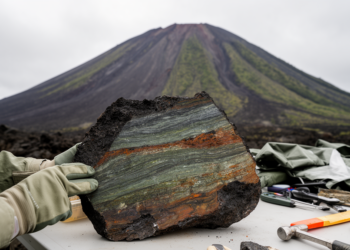
A newly identified ultrahigh-pressure eclogite from Papua New Guinea records a four-million-year-old subduction journey that shifted from unexpectedly hot conditions ...


Embark on a thrilling journey of discovery with Scienmag.com—your ultimate source for cutting-edge breakthroughs. Immerse yourself in a world where curiosity knows no limits and tomorrow’s possibilities become today’s reality!