


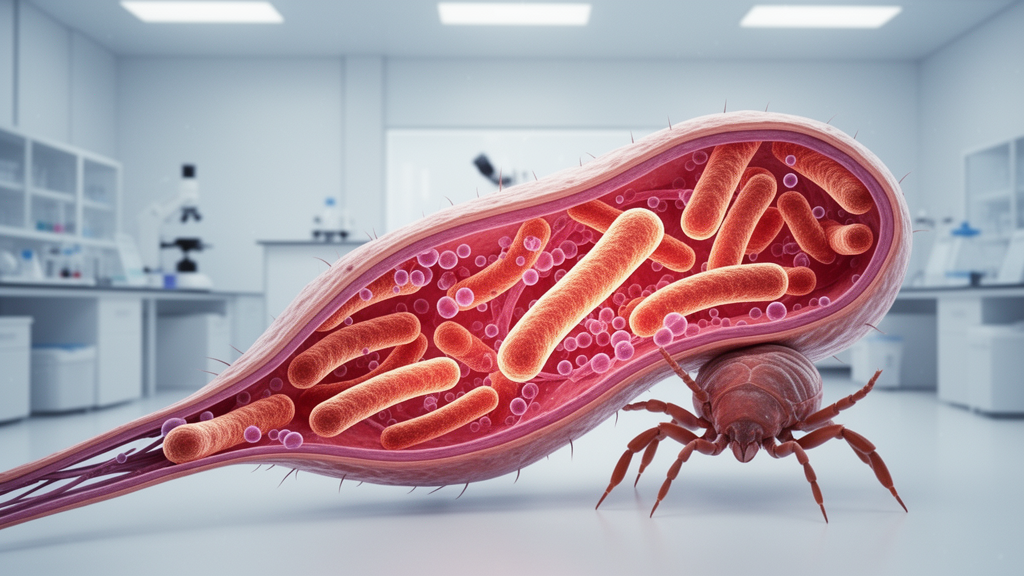
Researchers in South Korea have, for the first time in the country, isolated live Orientia tsutsugamushi—the bacterium that causes scrub typhus—directly from wild-caught trombiculid mites, the larval chiggers that transmit the pathogen to humans. The team established three genetically distinct strains, named Boryong, Kawasaki, and Yonchon, from mites collected at four geographically separated sites and confirmed their identity through sequencing, immunofluorescence, and phylogenetic analysis. The isolates have been deposited in the National Culture Collection for Pathogens in Cheongju as standardized biological resources for future research.
Scrub typhus is an acute febrile illness caused by O. tsutsugamushi, an obligate intracellular bacterium transmitted through the bite of infected larval trombiculid mites. In the Republic of Korea, the disease remains a significant public health concern, with approximately 4,000 cases reported annually and a pronounced seasonal peak during autumn, particularly in October and November. Early clinical manifestations are often nonspecific, which can delay diagnosis and appropriate treatment and may allow progression to severe complications including sepsis, respiratory failure, and cardiac dysfunction. Although the disease has traditionally been considered endemic to the Asia-Pacific region, reports of Orientia species from South America and the Middle East suggest the geographic distribution of these bacteria may be broader than previously recognized.
A central challenge in scrub typhus research is the organism’s remarkable genetic and antigenic diversity. Variation in the 56-kDa tsa gene serves as a key marker for strain differentiation, and this diversity has significant implications for disease progression, host immune response, diagnostic accuracy, and vaccine development. Antigenic variation among strains can influence the sensitivity and specificity of current diagnostic assays, and some strains have been reported to limit the efficacy of existing vaccine candidates. While numerous strains have been isolated from human patients over the years, recovery of viable O. tsutsugamushi from trombiculid mites—the primary biological vector and natural reservoir—has been reported only rarely, because the mites are tiny, roughly 150 to 300 micrometers long, bacterial loads within them are low, and the strict intracellular growth requirements of the pathogen make laboratory culture difficult.
The new study, led by researchers at the Korea Disease Control and Prevention Agency (KDCA), overcame these obstacles with a combined in vivo–in vitro approach. In November 2025, the team captured wild rodents at four sites spanning the country: Cheorwon in the north, Cheongju in the center, and Geoje and Hapcheon in the south. Rodents were euthanized under approved ethical protocols and hung above Petri dishes of water for 24 hours, allowing live ectoparasites to drop off. Fallen mites were recovered with a paintbrush, pooled in groups of 50 per site, washed with 1% sodium hypochlorite to remove surface-associated bacteria while preserving internal microbial viability, and homogenized in phosphate-buffered saline with ceramic beads.
Sequencing of the mite homogenates revealed which strains were present at each site: Hapcheon mites carried the Boryong strain, Cheongju and Geoje mites carried the Kawasaki strain, and Cheorwon mites carried the Yonchon strain. Positive homogenates were then injected intraperitoneally into immunodeficient NOD.SCID mice, which lack adaptive immune responses and therefore provide a permissive environment for amplifying bacteria from samples presumed to contain low bacterial loads. Mice were monitored daily for clinical signs such as piloerection, impaired eye opening, and reduced mobility. Beginning around seven days after inoculation, clinical signs developed in roughly 30% of inoculated animals, and mice showing progressive deterioration were humanely euthanized, with timing determined by each animal’s condition rather than a fixed schedule.
Spleens collected from infected mice served as the source material for cell culture. Spleen homogenates were inoculated onto confluent L929 mouse fibroblast cells in medium supplemented with daunorubicin to limit host-cell proliferation and favor bacterial growth, along with penicillin-streptomycin, to which O. tsutsugamushi is intrinsically resistant. Within three days of infection, the researchers observed cytopathic effect-like morphological changes—cell rounding, increased refractility, and focal disruption of the monolayer—in infected cultures but not in uninfected controls. Immunofluorescence assay using serum from scrub typhus patients revealed distinct green fluorescent signals localized to the perinuclear region of infected cells, directly visualizing the intracellular bacteria. Real-time quantitative PCR of infected cells yielded low cycle threshold values, indicating active bacterial replication.
The isolates were then serially passaged twice onto fresh L929 monolayers to establish stability. After the final passage, immunofluorescence signals remained consistent and qPCR cycle threshold values stayed low, ranging from 15.87 to 19.63 across the four isolates. Nested PCR targeting the 56-kDa tsa and 47-kDa htrA genes, followed by sequencing, confirmed that bacteria recovered from consecutive passages were genetically identical to the strains originally detected in the mite homogenates and mouse spleens. Phylogenetic analysis based on maximum likelihood methods placed the isolates squarely within the established Boryong, Kawasaki, and Yonchon lineages. Notably, strain-specific qPCR assays for the Yonchon isolate showed additional signals corresponding to the Gilliam lineage, consistent with previous reports that Yonchon is Gilliam-related, but sequencing confirmed each isolate represented a single dominant lineage rather than a mixed infection.
A critical quality-control step was the systematic screening for co-infecting intracellular bacteria. All isolates tested negative for Rickettsia species, Anaplasma species, Ehrlichia species, Borrelia species, and Coxiella burnetii by nested PCR. This exclusion was essential because Rickettsia species share a similar intracellular lifestyle with O. tsutsugamushi and cannot readily be distinguished based on morphology or immunofluorescence alone. The authors suggest that passage through NOD.SCID mice may have functioned as a biological filter, allowing a single O. tsutsugamushi strain to dominantly replicate while excluding other organisms. The verified isolates were cryopreserved as infected cell stocks at minus 70 degrees Celsius and deposited in the National Culture Collection for Pathogens under four accession identifiers.
The findings provide direct evidence that viable O. tsutsugamushi strains are maintained within natural trombiculid mite populations in South Korea. Most previous studies relied on PCR-based detection of bacterial DNA in mites, which documents pathogen distribution but cannot demonstrate the presence of living organisms. The three lineages recovered correspond to strains previously reported in Korean scrub typhus patients and in vector surveillance: Boryong has been frequently detected in human patients and in mites and rodents from southern regions, Kawasaki has been identified at lower frequency in patients and vectors from central regions, and Yonchon has been reported in patients and in mites from northern areas. However, the authors caution that establishing a direct strain-level epidemiological link between vector-derived isolates and human infections would require comparative analyses of matching human- and vector-derived isolates from the same period.
The study also carries important limitations. Mites were processed in pools of about 50 individuals, so the specific mite species harboring the bacterium could not be identified, precluding direct associations between strains and particular vector species; pooling may also have masked minor co-circulating strains within each sample. Phenotypic differences among strains were not systematically compared, and the use of immunodeficient mice limited assessment of host immune responses and pathogenicity, meaning the infection patterns observed may not fully reflect host–pathogen interactions in immunocompetent hosts. Bacterial loads in organs other than the spleen were not quantified, so the data should not be interpreted as evidence that the spleen is a preferential target organ. Despite these constraints, the vector-derived isolates fill a long-standing gap in scrub typhus research. Future work, including whole-genome sequencing of the isolates and comparison with clinical strains, is expected to clarify strain-level links between mite populations and human disease, support diagnostic development and vaccine candidate evaluation, and deepen understanding of how the pathogen is maintained in nature through transstadial and transovarial transmission within its mite reservoir.
Subject of Research: First isolation of viable Orientia tsutsugamushi strains from trombiculid mites in the Republic of Korea
Article Title: First isolation of three Orientia tsutsugamushi strains (Boryong, Kawasaki, and Yonchon) from trombiculid mites in the Republic of Korea
Article References: Yoon, H., Gill, B., Park, J. S., Lee, H. S., Kim, S. Y., & Lee, H. I. (2026). First isolation of three Orientia tsutsugamushi strains (Boryong, Kawasaki, and Yonchon) from trombiculid mites in the Republic of Korea. Frontiers in Cellular and Infection Microbiology, 16, Article 1994382. https://doi.org/10.3389/fcimb.2026.1994382
Image Credits: AI Generated
DOI: 10.3389/fcimb.2026.1994382
Keywords: Orientia tsutsugamushi, scrub typhus, trombiculid mites, strain isolation, Boryong, Kawasaki, Yonchon, NOD.SCID mice, L929 cells, Republic of Korea, molecular epidemiology, vector-borne disease
Cite Scienmag News
Phoebe Ingram. (October 24, 2026). Viable Scrub Typhus Bacteria Recovered from Mites for the First Time in South Korea. Scienmag. https://scienmag.com/viable-scrub-typhus-bacteria-recovered-from-mites-for-the-first-time-in-south-korea/
Phoebe Ingram. "Viable Scrub Typhus Bacteria Recovered from Mites for the First Time in South Korea." Scienmag, 24 October 2026, https://scienmag.com/viable-scrub-typhus-bacteria-recovered-from-mites-for-the-first-time-in-south-korea/. Accessed 24 October 2026.
Phoebe Ingram. "Viable Scrub Typhus Bacteria Recovered from Mites for the First Time in South Korea." Scienmag. October 24, 2026. https://scienmag.com/viable-scrub-typhus-bacteria-recovered-from-mites-for-the-first-time-in-south-korea/


