

Saturday, October 24, 2026
Science
No Result
View All Result
  • Login
  • HOME
  • SCIENCE NEWS
  • CONTACT US
  • HOME
  • SCIENCE NEWS
  • CONTACT US
No Result
View All Result
Scienmag
No Result
View All Result
Home Science News

New Framework Maps Elasto-Plastic Properties of Canine Bone for Patient-Specific Simulations

October 24, 2026
in Science News
William Thompson
By William Thompson Scienmag Editorial Profile - Livestock Health and Welfare
Reading Time: 3 mins read
0
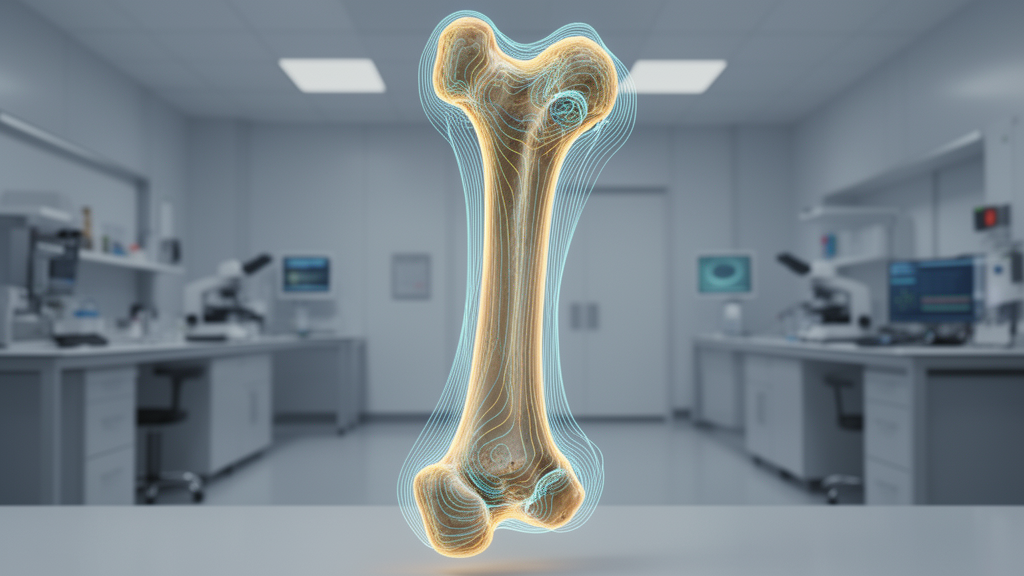
New Framework Maps Elasto-Plastic Properties of Canine Bone for Patient-Specific Simulations

New Framework Maps Elasto-Plastic Properties of Canine Bone for Patient-Specific Simulations

65
SHARES
587
VIEWS
Share on FacebookShare on Twitter
ADVERTISEMENT

Bone is a hierarchical and heterogeneous bio-composite whose cortical shell and trabecular interior behave mechanically in distinct ways across multiple scales. Patient-specific finite element analysis (FEA) derived from medical images is increasingly used in both human and veterinary medicine to predict how bone responds to loading, assess fracture risk, and evaluate treatment outcomes. Yet because measuring full elasto-plastic properties across scales—and bridging microscale behavior to macroscale models—is so complex, simulations often rely on simplified material definitions. Those simplifications can produce unrealistic mechanical responses and miss the permanent microscopic and macroscopic deformations that occur once stress exceeds the bone’s yield point, a particular concern in implant design.

Researchers now report an integrated experimental–computational framework for generating continuum material maps as a function of density, built from tissue-scale characterization of the canine femur. The approach combines high-depth spherical nanoindentation with Genetic Algorithm (GA)-based inverse optimization to extract mechanically consistent elasto-plastic properties of cortical and trabecular bone. The optimization works directly from load–displacement responses that are influenced by post-yield contact uncertainties, allowing the tissue-level properties to be recovered despite the complications that arise when indentation pushes material past its elastic limit.

With tissue-scale properties in hand, the team assigned trabecular values to Representative Volume Elements (RVEs) reconstructed from micro-Quantitative Computed Tomography (μQCT) data. These RVEs were then homogenized to capture architecture-dependent effective behavior, meaning the framework accounts for how the porous microstructure of trabecular bone alters its overall mechanical response without having to resolve that microarchitecture explicitly in a whole-bone model.

In the final step, the optimized cortical properties and the homogenized trabecular properties were correlated with density to establish compartment-specific material mapping relationships. These relationships are intended for use in whole-bone FEA simulations, where spatially varying material inputs are assigned across the femur based on density distributions obtained from imaging.

The optimized responses showed good agreement with the experimental indentation measurements, supporting the capability of the proposed framework to generate mechanically informed material definitions for patient-specific bone FEA. According to the authors, the framework provides a pathway for translating localized experimental measurements into heterogeneous elasto-plastic material inputs for whole-bone FEA without explicitly resolving trabecular microarchitecture. That translation step is significant for veterinary and translational applications, since it links tissue-level elasto-plastic characterization—capturing behavior beyond the yield point—to continuum models that can be run at the scale of the entire bone. The work was conducted by Behzad Amirzade, Tareq Zobaer, Janis Lapsley, Do-Gyoon Kim, Laura E. Selmic, and Ali Nassiri, and addresses a persistent gap between what can be measured at the tissue scale and what simplified material models typically assume in patient-specific simulations of both human and veterinary bone mechanics.

Subject of Research: Elasto-plastic characterization and density-based material mapping of canine bone for finite element analysis

Article Title: An integrated experimental–computational framework for elasto-plastic characterization and spatial mapping of canine bone properties

Article References: Amirzade, B., Zobaer, T., Lapsley, J., Kim, D.-G., Selmic, L. E., & Nassiri, A. (2026). An integrated experimental–computational framework for elasto-plastic characterization and spatial mapping of canine bone properties. PLOS One, 21(10), e0361283. https://doi.org/10.1371/journal.pone.0361283

Image Credits: AI Generated

DOI: 10.1371/journal.pone.0361283

Keywords: bone mechanics, finite element analysis, nanoindentation, genetic algorithm, μQCT, trabecular bone, cortical bone, canine femur, elasto-plasticity, material mapping, integrated, experimental

Cite Scienmag News

William Thompson. (October 24, 2026). New Framework Maps Elasto-Plastic Properties of Canine Bone for Patient-Specific Simulations. Scienmag. https://scienmag.com/new-framework-maps-elasto-plastic-properties-of-canine-bone-for-patient-specific-simulations/


William Thompson. "New Framework Maps Elasto-Plastic Properties of Canine Bone for Patient-Specific Simulations." Scienmag, 24 October 2026, https://scienmag.com/new-framework-maps-elasto-plastic-properties-of-canine-bone-for-patient-specific-simulations/. Accessed 24 October 2026.

William Thompson. "New Framework Maps Elasto-Plastic Properties of Canine Bone for Patient-Specific Simulations." Scienmag. October 24, 2026. https://scienmag.com/new-framework-maps-elasto-plastic-properties-of-canine-bone-for-patient-specific-simulations/

Tags: bone fracture risk assessmentbone mechanicscanine bone elasto-plastic propertiescanine femurcontinuum material mappingcortical and trabecular bone modelingcortical boneelasto-plasticityExperimentalfinite element analysisgenetic algorithmgenetic algorithm inverse optimizationhierarchical bone biomechanicsimplant design and simulationintegratedload-displacement response analysismaterial mappingmulti-scale bone behavior modelingnanoindentationnanoindentation for bone propertiespatient-specific finite element analysistissue-scale characterization of bonetrabecular boneμQCT
Share26Tweet16
Previous Post

Viable Scrub Typhus Bacteria Recovered from Mites for the First Time in South Korea

Next Post

Fourteen Winters of Alaskan Data Reveal How Sea Ice Openings Feed Arctic Wintertime Clouds

Related Posts

Fourteen Winters of Alaskan Data Reveal How Sea Ice Openings Feed Arctic Wintertime Clouds
Athmospheric

Fourteen Winters of Alaskan Data Reveal How Sea Ice Openings Feed Arctic Wintertime Clouds

October 24, 2026
Viable Scrub Typhus Bacteria Recovered from Mites for the First Time in South Korea
Biology

Viable Scrub Typhus Bacteria Recovered from Mites for the First Time in South Korea

October 24, 2026
Five AI chatbots put to the test on patient questions about brain-related vision loss
Science News

Five AI chatbots put to the test on patient questions about brain-related vision loss

October 24, 2026
Inside the hard-fought birth of three health sciences degrees in Kenya
Science Education

Inside the hard-fought birth of three health sciences degrees in Kenya

October 24, 2026
Scientists Grow Mini-Tissues From the Vaginal Wall to Probe Pelvic Organ Prolapse
Biology

Scientists Grow Mini-Tissues From the Vaginal Wall to Probe Pelvic Organ Prolapse

October 24, 2026
Deaf-Led Sign Language Course Shifts Medical Students’ Perspectives
Science Education

Deaf-Led Sign Language Course Shifts Medical Students’ Perspectives

October 24, 2026
Next Post
Fourteen Winters of Alaskan Data Reveal How Sea Ice Openings Feed Arctic Wintertime Clouds

Fourteen Winters of Alaskan Data Reveal How Sea Ice Openings Feed Arctic Wintertime Clouds

  • Mothers who receive childcare support from maternal grandparents show more optimized

    Mothers who receive childcare support from maternal grandparents show more parental warmth, finds NTU Singapore study

    27656 shares
    Share 11059 Tweet 6912
  • University of Seville Breaks 120-Year-Old Mystery, Revises a Key Einstein Concept

    1061 shares
    Share 424 Tweet 265
  • Bee body mass, pathogens and local climate influence heat tolerance

    682 shares
    Share 273 Tweet 171
  • Researchers record first-ever images and data of a shark experiencing a boat strike

    546 shares
    Share 218 Tweet 137
  • Groundbreaking Clinical Trial Reveals Lubiprostone Enhances Kidney Function

    531 shares
    Share 212 Tweet 133
Science

Embark on a thrilling journey of discovery with Scienmag.com—your ultimate source for cutting-edge breakthroughs. Immerse yourself in a world where curiosity knows no limits and tomorrow’s possibilities become today’s reality!

RECENT NEWS

  • Fourteen Winters of Alaskan Data Reveal How Sea Ice Openings Feed Arctic Wintertime Clouds
  • New Framework Maps Elasto-Plastic Properties of Canine Bone for Patient-Specific Simulations
  • Viable Scrub Typhus Bacteria Recovered from Mites for the First Time in South Korea
  • Five AI chatbots put to the test on patient questions about brain-related vision loss

Categories

  • Agriculture
  • Anthropology
  • Archaeology
  • Athmospheric
  • Biology
  • Biotechnology
  • Blog
  • Bussines
  • Cancer
  • Chemistry
  • Climate
  • Earth Science
  • Editorial Policy
  • Marine
  • Mathematics
  • Medicine
  • Pediatry
  • Policy
  • Psychology & Psychiatry
  • Science Education
  • Science News
  • Social Science
  • Space
  • Technology and Engineering

Subscribe to Blog via Email

Enter your email address to subscribe to this blog and receive notifications of new posts by email.

Join 5,152 other subscribers

© 2025 Scienmag - Science Magazine

Welcome Back!

Login to your account below

Forgotten Password?

Retrieve your password

Please enter your username or email address to reset your password.

Log In
No Result
View All Result
  • HOME
  • SCIENCE NEWS
  • CONTACT US

© 2025 Scienmag - Science Magazine

Discover more from Science

Subscribe now to keep reading and get access to the full archive.

Continue reading