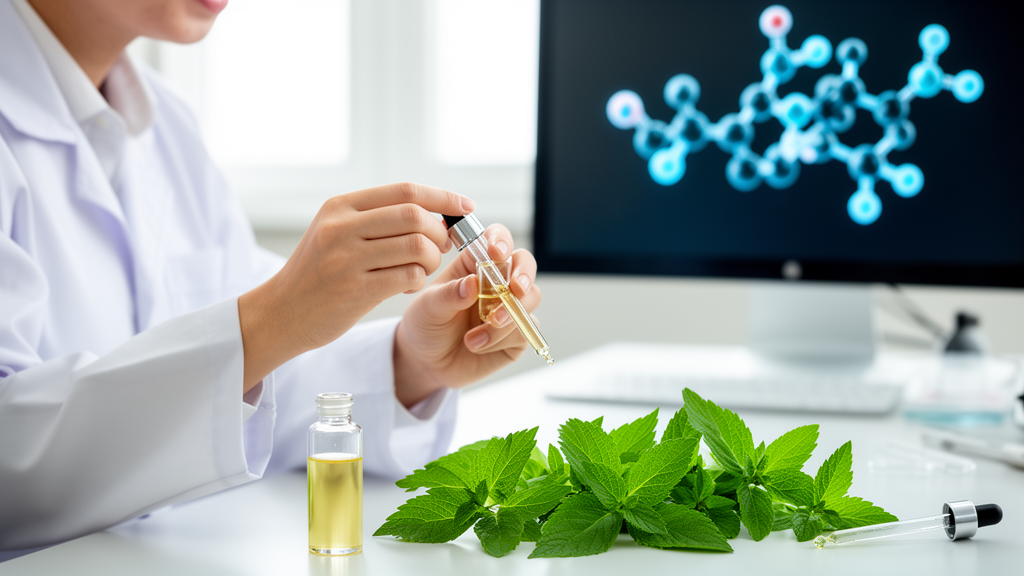
An essential oil distilled from the rhizome of a traditional Vietnamese medicinal plant has shown the ability, in laboratory and computer simulations, to interfere with two molecular players at the heart of gout and its painful inflammation. The plant, Homalomena occulta (Lour.) Schott, is known in Chinese as Qiannianjian and in Vietnamese as Thiên niên kiện, and its aromatic rhizome has long been used in decoctions and topical preparations to ease rheumatic and musculoskeletal complaints. A new study combining gas chromatography–mass spectrometry, cell-based assays, quantum chemistry, molecular docking, molecular dynamics simulation and ADMET prediction now offers the first reported analysis of this essential oil’s anti-inflammatory and anti-hyperuricemic potential, identifying linalool and alpha-terpineol as the constituents that most closely approach the binding performance of reference drugs in silico.
The research team collected H. occulta plants from Loc An commune in Hue City, Vietnam, in 2024, authenticated the material both morphologically and by DNA barcoding, and steam-distilled the fresh rhizomes for four hours in a Clevenger-type apparatus. The process yielded 0.54 percent of the fresh weight as a strongly aromatic yellow oil. Chemical profiling by GC–MS tentatively identified 28 constituents, and the composition was dominated by oxygenated monoterpenes, which accounted for 58.77 percent of the total. Linalool was the most abundant compound at 39.59 percent, followed by terpinen-4-ol at 16.24 percent, with smaller amounts of alpha-cadinol, 3-carene, sabinene, tau-muurolol, delta-cadinene and others. Seven compounds, including beta-thujene, beta-phellandrene, 2-heptyl acetate and globulol, were tentatively detected for the first time in the essential oil of this species, and several minor constituents were present at higher proportions than in earlier studies of plants from China and elsewhere in Vietnam.
The experimental heart of the study involved two bioassays. In the first, the essential oil was tested on RAW264.7 macrophage cells, a widely used mouse cell line, that had been stimulated with bacterial lipopolysaccharide to provoke an inflammatory response. Nitric oxide production, measured with the Griess reagent, was suppressed by the oil with a half-maximal inhibitory concentration of 25.7 plus or minus 1.2 micrograms per milliliter. Importantly, the oil showed no significant cytotoxicity: even at the highest concentration tested, 100 micrograms per milliliter, cell viability remained at 89.8 percent. Cardamonin, the positive control, was far more potent, with an IC50 of 0.38 plus or minus 0.03 micrograms per milliliter, so the oil’s activity was moderate rather than exceptional. In the second assay, the oil inhibited xanthine oxidase, the enzyme that converts xanthine to uric acid, with an IC50 of 108.8 plus or minus 3.6 micrograms per milliliter, compared with 3.74 plus or minus 0.09 micrograms per milliliter for the clinical drug allopurinol.
Nitric oxide and xanthine oxidase were not chosen arbitrarily. In gout, elevated serum uric acid leads to deposition of monosodium urate crystals in joints, triggering inflammatory responses that drive one of the most common forms of inflammatory arthritis, with prevalence between less than 1 percent and 6.8 percent and a rising incidence among younger adults. Current first-line treatments carry substantial burdens: colchicine frequently causes gastrointestinal symptoms, while corticosteroids and nonsteroidal anti-inflammatory drugs can produce gastrointestinal bleeding and cardiovascular complications. Allopurinol, the first-line urate-lowering agent, can trigger severe hypersensitivity reactions such as Stevens–Johnson syndrome, particularly in Asia-Pacific populations where the HLA-B*5801 allele is common, and requires dose adjustment in chronic kidney disease. These limitations underpin the search for new anti-gout agents, including from natural product sources.
To connect the measured activities of the whole oil to individual molecules, the researchers turned to computational chemistry. Quantum-chemical calculations at the M05-2X/6–311++G(d,p) level of theory showed that all 28 constituents had negative ground-state energies, indicating electronically stable configurations favorable for the non-covalent interactions that underpin ligand–protein binding. Dipole moments ranged from about 0.04 to 2.23 Debye, with oxygenated derivatives showing higher polarity than pure hydrocarbon terpenes. Molecular electrostatic potential maps localized the most negative regions around oxygen atoms in the oxygenated compounds, identifying probable reactive centers for hydrogen bonding. Frontier molecular orbital analysis gave HOMO–LUMO gaps between 6.855 and 10.371 electron volts; linalool and alpha-terpineol had gaps of 8.610 and 8.387 electron volts respectively, suggesting a limited tendency to exchange electrons and a binding style dominated by hydrogen bonds and van der Waals contacts rather than covalent chemistry.
Molecular docking against two protein targets delivered the study’s most striking computational results. For inducible nitric oxide synthase, the crystal structure PDB 4CX7, linalool achieved the best docking score among the natural compounds, at minus 11.0 kilocalories per mole, close to the reference ligand cardamonin at minus 11.6, with three binding interactions including hydrogen bonds to residues Asp 460 and Arg 199. For xanthine oxidase, PDB 3NVY, alpha-terpineol scored minus 11.0 kilocalories per mole against allopurinol’s minus 11.8, forming two hydrogen bonds with Arg 680 and one with Glu 676. Notably, at the specific binding sites preferred by linalool and alpha-terpineol, the reference drugs scored less favorably, at minus 7.9 and minus 9.3 kilocalories per mole respectively. The residues engaged by alpha-terpineol lie in the flavin adenine dinucleotide-binding domain of xanthine oxidase, hinting at a potentially non-competitive inhibitory mechanism distinct from allopurinol’s competition at the molybdopterin domain, though the authors caution that enzyme kinetic experiments would be needed to confirm this.
One-hundred-nanosecond molecular dynamics simulations in GROMACS then tested whether the two lead complexes would stay bound under simulated physiological conditions. The linalool–iNOS complex remained energetically favorable throughout, with backbone root-mean-square deviation mostly between 0.4 and 0.9 nanometers, stable radius of gyration around 2.29 to 2.34 nanometers, and persistent intermolecular hydrogen bonds. The alpha-terpineol–xanthine oxidase complex held its binding pose with roughly one hydrogen bond maintained for most of the trajectory, although the protein backbone drifted in the later stages beyond 70 nanoseconds, reaching deviations up to about 3.0 nanometers. Trajectory analysis attributed this drift to flexible surface loop regions remote from the FAD-binding domain rather than to dissociation of the ligand, and key binding residues retained their interactions.
Drug-likeness and pharmacokinetic predictions added a further layer of assessment. All 28 compounds fell well within Lipinski’s Rule of Five limits for molecular weight, hydrogen bond donors and acceptors, and 27 of 28 satisfied the lipophilicity criterion; only trans-beta-farnesex, compound 21, exceeded the logP threshold with a value of 5.518, representing a single acceptable violation. The predicted ADMET profiles were broadly favorable: high Caco-2 permeability, intestinal absorption above 92 percent, and negative predictions for AMES mutagenicity, hERG channel inhibition of both types, and hepatotoxicity. Two caveats stand out. Water solubility was low for several compounds, and 21 of the 28 carried a predicted skin sensitization alert, although the authors note that clinical sensitization to linalool and related monoterpenes is attributed mainly to oxidized hydroperoxide degradation products rather than the parent molecules, and that the models may overestimate this risk, which is most relevant to repeated dermal exposure.
The authors are explicit about the limits of what can be concluded. Compound identifications rest on tentative GC–MS spectral library matching and would be strengthened by retention indices and authentic standards. The bioassays were performed on the whole essential oil, so the specific contributions of linalool and terpinen-4-ol remain inferred rather than demonstrated; bioassay-guided fractionation and isolation are planned. The Griess assay measures nitric oxide production as a functional readout and does not directly quantify iNOS enzyme kinetics, and the docking scores estimate binding rather than inhibitory potency, a gap illustrated by the much larger potency difference between the oil and the reference drugs in the assays than in the docking calculations. No in vivo pharmacodynamic validation was performed, and the authors state that the findings do not support a claim of therapeutic application. Prior context supports the plausibility of the results: linalool has previously been reported to suppress inflammatory mediators through NF-kappaB and MAPK pathways, terpinen-4-ol inhibits inflammatory cytokine production in LPS-activated monocytes, and an ethanolic extract of H. occulta rhizomes earlier showed moderate xanthine oxidase inhibition. Within those boundaries, the study provides a preliminary but coherent experimental and computational basis for exploring H. occulta essential oil as a source of bioactive terpenoids, and sets out a clear roadmap of enzyme kinetics, compound isolation and animal studies that any serious development effort would need to complete.
Subject of Research: Anti-inflammatory and xanthine oxidase inhibitory potential of Homalomena occulta essential oil assessed by in vitro assays and computational modeling
Article Title: Potential of monoterpenoids from Homalomena occulta (Lour.) Schott in targeting nitric oxide and xanthine oxidase for hyperuricemia: in vitro and in silico studies
Article References: Hai, N. T. T., Quy, P. T., Ha, T. H., Phu, N. V., Triet, N. T., Duc, D. P. N., Bao, N. C., Onikanni, S. A., Dao, T. N. P., Phung, V. B. T., Dat, T. T. H., & Nhung, N. T. A. (2026). Potential of monoterpenoids from Homalomena occulta (Lour.) Schott in targeting nitric oxide and xanthine oxidase for hyperuricemia: in vitro and in silico studies. Results in Chemistry, 31, Article 103990. https://doi.org/10.1016/j.rechem.2026.103990
Image Credits: AI Generated
DOI: 10.1016/j.rechem.2026.103990
Keywords: Homalomena occulta, essential oil, hyperuricemia, gout, nitric oxide, xanthine oxidase, linalool, alpha-terpineol, molecular docking, molecular dynamics, ADMET, natural products
Cite Scienmag News
Bethany Barker. (October 24, 2026). Vietnamese Medicinal Plant’s Essential Oil Shows Promise Against Gout Drivers in Lab and Computer Studies. Scienmag. https://scienmag.com/vietnamese-medicinal-plants-essential-oil-shows-promise-against-gout-drivers-in-lab-and-computer-studies/
Bethany Barker. "Vietnamese Medicinal Plant’s Essential Oil Shows Promise Against Gout Drivers in Lab and Computer Studies." Scienmag, 24 October 2026, https://scienmag.com/vietnamese-medicinal-plants-essential-oil-shows-promise-against-gout-drivers-in-lab-and-computer-studies/. Accessed 24 October 2026.
Bethany Barker. "Vietnamese Medicinal Plant’s Essential Oil Shows Promise Against Gout Drivers in Lab and Computer Studies." Scienmag. October 24, 2026. https://scienmag.com/vietnamese-medicinal-plants-essential-oil-shows-promise-against-gout-drivers-in-lab-and-computer-studies/