


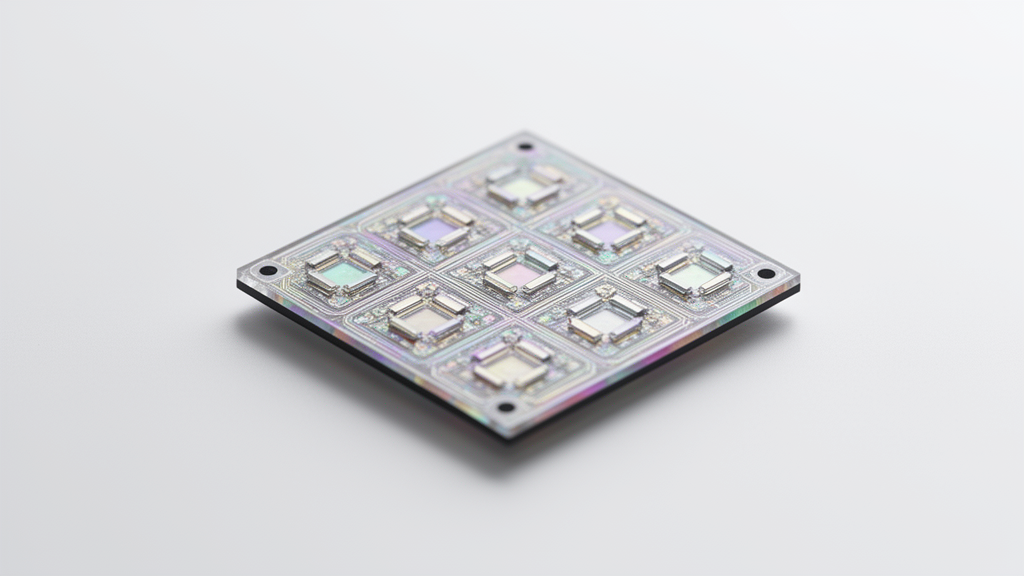
Researchers at Lanzhou University have published a comprehensive review in the journal PhotoniX Synergy that organizes recent advances in high-performance optoelectronic computing chips. The study, led by corresponding authors Professor Yonghui Tian and Researcher Huifu Xiao, establishes a full analytical framework covering device performance, computing architectures, system integration, and emerging paradigms. This work provides a critical reference for both research and industrial development as the field moves beyond the limits of traditional electronic systems. The review specifically addresses the post-Moore era, where traditional scaling laws no longer guarantee performance improvements, necessitating new architectural approaches to maintain computational growth.
As artificial intelligence and high-performance computing advance rapidly, traditional electronic computing systems face growing performance limits. While computing density continues to rise, on-chip data bandwidth, memory access efficiency, and energy efficiency fail to keep pace with these increases. This imbalance between computation, communication, and energy use has become a key bottleneck for next-generation computing systems. The review highlights that photons carry inherent strengths such as high bandwidth, low latency, and natural support for multidimensional multiplexing, offering a new path to break the speed and efficiency limits of traditional electronic computing.
Optoelectronic computing combines the high-speed parallel operation of photonic devices with the strengths of electronic systems in storage, control, and programmability. This hybrid approach has become one of the most notable research directions in the post-Moore era. Current research is shifting from single device demonstration to system-level development with coordinated performance metrics. However, different metrics often restrict each other and cannot all reach optimal levels at the same time, creating a complex optimization landscape that requires a complete system-level evaluation framework to clarify technical paths and key breakthrough directions.
To address this need, the review covers six core dimensions: computing power, computing accuracy, power consumption, functional integration, reconfigurability, and emerging photonic computing paradigms. For computing power, the paper presents three main development paths: high modulation bandwidth, large-scale integration arrays, and multidimensional multiplexing parallelism. It reviews progress in high-speed modulators and matrix scaling architectures, analyzing the trade-offs between performance gains and challenges such as insertion loss, channel crosstalk, and control complexity.
Regarding computing accuracy, the paper identifies common error sources and summarizes four improvement routes: digital-analog hybrid design, low optical depth structure, self-calibration control, and in-situ training. The authors note that accuracy improvement requires coordination across coding, hardware, calibration, and training layers. For power consumption, the review breaks total system energy use into four core parts and examines optimization solutions including low-photon computing, high-efficiency devices, non-volatile control, and low-bit conversion. It also discusses the trade-offs of extreme low-power designs in terms of accuracy, robustness, and functional flexibility.
In the realm of functional integration, the paper describes the evolution from discrete devices to complete end-to-end chip systems across three integration levels. It points out that higher integration shortens signal paths, reduces interface loss, and enhances parallel processing capability. For reconfigurability, the review compares four mainstream control technologies and examines three typical reconfigurable architectures. The authors note that future large-scale reconfigurable systems will need combined control mechanisms and intelligent configuration algorithms.
The review also introduces four non-classical photonic computing models beyond the traditional von Neumann architecture. These emerging paradigms map computing logic directly through light’s physical dynamics to enable low latency and low power operation. Professor Yonghui Tian emphasized that optoelectronic computing is not a simple replacement for traditional electronic computing. Instead, it builds a new fusion architecture for next-generation high-performance computing by making full use of the inherent advantages of both photons and electrons. He expressed hope that this review can help peers worldwide promote the field from device demonstration to system-level design and practical application.
Researcher Huifu Xiao added that the field has entered a key stage of system integration. A single performance breakthrough can no longer support practical systems, according to Xiao. Future progress needs cross-layer collaborative design of devices, architectures, algorithms, and heterogeneous integration. The review synthesizes recent advances and identifies key challenges, offering a valuable resource for the scientific community. As the demand for efficient and high-performance computing continues to grow, the insights provided by this review will likely guide future research efforts and industrial applications.
Subject of Research: Review of high-performance optoelectronic computing chip research progress and challenges
Article Title: High-performance optoelectronic computing chips: research progress, key challenges, and future trends
Article References: High-performance optoelectronic computing chips: research progress, key challenges, and future trends. Original publication (Bibliographic details unavailable.)
Image Credits: AI Generated
DOI: Not provided
Keywords: optoelectronic computing, photonic chips, Lanzhou University, post-Moore era, high-performance computing, system integration, PhotoniX Synergy, computing power, reconfigurability, energy efficiency, High-performance, optoelectronic
Cite Scienmag News
Bethany Barker. (October 23, 2026). Lanzhou University Review Maps Optoelectronic Chip Progress. Scienmag. https://scienmag.com/lanzhou-university-review-maps-optoelectronic-chip-progress/
Bethany Barker. "Lanzhou University Review Maps Optoelectronic Chip Progress." Scienmag, 23 October 2026, https://scienmag.com/lanzhou-university-review-maps-optoelectronic-chip-progress/. Accessed 23 October 2026.
Bethany Barker. "Lanzhou University Review Maps Optoelectronic Chip Progress." Scienmag. October 23, 2026. https://scienmag.com/lanzhou-university-review-maps-optoelectronic-chip-progress/


