


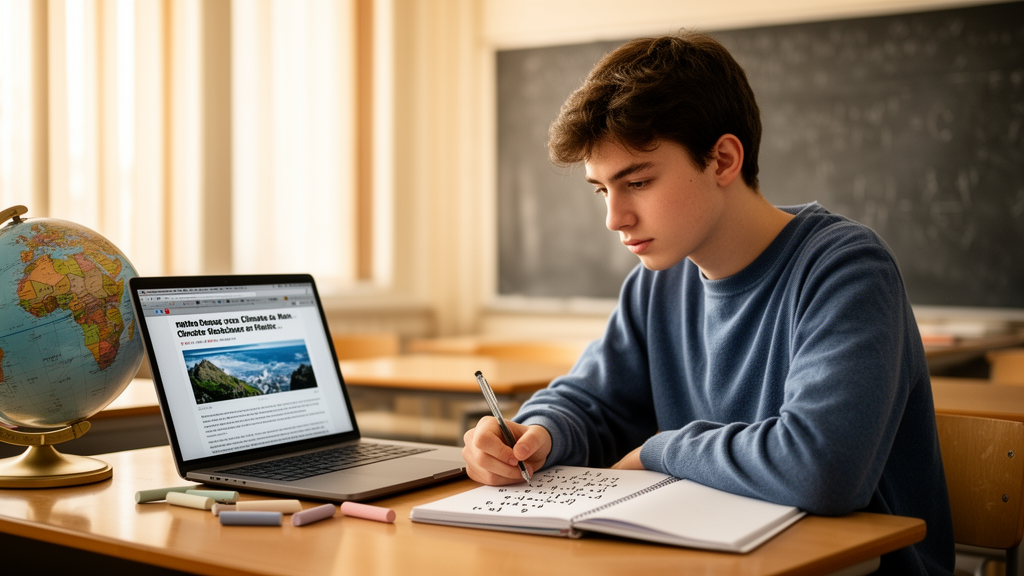
Climate change is often framed as a problem for atmospheric scientists, ecologists, and engineers, yet a growing body of educational research argues that the mathematics classroom may be one of the most underappreciated arenas in which climate literacy can be built. A new study conducted within a mathematics teacher education programme at a public university in Hong Kong suggests that carefully structured engagement with climate-related media can transform how prospective teachers understand both the climate emergency and their own professional responsibilities. The research, published in Humanities and Social Sciences Communications by Oi-Lam Ng and Sally Wai-Yan Wan of the Chinese University of Hong Kong and Alf Coles of the University of Bristol, offers a detailed look at how future mathematics teachers move from passive awareness of environmental crisis to concrete plans for classroom practice.
The study addresses what the authors describe as an urgent need in teacher education: preparing graduates with the knowledge, skills, and ethical dispositions required to confront pressing global challenges, particularly climate change. Teacher education programmes have traditionally treated sustainability as the domain of geography, biology, or environmental science courses, leaving mathematics largely untouched. But mathematics is deeply implicated in how climate information is produced, communicated, and contested. Rising temperature curves, carbon budget calculations, probability estimates of extreme weather events, and statistical summaries of biodiversity loss are all mathematical artefacts. A teacher who cannot help students read these artefacts critically leaves them ill-equipped to navigate public discourse about the climate.
To probe this gap, the researchers designed media-based learning activities within the undergraduate programme. Prospective teachers of mathematics engaged with climate-related media and then participated in structured reflection and dialogue focused on pedagogical approaches for integrating climate literacy into mathematics teaching. The method is deceptively simple: rather than lecturing future teachers about sustainability, the programme asked them to encounter media representations of the climate emergency, reflect in writing on what they saw, and discuss in groups how such material might be turned into mathematics lessons. The researchers then applied discourse analysis to the prospective teachers’ written reflections and group discussions, examining how the participants made sense of the climate emergency and of their roles as future educators.
The findings point to three powerful psychological and social mechanisms at work. First, the media-based reflections fostered shared attention. When a group of future teachers engages with the same piece of climate media, they develop a common object of focus, which makes collective discussion possible in a way that abstract lectures rarely achieve. Second, the activities produced emotional engagement. Climate media, by its nature, tends to evoke affective responses, and the study found that these responses were not obstacles to learning but resources for it, animating the prospective teachers’ sense that the issue mattered to them personally. Third, and perhaps most significantly, the reflections cultivated a sense of collective responsibility. Participants came to see responding to the climate emergency not as someone else’s job but as part of what it means to be a mathematics educator.
Beyond these mechanisms, the analysis revealed that participants articulated genuine shifts in perspective and envisaged concrete changes to their future mathematics teaching practices. The researchers organised these envisioned changes into three thematic areas, each of which maps onto a distinct strand of mathematical capability. The first theme is raising awareness of climate change through cultivating data literacy. Climate science rests on data: time series of global temperatures, measurements of atmospheric carbon dioxide concentrations, records of sea level rise, and inventories of greenhouse gas emissions. A mathematics teacher who equips students to interpret graphs, understand rates of change, and evaluate the reliability of data sources is, in effect, teaching climate awareness through the mathematics curriculum itself.
The second theme involves teaching environmental sustainability through mathematical modelling. Modelling is a cornerstone of both school mathematics reform and climate science. When students build a simple model of population growth, resource consumption, or carbon accumulation, they experience firsthand how mathematical assumptions translate into projections about the future. The prospective teachers in the study came to see modelling not merely as an abstract technique for satisfying curriculum requirements but as a vehicle through which students can explore sustainability questions, test scenarios, and appreciate the consequences of different policy and behavioural choices. This reframing turns the mathematics classroom into a space where environmental futures are not just described but actively explored.
The third theme centres on fostering critical evaluation of quantitative information and representations. This may be the most distinctive contribution of mathematics education to climate literacy. Public debates about climate change are saturated with numbers, charts, and statistics, and these can be manipulated, cherry-picked, or misleadingly scaled. A line graph with a truncated axis can make a steep warming trend look gentle; a percentage change without an absolute baseline can exaggerate or minimise an effect. The prospective teachers recognised that teaching students to interrogate such representations, to ask who produced a figure, how it was calculated, and what it leaves out, is a form of civic education that mathematics is uniquely positioned to deliver. Critical data literacy, in this view, is a defence against both misinformation and despair.
What makes the study methodologically interesting is its use of discourse analysis as the primary analytical lens. Rather than measuring climate literacy with a before-and-after test, the researchers examined the language prospective teachers used in their written reflections and group discussions, tracking how their sense-making evolved. Discourse analysis is well suited to capturing the subtle ways in which people negotiate identity and responsibility. When a future teacher shifts from describing climate change as a global problem to describing what she would do in her own classroom, that linguistic shift marks a genuine reorientation of professional identity, something a standardised questionnaire might miss entirely.
The broader significance of the work lies in its argument about pedagogy. Media-based reflective pedagogies, the authors suggest, can support the development of climate literacy by strengthening prospective teachers’ capacity for critical reflection on sustainability issues and their pedagogical implications. This positions media not as a distraction from rigorous mathematics teaching but as a catalyst for it. News reports, documentary footage, and data visualisations provide authentic contexts that give mathematical content meaning, while the structured reflection ensures that emotional responses are channelled into professional planning rather than left as free-floating anxiety. The approach also aligns with international calls to embed education for sustainable development across teacher preparation, rather than confining it to specialist courses.
The study was conducted in accordance with the ethical principles of the Declaration of Helsinki, with ethical approval granted by the Chinese University of Hong Kong’s Survey and Behavioural Research Ethics Committee, and it was fully supported by the Worldwide Universities Network Research Development Fund. Its implications extend well beyond Hong Kong. Mathematics teacher educators around the world face the same challenge: a generation of students who will live through intensifying climate impacts, taught by teachers who may feel that climate change belongs to someone else’s subject. This research offers a concrete, replicable pathway forward, one in which the humble tools of the mathematics classroom, graphs, models, and critical questions about numbers, become instruments of climate understanding. As the climate emergency deepens, the study suggests, the question is no longer whether mathematics teachers should engage with it, but how quickly teacher education programmes can prepare them to do so well.
Subject of Research: Media-based reflection activities for developing climate literacy among prospective mathematics teachers
Article Title: Media-based reflections to foster climate literacy in mathematics teacher education
Article References: Media-based reflections to foster climate literacy in mathematics teacher education. (n.d.). https://doi.org/10.1038/s41599-026-09162-z
Image Credits: AI Generated
DOI: 10.1038/s41599-026-09162-z
Keywords: climate literacy, mathematics education, teacher education, media-based reflection, prospective teachers, data literacy, mathematical modelling, sustainability education, discourse analysis, critical evaluation, Hong Kong, environmental sustainability
Cite Scienmag News
Courtney Benton. (October 16, 2026). How Climate Media Is Reshaping the Way Future Math Teachers Think. Scienmag. https://scienmag.com/how-climate-media-is-reshaping-the-way-future-math-teachers-think/
Courtney Benton. "How Climate Media Is Reshaping the Way Future Math Teachers Think." Scienmag, 16 October 2026, https://scienmag.com/how-climate-media-is-reshaping-the-way-future-math-teachers-think/. Accessed 16 October 2026.
Courtney Benton. "How Climate Media Is Reshaping the Way Future Math Teachers Think." Scienmag. October 16, 2026. https://scienmag.com/how-climate-media-is-reshaping-the-way-future-math-teachers-think/


