


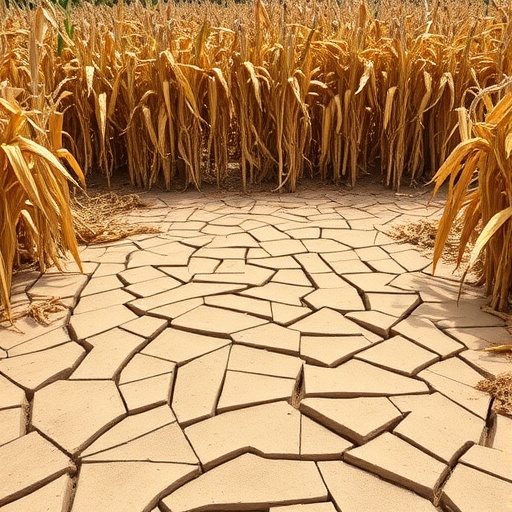
A new study in Communications Earth & Environment warns that “flash droughts” are now poised to worsen crop losses by pushing the atmosphere itself into deeper dryness—right at the moments maize is most vulnerable. The research, published in 2026, links these abrupt drought events to intensified atmospheric aridity rather than relying solely on how little rain reaches the ground.
Flash droughts differ from conventional droughts because they develop quickly. Instead of seasonal drying, soil moisture and plant access to water can collapse over days to weeks. The team found that this rapid decline triggers chain reactions in the lower atmosphere, amplifying conditions that make water extraction from the soil increasingly difficult.
Using observational datasets and model-based analyses, the authors track how maize yield responds when the air becomes unusually dry while heat and atmospheric demand rise. Their results indicate that aridity is not a passive background factor; it actively drives additional stress by increasing evapotranspiration demand and deepening the vapor-pressure deficit experienced by crops.
The mechanism is both direct and indirect. As the atmosphere dries, plants lose water faster through stomata—often before they can fully adjust their growth or root water uptake. At the same time, rapid soil drying reduces the water reservoir available to replenish leaf water, creating a feedback loop that accelerates stress.
In the model experiments, intensified atmospheric aridity magnified yield declines during flash drought periods. Even when rainfall deficits were not identical, the same crop responded more strongly when the atmosphere increased its drying power, suggesting that “how dry the air gets” may be as important as “how little it rains.”
The findings also imply that risk forecasts based only on precipitation may underestimate actual agricultural damage. Flash drought damage could intensify under climate-change scenarios that raise atmospheric vapor demand, making early warning systems that include atmospheric humidity and aridity metrics more effective.
For maize-dependent regions, the study points to a potentially urgent adaptation challenge: managing crops when both soil and air rapidly turn against them. Strategies may need to focus on buffering atmospheric stress, not just conserving soil water.
Overall, the work reframes flash droughts as events that couple fast hydrologic collapse with rapid atmospheric drying. As such, agricultural vulnerability may depend on the speed of these combined changes, and not simply on drought duration alone.
Cite Scienmag News
Alan Morgan. (July 29, 2026). Flash Droughts Worsen Maize Yield Losses by Intensifying Atmospheric Dryness. Scienmag. https://scienmag.com/flash-droughts-worsen-maize-yield-losses-by-intensifying-atmospheric-dryness/
Alan Morgan. "Flash Droughts Worsen Maize Yield Losses by Intensifying Atmospheric Dryness." Scienmag, 29 July 2026, https://scienmag.com/flash-droughts-worsen-maize-yield-losses-by-intensifying-atmospheric-dryness/. Accessed 3 September 2026.
Alan Morgan. "Flash Droughts Worsen Maize Yield Losses by Intensifying Atmospheric Dryness." Scienmag. July 29, 2026. https://scienmag.com/flash-droughts-worsen-maize-yield-losses-by-intensifying-atmospheric-dryness/


