

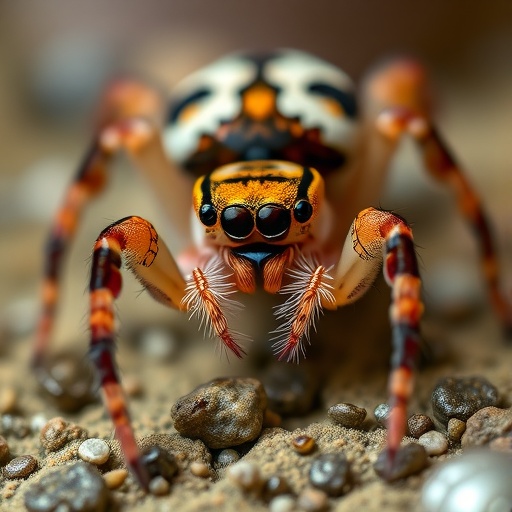
A fleeting brush with a mild heatwave can scramble the sexual fate of a spider’s lineage for generations, without the animals themselves ever feeling the warmth. A new study reveals that exposing tiny dwarf spiders to just a few degrees of extra heat for a single generation dismantles a bacterial sex-manipulation system in their descendants, triggering the sudden resurrection of males in a lineage that was otherwise engineered to be all-female. The work, published in Molecular Ecology, uncovers a hidden tug-of-war inside the spider’s body where rival microbes battle for control of reproduction, and where a small environmental nudge can tip the balance with consequences that echo across generations.
The cast of this micro-drama is the dwarf spider Mermessus fradeorum, an inconspicuous arachnid that harbors a bustling internal ecosystem of up to five different maternally inherited bacteria. One of these passengers, a strain of the famous reproductive parasite Wolbachia, acts as a puppet master. It forces genetically male embryos to develop into functional females, a trait known as feminization. This radical intervention ensures that almost every offspring is a female capable of transmitting the bacterium to the next generation through her eggs, allowing Wolbachia to sweep through a population. Yet in nature, feminizing Wolbachia rarely reaches fixation; something keeps it in check, maintaining a reservoir of males that prevents a population from collapsing into an evolutionary dead end.
To probe what reins in the rampant feminizer, researchers from the Hebrew University of Jerusalem, the University of Kentucky, and the University of Illinois subjected young M. fradeorum spiderlings to a single thermal spike—temperatures of 27°C to 28°C mimicking a warm summer day’s surface heat—for one developmental generation before returning them to a cool 20°C environment. The directly heated spiders grew into females, as expected under Wolbachia’s influence. The shock came when those females laid eggs under standard cool conditions. Their offspring, which had never experienced the heat, and even the subsequent grand-offspring, produced a dramatic surge of males. Feminization had been broken, not in the heated individuals, but in the generations that followed.
The mechanism behind this transgenerational collapse is a seismic shift in the spider’s internal microbial community. Under the heat pulse, the feminizing Wolbachia actually increased its within-host density, a typical stress response. However, this apparent boost proved deceptive: the bacterium’s ability to successfully transmit from mother to eggs plummeted. Simultaneously, another core symbiont, Tisiphia, was completely purged from the lineage. The vacuum left by these disruptions was filled by a third bacterium, Rickettsiella, which underwent a population explosion in the very generation where males reappeared. Statistical modeling showed a strong negative association between relative Rickettsiella abundance and feminization, positioning this microbe not as a passive bystander but as an active antagonist that blocks Wolbachia’s reproductive manipulation.
The antagonism likely hinges on competitive exclusion within the ovarian tissues and developing eggs, where these intracellular bacteria must establish themselves to be transmitted. High Rickettsiella titres may physically or chemically interfere with Wolbachia’s ability to colonize the germline, or the two may trigger host immune responses that differentially affect their persistence. What is clear is that feminization is not simply a function of whether Wolbachia is present; it requires the symbiont to dominate the microscopic arena. A brief thermal disruption reshuffles that hierarchy, and the new order can stick for multiple generations before equilibrium is restored.
Intriguingly, not all spider lineages were equally vulnerable. Individuals carrying a multi-strain infection of Wolbachia—specifically strains 1, 2, and 3—showed remarkable resilience. These co-infected spiders maintained more stable relative abundances of their symbionts under the same heat stress and recovered their strongly female-biased sex ratios within one to two generations. The presence of multiple Wolbachia strains appears to buffer the community against collapse, perhaps because they occupy slightly different niches or cooperate to suppress rivals like Rickettsiella. This finding highlights how biodiversity within a single host can stabilize the extended phenotype that a symbiont imposes.
For ecologists, the results offer a concrete mechanism by which real-world thermal fluctuations—daily and seasonal cycles, or longer-term climatic shifts—can regulate the spread of selfish genetic elements. By periodically knocking down feminization efficiency, transient heat events likely maintain the critical minority of males needed for sexual reproduction and genetic exchange. Without such ecological checks, an overzealous feminizer could push its host population toward a demographic dead end where males vanish entirely, jeopardizing long-term survival.
The study transforms our understanding of how environmental history sculpts an organism’s functional biology. It shifts the analytical lens from the host’s own genome to the competitive dynamics of its resident microbes, treating the animal as an ecosystem in miniature. The notion that a heatwave can echo through two generations, not via epigenetic marks or DNA mutations, but through the rise and fall of rival bacterial factions, adds a new layer of complexity to predicting species responses in a warming world. For the dwarf spider, a few degrees of warmth is enough to rewrite the rules of sex, and its grandchildren bear the consequences.
Subject of Research: Dwarf spider (Mermessus fradeorum) and its maternally transmitted bacterial symbionts, specifically Wolbachia-induced feminization and microbial community dynamics under thermal stress.
Article Title: Elevated Temperatures Disrupt Wolbachia-Induced Feminisation and Reshape Microbial Community Dynamics Across Generations in a Spider Host
News Publication Date: 8-May-2026
Web References: 10.1111/mec.70371
References: Molecular Ecology, DOI: 10.1111/mec.70371
Image Credits: Rebecca Robertson, University of Kentucky
Keywords: Arachnids, dwarf spider, Mermessus fradeorum, Wolbachia, feminization, reproductive manipulation, Rickettsiella, symbiont competition, transgenerational effect, thermal stress, microbial community dynamics, evolutionary ecology, climate change effects


