

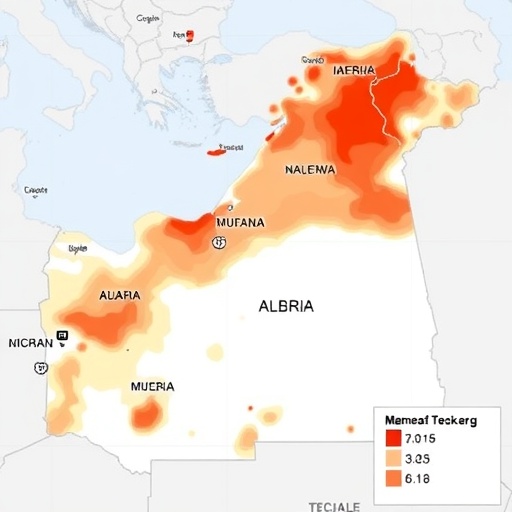
A comprehensive genomic surveillance effort has finally lifted the veil on the cryptic dynamics of West Nile Virus in Algeria, revealing a complex picture of repeated reintroductions, localized overwintering, and evolutionary divergence that challenges traditional assumptions about how the mosquito-borne pathogen circulates at the margins of the Mediterranean. Published this week in Nature Communications, the study by Hachid and colleagues represents the most extensive phylogeographic reconstruction of West Nile Virus in North Africa to date, leveraging more than two decades of viral genome sequences and sophisticated Bayesian statistical frameworks to trace the virus’s hidden movements across the country’s diverse ecological zones. The findings arrive at a moment when climate change is rapidly altering the transmission potential of arboviruses in temperate and subtropical regions, making an understanding of persistence mechanisms in under-sampled locales urgently important.
West Nile Virus is a single-stranded RNA flavivirus maintained in an enzootic cycle between ornithophilic mosquitoes, primarily of the Culex genus, and a wide range of avian reservoir hosts, with humans and equids serving as incidental dead-end hosts. While the virus is now endemic across much of the Americas following its dramatic introduction into New York in 1999, its circulation in the Old World has historically been more episodic, characterized by sporadic outbreaks separated by years of apparent silence. Algeria, with its Mediterranean coastline, Saharan interior, and position at the intersection of major Afro-Eurasian bird migration flyways, has long been suspected as a key node in the virus’s intercontinental dynamics. Yet prior to this work, only fragmented case reports and a handful of viral sequences existed, leaving fundamental questions about local transmission cycles unanswered.
The research team set out to close that gap. They generated a substantial collection of new West Nile Virus genomes from mosquitoes, birds, and human clinical cases sampled between 2001 and 2024, integrating these with all publicly available sequences from North Africa and the broader Mediterranean basin. Using a Bayesian phylogeographic approach that models spatial diffusion as a continuous process across geographic coordinates, the authors were able to reconstruct the virus’s dispersal history with unprecedented resolution. The resulting phylogenies were not merely static evolutionary trees but dynamic maps of viral movement, calibrated against time and landscape features.
One of the study’s most striking revelations is that West Nile Virus does not persist as a single endemic lineage within Algeria. Instead, the virus has been introduced multiple times from distinct external sources, primarily from Western and Central Europe, with additional contributions from West African lineages. These introductions have seeded transient transmission chains that flared up during warm months and, in many cases, faded out. Critically, however, the analysis identified genetic evidence of local overwintering in two distinct ecological pockets: the coastal wetlands of the Kabylie region and the oases of the northern Sahara. In these refugia, viral lineages appeared to persist across multiple years without external reintroduction, a pattern inferred from deeply branching, spatially confined clades with evolutionary rates consistent with continuous local replication.
The mechanisms that permit overwintering remain a subject of intense interest. The authors explored correlations with environmental covariates and found that the probability of local persistence increased significantly in areas where winter temperatures remained above a critical threshold for Culex pipiens activity and where irrigated agriculture provided year-round mosquito breeding sites. The Sahara oasis lineage, in particular, showed genetic signatures of adaptation, including non-synonymous mutations in the NS3 helicase and NS5 polymerase genes that might confer replication efficiency at higher ambient temperatures. While the functional significance of these mutations awaits experimental confirmation, their fixation within a geographically isolated viral population points to ongoing local adaptation to a unique microclimate.
Migratory birds, long considered the primary vehicles for long-distance dissemination of West Nile Virus, were confirmed as major players in seeding outbreaks. By cross-referencing viral introduction timelines with satellite-tracked bird migration patterns, the team demonstrated that peaks in viral influx coincided with the spring arrival of trans-Saharan passerines and the autumn southerly movement of waterfowl from Europe. The Serratella wetland complex near Algiers emerged as a particularly significant hotspot, acting as a mixing vessel where European and African lineages co-circulated, occasionally giving rise to recombinant genomes. The identification of a recombinant strain sampled from a horse in 2018 underscores the potential for genetic exchange to generate novel phenotypic variants, though the fitness of such recombinants remains poorly characterized.
From a public health standpoint, the study’s findings carry immediate implications. The confirmation of localized overwintering means that even in the absence of new bird-mediated introductions, the virus can re-emerge from cryptic enzootic foci, catching health systems off guard. The authors propose a risk stratification framework based on environmental suitability indices that integrate temperature, irrigation density, and proximity to migratory stopover sites. When retrospectively tested against historical human case data, the model predicted outbreak locations with high accuracy, suggesting it could serve as an early warning tool. Furthermore, the genomic evidence for ongoing adaptation in the NS3 and NS5 genes raises the question of whether these changes could eventually influence viral pathogenesis or transmissibility, underscoring the need for sustained surveillance.
The work is not without limitations. Sampling intensity varied geographically, and the vast, sparsely populated expanses of the southern Sahara remain almost entirely unsampled, a gap that could obscure connections to viral reservoirs in sub-Saharan Africa. Additionally, the reliance on human and equine clinical cases introduces a detection bias, as subclinical enzootic circulation in wild birds is inevitably underrepresented. Nevertheless, by combining state-of-the-art phylodynamics with ecological analysis, the study sets a new benchmark for understanding arbovirus circulation in North Africa and beyond.
As global temperatures continue to rise, the boundaries of viable transmission for vector-borne viruses are shifting poleward, turning previously marginal habitats into enzootic strongholds. The Algerian experience, as detailed by Hachid and colleagues, illustrates that the line between epidemic and endemic transmission is thin, fragile, and easily modulated by climate, land use, and the relentless movement of birds across continents. Their work not only deciphers the past and present of West Nile Virus in a historically neglected region but also equips public health agencies with the conceptual tools to anticipate its future.
Subject of Research: Patterns of emergence, local persistence, and phylogeographic circulation of West Nile Virus in Algeria, including multiple introductions, overwintering refugia, and genetic adaptation.
Article Title: Patterns of emergence and circulation of West Nile Virus in Algeria
Article References: Hachid, A., Benbetka, C., Bouamra, A. et al. Patterns of emergence and circulation of West Nile Virus in Algeria. Nat Commun (2026). https://doi.org/10.1038/s41467-026-74856-6
Image Credits: AI Generated
DOI: 10.1038/s41467-026-74856-6
Keywords: West Nile Virus, Algeria, phylogeography, genomic epidemiology, arbovirus, mosquito-borne disease, bird migration, virus overwintering, climate change adaptation, Bayesian phylodynamics


