

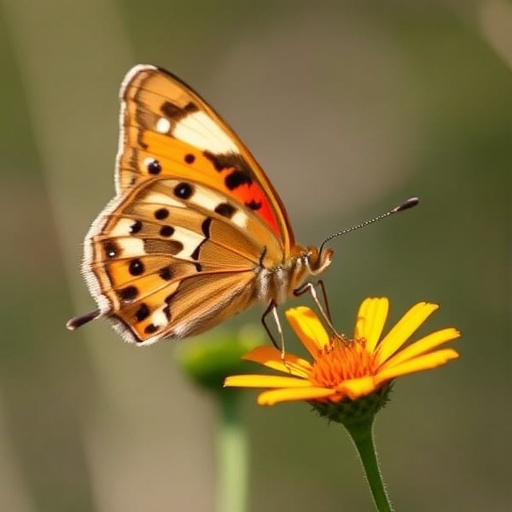

view more
Credit: Korbinian Schrauth
A new study published in the open-access journal Alpine Entomology has found that alpine butterflies in the Swiss National Park are closely matching the pace of local warming in their range shift to higher elevations.
But the research, conducted by scientists from the University of Würzburg, the University of Lausanne, Hintermann and Weber AG, and the Bavarian Forest National Park, reveals a more nuanced picture: habitat availability was found to be the key driver of butterfly community composition in the Alps.
Analysing a recent butterfly survey, the research team found that the proportions of available habitat types explained close to half of all variation in butterfly communities, while elevation on its own accounted for only a small fraction of the difference. The finding challenges the widely held assumption that temperature niche is the primary force shaping the elevational distribution of mountain butterflies.
Lead researcher Korbinian Schrauth, of the Chair of Conservation Biology and Forest Ecology at the University of Würzburg, explained what first prompted the team’s hypothesis: “The common assumption is that temperature adaptation is the main driving force behind the elevational distribution of butterflies in the Alps,” he said. “But there are a few cases that appear to be contradictory to this assumption.”
He cited the Peak White, a high-alpine butterfly, which has established colonies on lowland gravel banks, after its high-alpine host plants arrived there via alluvial deposits carried down from higher elevations. “This and similar examples led us to suspect that the elevational distribution of alpine butterflies might be rather driven by available habitats than by temperatures,” Schrauth added.
When the results came in, even the researchers were taken aback by how decisively habitats outweighed elevation as an independent explanatory factor. “At first we were surprised that the amount of variance explained by elevation on its own was that small,” said Schrauth, “but in the end, it fits quite well with our initial considerations and makes perfect sense given the knowledge of the complex ecology of butterflies.”
The study also found that butterfly communities have become measurably more warm-adapted over the past two decades. This shift was least pronounced at high elevations, which still appear to be dominated by cold-adapted alpine species.
At the same time, the average upslope displacement since 2004 corresponded closely to what would be expected from the local warming recorded in the region, suggesting that butterflies overall are keeping pace with the warming climate.
Not all species are faring equally well, however. Those restricted to a narrow range of habitat types showed markedly stronger upward shifts than generalist species, pointing to a particular vulnerability among alpine specialists. As vegetation struggles to keep pace with rising temperatures, specialist butterflies face the added risk of elevational butterfly-hostplant mismatches.
The conservation implications are significant. “One of the implications of our study is that, besides reducing carbon emissions, the protection of alpine habitats is the most important measure for preserving the diversity of alpine butterflies,” said Schrauth.
To keep track of future changes, the authors recommend repeating the surveys in the Swiss National Park at roughly ten-year intervals, though Schrauth acknowledged that more frequent monitoring would be preferable.
Original source:
Schrauth K, Plattner M, Müller J, Pellet J (2026) Habitat availability shapes composition and climate change response of alpine butterfly communities. Alpine Entomology 10: 121-135.
Journal
Alpine Entomology
Article Title
Habitat availability shapes composition and climate change response of alpine butterfly communities
Article Publication Date
15-Jun-2026
Katrin Jivkova
Pensoft Publishers
dissemination@pensoft.net
Office: 359-287-04281
Journal
Alpine Entomology
Article Title
Habitat availability shapes composition and climate change response of alpine butterfly communities
Article Publication Date
15-Jun-2026
bu içeriği 600 ile 800 kelime arasında olacak şekilde ve alt başlıklar ve madde içermiyecek şekilde ünlü bir science magazine için İngilizce olarak yeniden yaz. Teknik açıklamalar içersin ve Viral science news olacak şekilde İngilizce yaz. Haber dışında başka bir şey içermesin. Haber içerisinde 8 ile 10 paragraf olsun ve toplam uzunluk 600 ile 800 kelime arasında kalsın. Cevapta sadece haber olsun. Ayrıca haberi yazdıktan sonra içerikten yararlanarak aşağıdaki başlıkların bilgisi var ise haberin altında doldur. Eğer yoksa bilgisi ilgili kısmı yazma.:
Subject of Research:
Article Title:
News Publication Date:
Web References:
References:
Image Credits:
Keywords

