


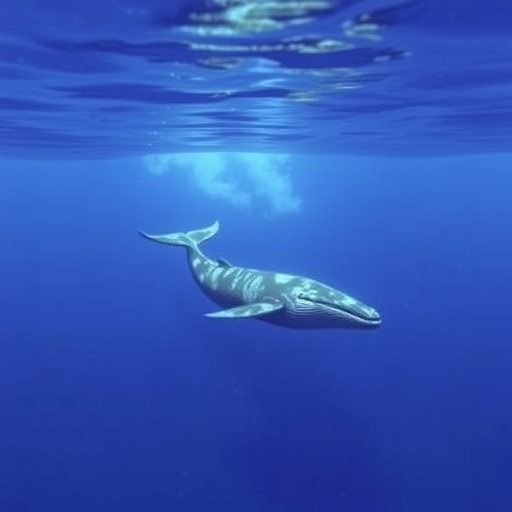
In the remote expanse of the Pacific Ocean, approximately one thousand kilometers south of Tokyo, the Ogasawara Islands, or Bonin Islands, play host to a spectacular natural phenomenon that attracts both scientists and tourists alike: the annual migration and breeding of humpback whales. These magnificent creatures, known for their acrobatic breaches and haunting songs, become a focal point during the months from December through May, as they navigate the warm, shallow coastal waters of this isolated archipelago. This region has long been recognized for its ecological significance, yet the precise habitats within the Ogasawaras that are most critical for humpback whale activities, particularly around Chichijima Island—the archipelago’s biggest inhabited island—have remained elusive.
Recent advancements in ecological modeling and detailed observational data have enabled a team of marine biologists and computational researchers from Kyoto University, Tokyo University of Marine Science and Technology, and the Ogasawara Whale Watching Association to illuminate these mysteries. By leveraging extensive sighting survey data obtained over a five-year period between 2013 and 2018, the researchers have pioneered an approach that marries rigorous field observations with sophisticated species distribution models. The combination of empirical data and predictive simulation allows for an unprecedented mapping of habitat suitability for humpback whales in these waters, revealing intricate patterns of spatial use that challenge previous assumptions about whale ecology in this region.
The raw data underpinning this study consist of visual sightings recorded from whale-watching vessels operated by the Ogasawara Whale Watching Association. Across the multi-year survey, observers documented 160 distinct groups of humpback whales, totaling 234 individual animals. These sightings were meticulously georeferenced and accompanied by environmental parameters, including bathymetric readings that provided information about water depth and seabed slope, as well as the proximity of sighting locations to the coastline. This dataset formed the empirical backbone for habitat suitability modeling, enabling the researchers to explore how the physical marine environment influences whale distribution around Chichijima.
Species distribution modeling (SDM), the computational technique employed in this study, integrates occurrence records of a species with environmental variables to predict areas that are ecologically favorable for the species’ presence. In this context, two distinct but complementary SDM approaches were utilized to refine predictions of humpback whale habitat preferences. By inputting variables such as bathymetry, seabed slope, and coastal distance into these models, the team derived predictive maps that delineate the spatial variance in habitat suitability. This modeling is particularly valuable in marine contexts where direct observation is limited by logistical constraints and where species may exploit a complex mosaic of environmental niches.
Analysis of the modeling outputs underscored the dominant influence of water depth on habitat suitability for humpback whales. Specifically, the whales showed a pronounced preference for shallow waters with gentle seabed slopes, conditions prevalent along the west coast of Chichijima Island. These findings resonate with broader ecological theories that suggest shallow marine environments provide optimal conditions for social and reproductive behaviors in large baleen whales. Factors such as ease of access to the surface for breathing, protection from deep-water predators, and suitable acoustic environments for communication may underlie these habitat preferences.
The seabed slope emerged as another significant factor, albeit secondary to water depth, influencing whale distribution patterns. Gentle slopes likely correspond with specific benthic conditions and prey availability, shaping the distribution of humpback whales during their prolonged breeding season around the islands. Interestingly, areas characterized by steep slopes or deeper waters were predicted to be less suitable, suggesting that these whales selectively utilize coastal habitats that provide both environmental stability and biological resources necessary for successful reproduction.
The integrative habitat suitability map generated through this study represents the first comprehensive visualization of humpback whale habitats around Chichijima Island. This map does not merely serve academic interest; it holds tangible implications for marine conservation and sustainable tourism management. Given the economic and cultural importance of whale watching in the Ogasawaras, these insights offer a scientific basis for balancing human recreational activities with the preservation of essential wildlife habitats. By delineating critical areas and seasonal hotspots for humpback whale presence, stakeholders can devise informed management strategies that mitigate disturbance and promote coexistence.
Koki Tsujii, the first author of the research paper, highlights the dual significance of humpback whales as both an integral component of marine biodiversity and a pillar of local tourism economies. “Whale watching focused on humpback whales is a thriving activity in the Ogasawara waters, so this species holds significant economic value not only as a component of marine biodiversity but also as a local tourism resource,” Tsujii emphasizes. The visualization of suitable habitats aims to empower conservation efforts with scientific rigor, facilitating targeted protection measures that accommodate both ecological and human interests.
Furthermore, this research sets the stage for refined investigations into how pod dynamics and social structures influence habitat use across the archipelago. Previous studies in other regions have demonstrated that variations in group composition—such as mother-calf pairs compared to large breeding aggregations—significantly affect spatial distribution patterns within breeding grounds. Understanding these nuances will enhance prediction models and conservation planning, enabling a more differentiated approach that considers the behavioral ecology of humpbacks rather than treating the population as a monolithic entity.
The researchers also acknowledge the necessity of expanding the spatial scale of future models to encompass the entire Ogasawara archipelago, beyond just the Chichijima group. Such comprehensive modeling endeavors would provide a holistic perspective on habitat connectivity and seasonal migratory corridors, yielding critical knowledge to support marine spatial planning and transboundary conservation initiatives. As humpback whale populations face increasing pressures from climate change, noise pollution, and vessel traffic worldwide, localized, high-resolution data like these become instrumental in devising adaptive management frameworks.
By integrating years of meticulously collected observational data with computational simulations grounded in marine topography, this study exemplifies the power of interdisciplinary approaches in marine science. It bridges gaps between traditional ecological methods, emerging technological tools, and applied conservation goals. The outcomes resonate beyond the Ogasawaras, offering a methodological blueprint for assessing and protecting cetacean habitats in similar island ecosystems globally.
In conclusion, the breakthrough habitat suitability map for humpback whales in the Ogasawara Islands underscores the intricate relationships between marine mammals and their physical environments, emphasizing water depth and seabed slope as key determinants of habitat preference. This pioneering work not only enriches scientific knowledge but also strengthens the foundation for evidence-based conservation strategies and sustainable eco-tourism practices in one of the Pacific’s most treasured natural arenas.
News Publication Date: 18-May-2026
Web References: DOI: 10.3106/ms2025-0036
Cite Scienmag News
Violet Maxwell. (June 10, 2026). Discovering Optimal Habitats for Humpback Whales. Scienmag. https://scienmag.com/discovering-optimal-habitats-for-humpback-whales/
Violet Maxwell. "Discovering Optimal Habitats for Humpback Whales." Scienmag, 10 June 2026, https://scienmag.com/discovering-optimal-habitats-for-humpback-whales/. Accessed 4 September 2026.
Violet Maxwell. "Discovering Optimal Habitats for Humpback Whales." Scienmag. June 10, 2026. https://scienmag.com/discovering-optimal-habitats-for-humpback-whales/


