

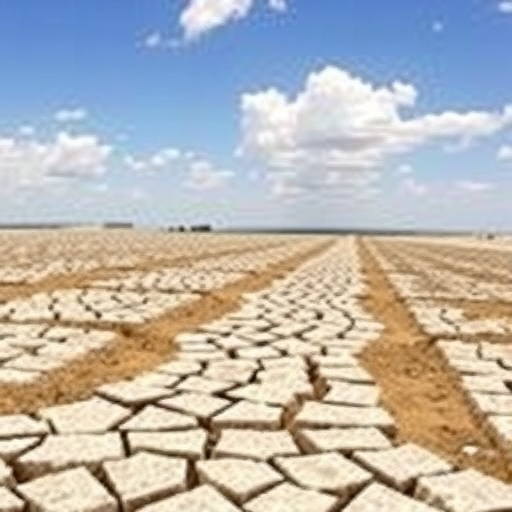
Drought research has entered a new phase in which the central question is no longer simply whether rainfall is declining, but how water shortages develop into complex risks for societies, ecosystems and economies. A 2026 author correction published in Nature Water revisits “Ten key insights and gaps to inform drought risk research, policy and practice,” a wide-ranging contribution by M.L.K. Wens, M. Hagenlocher, A. Shyrokaya and colleagues. Although the publication is formally a correction, its subject places renewed attention on one of the most difficult challenges in climate science: translating drought knowledge into decisions before crisis conditions emerge.
Unlike a single storm or flood, drought rarely begins with a clearly defined moment of impact. It can build gradually through a combination of below-average precipitation, elevated temperatures, depleted soil moisture, reduced river flows and falling groundwater levels. Scientists therefore distinguish among meteorological drought, agricultural drought, hydrological drought and socioeconomic drought. These categories describe different stages and consequences of the same broad phenomenon, but they do not always occur in sequence or at the same speed. A short rainfall deficit, for example, may be rapidly intensified by heat, while a river basin can remain hydrologically stressed long after rainfall has returned.
The paper’s focus on key insights and research gaps reflects a growing recognition that drought risk cannot be measured by climate variables alone. Risk is generally understood as the interaction of hazard, exposure and vulnerability. The hazard may be a prolonged moisture deficit, but the damage depends on who or what is exposed and how resilient those systems are. A farming region dependent on rain-fed crops, a city drawing from an overused aquifer and a wetland supporting endangered species may experience the same drought differently. This makes drought assessment a multidisciplinary task involving climatology, hydrology, ecology, agriculture, economics, public health and social science.
Climate change is making this challenge more urgent by altering the physical conditions that shape drought. Rising temperatures increase atmospheric demand for water, a process commonly described through potential evapotranspiration. Even when precipitation does not decline substantially, hotter air can dry soils and vegetation more rapidly. In some regions, climate change may also intensify precipitation variability, producing longer dry intervals interrupted by short, intense rainfall events. Such storms may generate flooding without efficiently replenishing groundwater or restoring soil moisture, particularly where water runs off compacted or degraded land.
One of the most important scientific problems is the difficulty of connecting indicators to real-world impacts. Drought monitoring systems often rely on indexes such as the Standardized Precipitation Index, soil-moisture measurements, streamflow records or satellite observations of vegetation stress. Each indicator captures a different component of drought, and none provides a complete picture by itself. A region can show normal rainfall while crops suffer from extreme heat, or display improved surface conditions while reservoirs and aquifers remain dangerously low. Effective early warning therefore requires combining multiple observations with information about water use, infrastructure, ecosystems and social vulnerability.
The title of the corrected article also highlights the gap between research, policy and practice. Governments may possess sophisticated forecasts yet struggle to activate measures before visible damage occurs. This is partly because drought decisions involve uncertainty, competing demands and political pressure. Restricting irrigation, changing reservoir operations or prioritizing drinking-water supplies can impose immediate costs, while the benefits of early action may be difficult to see if a predicted drought weakens. Researchers and institutions must therefore communicate probabilities, thresholds and possible consequences in ways that are usable by farmers, water managers, emergency planners and communities.
Drought risk is also increasingly understood as a cascading and interconnected process. Reduced water availability can lower agricultural production, increase food prices, constrain energy generation, damage river ecosystems and intensify competition among users. Hydropower output may fall when reservoirs decline, while thermal power plants can face operational constraints when rivers become too warm or too shallow for cooling. Forests weakened by prolonged dryness may become more vulnerable to fire, pests and disease. These chains of effects mean that drought policy focused only on rainfall or crop losses may overlook consequences spreading through trade, energy systems, public health and migration.
Another challenge is that drought does not respect administrative boundaries. River basins cross municipal, regional and national borders, while food and energy markets connect distant communities. Water consumption in one location can influence availability downstream, and imported commodities may transfer drought pressure from one region to another. This makes coordination essential, but shared governance is often complicated by different laws, monitoring systems and definitions of drought. Research that produces comparable data and transparent methods can help decision-makers recognize common risks rather than responding only after local impacts become severe.
The correction itself underscores the importance of precision in scientific communication. Author corrections are issued when published information requires clarification or amendment, helping preserve the reliability of the scholarly record. In a field where policy recommendations may influence water allocation, agricultural planning and disaster preparedness, accurate wording, attribution and interpretation matter. The corrected publication does not eliminate the broader uncertainty surrounding drought; instead, it reinforces the need for carefully documented evidence and clear distinctions between observed trends, model projections and policy judgments.
The continuing message from drought science is both alarming and practical: waiting for a crisis is one of the most expensive forms of water management. Better preparation depends on monitoring systems that detect emerging stress, models that represent compound hazards, and policies designed to act under uncertainty. It also requires attention to equity, because households with limited income, small-scale farmers, Indigenous communities and ecosystems often have fewer options when water supplies fail. By bringing research gaps and decision-making needs into the same conversation, the corrected Nature Water article arrives at a moment when drought is no longer a distant seasonal concern, but a rapidly evolving test of how societies understand and manage risk.
Subject of Research: Drought risk research, policy and practice
Article Title: Author Correction: Ten key insights and gaps to inform drought risk research, policy and practice
Article References: Wens, M.L.K., Hagenlocher, M., Shyrokaya, A. et al. Author Correction: Ten key insights and gaps to inform drought risk research, policy and practice. Nature Water (2026). https://doi.org/10.1038/s44221-026-00705-x
Image Credits: AI Generated
DOI: 10.1038/s44221-026-00705-x
Keywords: drought risk, climate change, water scarcity, drought monitoring, climate resilience, hydrology, agriculture, water policy, environmental science


