


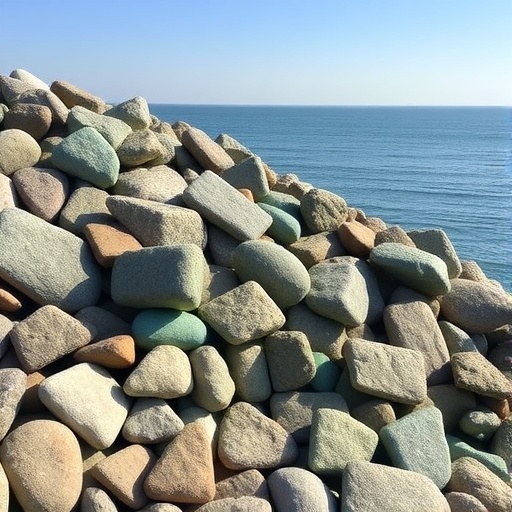
The ocean already absorbs roughly 30 percent of the carbon dioxide released by human activities, but scientists have long searched for ways to strengthen that natural climate service without creating a new environmental burden. Researchers at KAIST, working with a team at the Massachusetts Institute of Technology, have now developed an electrochemical system that turns carbon dioxide dissolved in seawater into a stable mineral. The process transforms the gas into calcium carbonate, a stone-like form that can remain locked away for extremely long periods rather than returning to the atmosphere.
The technology, known as electrochemical dissolved ocean carbon removal, or e-DOC, targets dissolved inorganic carbon, the collection of carbon-containing chemical species naturally present in seawater. When carbon dioxide enters the ocean, it does not remain only as a dissolved gas. It reacts with water to form carbonic acid, bicarbonate, and carbonate ions. By removing some of this dissolved carbon, the system creates a chemical imbalance that encourages the ocean to draw down additional carbon dioxide from the atmosphere, much as water flows into a container when its level is lowered.
The central challenge has been controlling what happens at the electrodes. Conventional electrochemical carbon-removal systems can cause calcium carbonate and other minerals to accumulate directly on electrode surfaces. This phenomenon, known as mineral scaling, gradually blocks active sites, restricts the movement of seawater, increases electrical resistance, and reduces the system’s performance. The deposits can force operators to shut down equipment for cleaning or replace components, adding maintenance demands and energy costs that have limited the practicality of continuous operation.
To address the problem, the KAIST and MIT researchers designed a hollow fiber electrode assembly, or HFEA. The device consists of many thin, hollow, thread-like electrodes bundled together in a compact structure. Rather than allowing minerals to build up directly on the electrochemical surfaces, the architecture encourages their formation away from the electrodes. At the same time, hydrogen bubbles produced naturally during the electrochemical reaction move across the surfaces. Their repeated motion functions like a microscopic brush, helping dislodge particles and suppressing the buildup that typically causes systems to fail.
The chemistry inside the device is carefully managed through electrochemical reactions. Applying electricity changes the local acidity and alkalinity of seawater near the electrodes, shifting the balance among dissolved carbon species and promoting the formation of carbonate ions. These ions can react with calcium present in seawater to produce calcium carbonate, effectively converting mobile dissolved carbon into a solid mineral. The approach does not simply capture carbon temporarily on a filter or chemical solvent; it aims to place the carbon in a form that is far less likely to escape back into the air.
In tests using seawater collected from Jeju, South Korea, the hollow fiber system operated continuously for more than 120 hours while maintaining stable performance. The researchers reported that it removed between 80 and 90 percent of the dissolved inorganic carbon in the treated seawater. The device also consumed up to 54 percent less electricity than existing approaches under comparable conditions. Although such laboratory and pilot-scale results will need to be confirmed over much longer operating periods, the combination of carbon removal, resistance to scaling, and lower energy use addresses several of the main obstacles facing marine carbon-removal technologies.
The process also generates potentially valuable products alongside mineralized carbon. High-purity hydrogen is produced during the electrochemical reactions, offering a possible source of clean fuel or an industrial feedstock if the electricity comes from low-carbon sources. The system also produces magnesium hydroxide, a compound used in industrial processes and in products marketed as environmentally friendly. These additional outputs could help improve the economics of carbon removal by creating revenue streams that offset some of the costs of electricity, seawater handling, and equipment deployment.
The compact and modular design could make the technology suitable for use in settings where large land-based facilities are difficult to build. Multiple HFEA units could potentially be connected to create larger systems on ships, offshore platforms, coastal plants, or other marine industrial facilities. However, scaling up will require careful evaluation of the full environmental footprint, including electricity sources, seawater intake, mineral management, hydrogen handling, and the effects of returning treated water to the ocean. Demonstrating that the system remains reliable under changing temperatures, salinity levels, and water chemistry will also be essential.
The researchers say the technology could help the ocean continue absorbing atmospheric carbon dioxide while permanently storing the removed carbon as calcium carbonate. Professor Dong-Yeun Koh of KAIST described the system as a route to converting dissolved ocean carbon into a mineral form that does not readily return to the atmosphere. The study was co-led by KAIST Ph.D. candidate Inhwan Park and MIT researcher Young Hun Lee, who earned his doctorate at KAIST in 2023. Their findings, published in Advanced Energy Materials, present the hollow fiber electrode assembly as a potentially important step toward continuous electrochemical marine carbon dioxide removal and the broader commercialization of ocean-based climate technologies.
Web References: https://doi.org/10.1002/aenm.71205
References: Advanced Energy Materials, DOI: 10.1002/aenm.71205
Cite Scienmag News
Violet Maxwell. (August 4, 2026). KAIST converts seawater carbon dioxide into stone for permanent marine storage. Scienmag. https://scienmag.com/kaist-converts-seawater-carbon-dioxide-into-stone-for-permanent-marine-storage/
Violet Maxwell. "KAIST converts seawater carbon dioxide into stone for permanent marine storage." Scienmag, 4 August 2026, https://scienmag.com/kaist-converts-seawater-carbon-dioxide-into-stone-for-permanent-marine-storage/. Accessed 4 September 2026.
Violet Maxwell. "KAIST converts seawater carbon dioxide into stone for permanent marine storage." Scienmag. August 4, 2026. https://scienmag.com/kaist-converts-seawater-carbon-dioxide-into-stone-for-permanent-marine-storage/


