


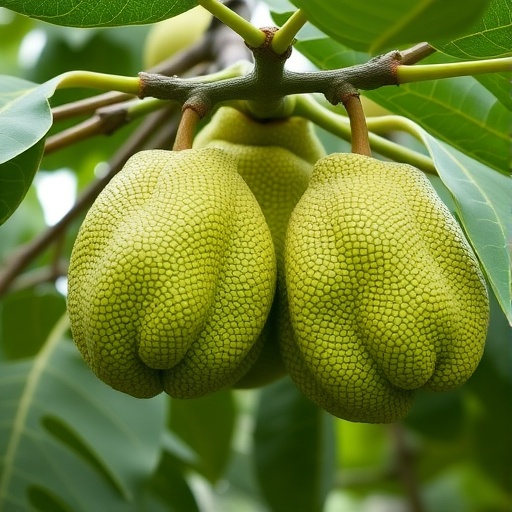
Jackfruit, the sprawling tropical tree that produces the world’s largest tree-borne fruit, has long been constrained by a single vulnerability: the cold. When temperatures dip below roughly 5°C to 7°C, jackfruit trees are prone to flower and fruit drop, and recurring winter cold damage has become a major bottleneck for the jackfruit industry across subtropical growing regions. Now, a research team working at the Guangxi Institute of Subtropical Crops in China has taken a major step toward understanding how this tropical giant copes with chilling temperatures at the level of its genome, delivering a comprehensive inventory of one of the plant kingdom’s most important families of gene regulators and revealing which members spring into action when the mercury falls.
Published in the open-access journal Plant Direct, the study reports the first genome-wide identification of the MYB transcription factor family in jackfruit (Artocarpus heterophyllus). Transcription factors are the master switches of gene regulation in eukaryotes; they bind specific DNA sequences and determine whether downstream genes are switched on or off. MYB proteins constitute one of the largest transcription factor families in plants, and their signature is a conserved MYB domain at the N-terminus, built from one to four incomplete repeats. Each repeat, roughly 50 to 53 amino acids long, folds into a three-alpha-helical structure that grips target DNA with high specificity. The C-terminal region, by contrast, is highly variable, which is what allows different MYB proteins to perform such a wide range of functions, from controlling pigment synthesis to coordinating hormone signaling and stress responses. Based on repeat architecture, MYB proteins fall into four classes: 1R-MYB, R2R3-MYB, 3R-MYB, and 4R-MYB, with the R2R3 type being the largest and best studied.
Using the previously published genome of the “S10” jackfruit cultivar, the team scanned the entire genome with BLAST searches and Pfam domain annotation and identified 298 MYB genes, designated AhMYB1 through AhMYB298. The encoded proteins vary dramatically in size, spanning from just 52 amino acids in AhMYB210 to 1,384 amino acids in AhMYB265, with molecular weights ranging from about 6 to 155 kilodaltons. Theoretical isoelectric points ranged from 4.47 to 10.14, indicating a broad spectrum of protein chemistries. Stability analysis showed that only 22 of the 298 proteins had instability indices below 40, marking them as stable, while the remaining 276 were predicted to be unstable, a pattern consistent with the transient, tightly regulated nature of stress-responsive transcription factors.
To make sense of this large family, the researchers constructed a phylogenetic tree using the neighbor-joining method with 1,000 bootstrap replicates, which organized the AhMYB proteins into seven subfamilies. Members of the same subfamily shared remarkably similar architectures: motif analysis using the MEME suite revealed ten distinct conserved motifs, and nearly every AhMYB protein contained Motif 3, underscoring its deep evolutionary conservation. Conserved residues beyond the canonical tryptophan included lysine, arginine, threonine, leucine, glycine, glutamate, valine, aspartate, and proline. Gene structure analysis added another layer of insight: the number of introns in AhMYB genes ranged from zero to eleven, with most genes carrying no more than two introns, echoing the compact intron organization typical of MYB genes across higher plants.
Chromosome mapping revealed that the 298 genes are scattered unevenly across the jackfruit genome’s 28 chromosomes, which range in size from 14.6 megabases to 44.1 megabases. Chromosome 8 harbors the largest contingent with 19 genes, followed by chromosomes 7 and 24 with 18 each and chromosome 22 with 17. At the other extreme, chromosome 2 carries only three. These dense clusters, the authors suggest, may represent evolutionary hot spots for MYB family expansion. Collinearity analysis using MCScanX identified a striking 1,439 duplicated gene pairs within the family, pointing to segmental duplication and tandem repeats as the dominant engines of MYB family expansion in jackfruit. Such proliferative duplication is thought to furnish plants with the raw genetic material needed to adapt to diverse and shifting environments.
The promoters of the AhMYB genes told an equally compelling story. By extracting 2,000-base-pair upstream sequences and running them through PlantCARE, the team catalogued the cis-acting elements that serve as docking sites for transcription factors. These elements fell into four functional categories: light signaling, hormone response, abiotic stress response, and growth and development. Abscisic acid response elements, jasmonate-responsive MYC elements, and ethylene response elements dominated the hormone category, while stress-response motifs such as anaerobic-responsive ARE elements and STRE elements featured prominently. Critically, many promoters contained low-temperature-responsive (LTR) elements, the molecular beacons that switch genes on when the mercury drops, foreshadowing the family’s role in cold tolerance.
The real proof came when the researchers turned to expression data from two jackfruit varieties subjected to natural cold stress. The experiment took advantage of a genuine cold snap in Nanning City, Guangxi, in February 2022, when ambient temperatures swung between 3°C and 15°C and crown-level temperatures between 3.5°C and 14°C. Leaf samples were collected from a local Guangxi strain (GX) and an introduced Thai strain (THA), then flash-frozen for RNA extraction. Transcriptome analysis showed that 157 of the 298 AhMYB genes were barely expressed at all, while 90 genes were highly expressed in the GX variety and 51 in the THA variety. Thirteen genes stood out as differentially expressed between the two strains under cold stress, and quantitative real-time PCR confirmed the transcriptome patterns with statistical rigor. Ten of these genes, including AhMYB18, AhMYB28, AhMYB45, and AhMYB285, showed elevated expression in the Thai strain, while three others, AhMYB87, AhMYB96, and AhMYB238, were expressed at lower levels.
The physiological measurements completed the picture. After cold exposure, the Thai strain developed visible water-soaked lesions on its leaves, a hallmark of chilling injury, while the Guangxi strain showed far less damage. Biochemical assays revealed that the Guangxi strain maintained significantly higher activities of superoxide dismutase (SOD) and catalase (CAT), two antioxidant enzymes that neutralize the reactive oxygen species generated when cold disrupts cellular metabolism. At the same time, the Guangxi strain accumulated markedly lower levels of malondialdehyde (MDA), the chemical fingerprint of membrane lipid peroxidation. In other words, the local Guangxi jackfruit defends itself against cold by ramping up its antioxidant defenses, limiting the oxidative assault on its cell membranes, and this molecular resilience is coordinated, at least in part, by its MYB transcription factor network.
The broader context matters here. MYB transcription factors have been repeatedly implicated in cold tolerance across the plant kingdom: overexpression of R2R3-type MYB genes enhances chilling tolerance in rice, Malus baccata MYB4 boosts cold resistance in Arabidopsis, and MYB genes from sandalwood, pear, and soybean have all been shown to participate in low-temperature responses. In Arabidopsis, the MYB protein AtMYB15 binds the promoters of CBF cold-response genes to fine-tune freezing tolerance. The jackfruit study now extends this picture to a major tropical fruit tree whose genome had, until recently, been a blank slate with respect to this gene family.
For breeders, the implications are practical. By pinpointing which AhMYB genes respond to cold and in which genetic backgrounds, the study provides a shortlist of candidate genes for marker-assisted selection and eventual transgenic or gene-editing approaches aimed at producing cold-hardy jackfruit varieties. The identification of superior cold-resistant gene resources, combined with modern molecular breeding methods, could dramatically accelerate the development of cultivars that can push the crop’s cultivation limits poleward and into higher elevations, expanding production in regions currently deemed too risky for jackfruit orchards.
The study also offers a snapshot of how gene families evolve under domestication and environmental pressure. The uneven chromosomal distribution, the abundance of duplicated gene pairs, and the diversity of conserved motifs all suggest that jackfruit’s MYB repertoire has been shaped by repeated duplication events that granted the species functional redundancy and adaptability. Some of these copies may have been co-opted for stress response, others for development, and still others may await functional characterization. The authors caution that the specific roles of individual AhMYB genes in cold tolerance still require direct functional validation, for example through overexpression or gene-silencing experiments, but the expression patterns and promoter architecture provide a strong foundation for such work.
As climate variability brings more frequent and severe cold snaps to subtropical Asia, understanding the molecular machinery that allows some jackfruit trees to shrug off the chill while others succumb has never been more urgent. This genome-wide inventory of 298 MYB transcription factors, complete with phylogenetic classification, structural annotation, chromosomal mapping, and cold-responsive expression profiling, transforms jackfruit from a genomic orphan into a tractable target for the next generation of climate-resilient fruit breeding. The humble jackfruit, it turns out, carries a sophisticated molecular thermostat, and scientists have just begun to read its settings.
Cite Scienmag News
Juliet Wilcox. (September 4, 2026). Genome-Wide MYB Gene Analysis Reveals Cold Stress Responses in Jackfruit. Scienmag. https://scienmag.com/genome-wide-myb-gene-analysis-reveals-cold-stress-responses-in-jackfruit/
Juliet Wilcox. "Genome-Wide MYB Gene Analysis Reveals Cold Stress Responses in Jackfruit." Scienmag, 4 September 2026, https://scienmag.com/genome-wide-myb-gene-analysis-reveals-cold-stress-responses-in-jackfruit/. Accessed 4 September 2026.
Juliet Wilcox. "Genome-Wide MYB Gene Analysis Reveals Cold Stress Responses in Jackfruit." Scienmag. September 4, 2026. https://scienmag.com/genome-wide-myb-gene-analysis-reveals-cold-stress-responses-in-jackfruit/


