


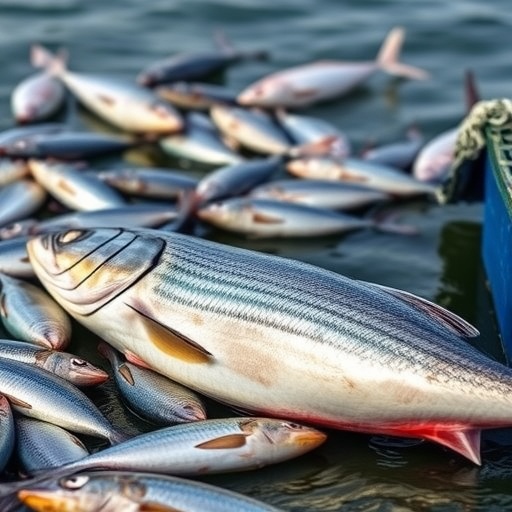
Industrial-scale illegal fishing is not a marginal crime carried out by a handful of rogue vessels. It is a deeply embedded feature of the global seafood economy, according to a comprehensive analysis by researchers at the University of British Columbia (UBC). Published in the Proceedings of the National Academy of Sciences, the study estimates that illegal and unreported industrial fishing accounts for approximately 8 to 15 per cent of global marine wild capture. The illicit catch supports a seafood trade worth between US$6.2 billion and US$12.2 billion each year, revealing a hidden market whose scale rivals the economies of entire nations.
The researchers describe illegal fishing as a transnational system sustained by weak governance, opaque ownership structures, harmful government subsidies, and supply chains that make it difficult to determine where seafood comes from. “Illegal fishing is not a fringe activity, but a systemic feature of the global seafood economy,” said lead author Philippe Le Billon, a professor in UBC’s Department of Geography and School of Public Policy and Global Affairs. The study argues that illegality remains profitable because the potential rewards are high, while the probability of detection, prosecution, and meaningful punishment is often low.
The geographic distribution of illegal fishing is highly uneven. Although unlawful activity occurs in waters around the world, roughly two-thirds of the illicit seafood trade by value originates in West Africa, East Asia, and Southeast Asia. These regions often combine rich marine resources with limited enforcement capacity, making them particularly vulnerable to incursions by distant-water fleets. Fishing is also central to local food security, employment, and national economies, so the depletion of fish stocks can produce consequences that extend far beyond environmental damage.
The seafood caught illegally does not remain in the regions where it is harvested. Much of it is eventually consumed in wealthier markets in North America, Europe, and East Asia. This creates a global imbalance in which coastal communities and developing states absorb the ecological and social costs, while profits move through international traders, processors, and retailers. UBC fisheries economist Rashid Sumaila said the pattern illustrates how the benefits of illegal fishing often flow elsewhere, while the losses are experienced by communities that depend directly on the ocean.
A central finding of the analysis is that illegal seafood can be laundered through multiple stages of the supply chain. At-sea transshipment allows fishing vessels to transfer catches to refrigerated cargo ships without returning to port, reducing opportunities for inspection and obscuring the location where fish were caught. Fraudulent catch certificates, species mislabeling, and the mixing of illegal and legal fish can further disguise the origin of seafood. Once the products enter processing facilities, ports, and distribution networks, separating lawful catch from illicit catch becomes technically and legally difficult.
Vessel ownership can be equally difficult to trace. Large fishing operations may use layered corporate structures, shell companies, and flags of convenience to hide the individuals or businesses that ultimately control vessels. Ships can also be re-registered under new flags or moved between corporate entities to evade sanctions and weaken accountability. According to the researchers, these arrangements exploit gaps between national jurisdictions. A vessel may be owned in one country, registered in another, fish under the authority of a third, and land its catch in a fourth before the seafood reaches consumers through several additional markets.
The study identifies fuel and other capacity-enhancing fisheries subsidies as important factors that can make destructive and illegal operations financially viable. Subsidized fuel lowers the cost of traveling to distant fishing grounds and allows industrial fleets to remain at sea for longer periods. This can intensify competition with small-scale and Indigenous fishers, whose vessels generally lack comparable financial support or technological capacity. The researchers argue that reducing illegal fishing will require more than increasing surveillance; it will also require reforming the economic incentives that make overcapacity and unlawful activity profitable.
New technologies are improving the ability to detect suspicious behavior. Satellite-based vessel tracking can reveal fishing activity in restricted areas, while artificial intelligence can identify unusual movement patterns, gaps in tracking data, or possible rendezvous between fishing and transport vessels. Electronic monitoring systems, including onboard cameras and sensors, can provide evidence about catches and fishing practices. However, technology cannot close the enforcement gap on its own. Inconsistent monitoring, weak port inspections, inadequate penalties, and political interference can prevent evidence from leading to prosecution. Powerful commercial or geopolitical interests may also limit how aggressively authorities act.
The consequences reach beyond declining fish populations. Illegal fishing can reduce government revenues, undermine legitimate seafood businesses, increase food and nutritional insecurity, and intensify pressure on coastal livelihoods. The researchers also highlight labor abuses aboard fishing vessels, including unsafe working conditions and a high risk of forced labor for tens of thousands of crew members, particularly on vessels operating far from public oversight. In some contexts, illegal fishing is connected to corruption, smuggling, and maritime insecurity, transforming what may appear to be an environmental offense into a broader governance and human-rights crisis.
The authors say effective reform must combine stronger port-state controls, mandatory electronic vessel identification, transparency about beneficial ownership, and closer international cooperation. Policies should also protect small-scale and Indigenous fisheries and support co-management systems that give local communities a meaningful role in regulating marine resources. Recent developments offer limited grounds for optimism: the World Trade Organization rectified its first fisheries subsidies agreement in 2025 and is working toward a follow-up agreement, while the High Seas Treaty entered into force on January 17, 2026. China has also become a party to the Agreement on Port State Measures. Yet the researchers stress that treaties and surveillance systems will matter only if governments, companies, and consumers push consistently for enforcement. Illegal fishing persists in the darkness created by fragmented responsibility; exposing that system is the first step toward dismantling it.
Web References: https://doi.org/10.1073/pnas.2512081123
References: Proceedings of the National Academy of Sciences; DOI: 10.1073/pnas.2512081123
Cite Scienmag News
Violet Maxwell. (August 10, 2026). Subsidies and fragmented enforcement hinder progress against illegal fishing, study finds. Scienmag. https://scienmag.com/subsidies-and-fragmented-enforcement-hinder-progress-against-illegal-fishing-study-finds/
Violet Maxwell. "Subsidies and fragmented enforcement hinder progress against illegal fishing, study finds." Scienmag, 10 August 2026, https://scienmag.com/subsidies-and-fragmented-enforcement-hinder-progress-against-illegal-fishing-study-finds/. Accessed 4 September 2026.
Violet Maxwell. "Subsidies and fragmented enforcement hinder progress against illegal fishing, study finds." Scienmag. August 10, 2026. https://scienmag.com/subsidies-and-fragmented-enforcement-hinder-progress-against-illegal-fishing-study-finds/


