


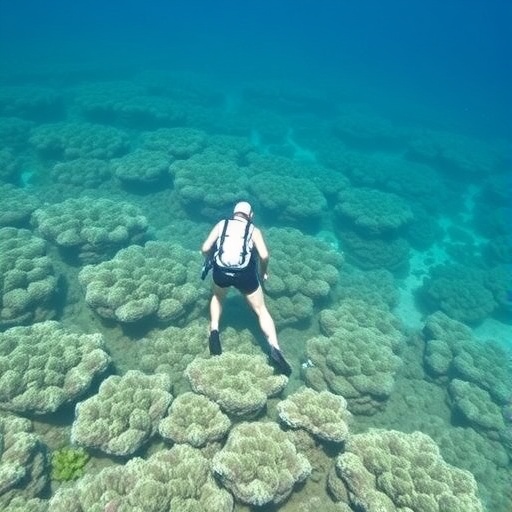
For thousands of years, the Anindilyakwa people have maintained a close cultural, practical and spiritual relationship with the waters surrounding Groote Eylandt, a remote island in Australia’s Gulf of Carpentaria. Beneath those waters are coral reefs that support marine life, subsistence fishing and cultural wellbeing, yet until recently they remained almost invisible to modern scientific records. A new study published in PLOS One has produced the most detailed baseline assessment yet of five reefs in the Groote Archipelago. The research reveals a complex reef system dominated by hardy, massive corals and shows why remote reefs cannot be assumed to be naturally protected from climate-driven stress. It also demonstrates how Indigenous knowledge and robotic survey technology can transform the study of hazardous and poorly documented marine environments.
The researchers examined the benthic communities of five reefs, recording the organisms and geological features found on the seafloor. Benthic surveys are essential for understanding reef condition because they measure not only the amount of living coral, but also the broader community occupying the substrate, including algae, sponges, sediment and other organisms. In the Groote Archipelago, the work was conducted largely with underwater remotely operated vehicles, or ROVs. These tethered robotic platforms can carry cameras and other instruments into waters where conventional diving is difficult or dangerous. Saltwater crocodiles, marine stingers, strong currents and limited access make direct human surveys challenging in the region. By operating an ROV from the surface, researchers were able to document reef structure and coral communities without exposing divers to the same risks.
The survey found that live coral cover varied widely between sites, ranging from about 5 per cent to 47 per cent. That variation suggests the reefs are not responding uniformly to their local conditions. Depth, exposure to waves and currents, sediment movement, water quality and the physical shape of the seabed can all influence where coral thrives. The communities were dominated by massive, robust coral colonies rather than the delicate branching forms that are often associated with better-known tropical reefs. Massive corals grow in compact, mound-like structures that can withstand physical disturbance more effectively than many branching species, but their apparent toughness does not make them immune to prolonged heat, disease, poor water quality or declining oxygen concentrations. Their presence provides important information about the reefs’ ecological character, but it should not be interpreted as proof that the system is invulnerable.
The timing of the fieldwork gave the researchers an unusually important view of the reefs. Surveys coincided with a stress event in early 2024, after satellite observations recorded elevated sea temperatures in the period leading up to the expedition. The temperatures did not reach the levels typically associated with severe coral bleaching, a process in which heat-stressed corals expel the microscopic algae that live within their tissues. Those algae provide much of the coral’s energy and colour, so their loss can leave colonies pale and physiologically weakened. Despite the absence of an obvious satellite signal indicating extreme heat, on-the-ground observations by the Anindilyakwa Land and Sea Rangers identified mass bleaching at several sites in the Gulf of Carpentaria. The contrast highlights a central limitation of remote sensing: satellites can detect broad environmental warning signs, but only field monitoring can reveal what is actually happening to individual reefs.
For lead author Dane Wattle, the lack of basic ecological information was a major obstacle to conservation planning. Coral reefs around the world are being exposed to increasingly frequent and intense stress events, including marine heatwaves, storms, disease outbreaks and changes in water chemistry. When disturbances occur repeatedly, corals may not have enough time to recover, causing reefs to shift toward algal-dominated or structurally degraded states. Without a baseline, however, it is difficult to determine whether a future change represents a temporary fluctuation, a natural difference between sites or a serious ecological decline. The new observations establish a reference point for the Groote Archipelago by documenting coral cover, community composition and the physical characteristics of the reefs. Future surveys can use those measurements to track recovery, identify new damage and determine which areas are most sensitive to environmental change.
The findings also challenge the assumption that marginal reef systems are automatically resilient. Reefs in less frequently studied regions are sometimes considered refuges because they may experience different temperature patterns or fewer direct human impacts than heavily visited reef systems. Yet resilience is not a permanent trait. It depends on the interaction of coral biology, local water circulation, sediment conditions, food availability and the frequency of disturbance. A reef that survives one heat event may be severely weakened by the next, particularly if warming oceans shorten the interval between episodes. Associate Professor Emma Camp, a senior researcher on the study, said remote reefs have too often been treated as an afterthought in conservation, even though they can be crucial to the communities that depend on them. The Groote Archipelago illustrates why remoteness should not be confused with ecological security.
The project was built around a partnership between UTS scientists, the Anindilyakwa Land and Sea Rangers and Traditional Owners. Rangers helped identify important reef locations and guided researchers through Sea Country using knowledge developed through long-term observation and cultural connection. Scientists, in turn, trained rangers to operate ROVs and drones, expanding the community’s ability to collect and interpret environmental data. This collaboration is scientifically valuable because local knowledge can reveal patterns that short-term expeditions might miss, including changes in water conditions, marine life and reef appearance over time. It also strengthens the continuity of monitoring. Rather than treating research as a one-off visit by external teams, the project has helped place coral reef observation within the rangers’ regular management activities.
That continuity matters because the reefs face pressure from both global and local forces. Climate change and sea-level rise threaten the low-lying landscapes and culturally significant marine sites around Groote Eylandt. The region is also home to a large manganese mine that is approaching a predicted closure in 2032. As the mine faces major water-inundation challenges, a proposed ocean outfall that could discharge gigalitres of water into the sea has raised concerns about potential effects on nearby coral, seagrass and marine microorganisms. Any change in the volume, chemistry or sediment content of coastal water could influence organisms living on the seafloor. Assessing such impacts requires reliable information about existing conditions, including where corals are concentrated and how their communities vary naturally from one site to another.
The study also exposes a governance gap. Traditional Owners have strong rights over land under Australia’s Aboriginal Land Rights Act, but legal protections for marine environments are more limited, even though Sea Country accounts for roughly 70 per cent of the Anindilyakwa Indigenous Protected Area. That imbalance is significant in a region where ecological value and cultural value are inseparable. The reefs provide habitat for marine organisms and contribute to local food systems, while also forming part of a living cultural landscape. Baseline science cannot resolve questions of marine authority or protection by itself, but it can supply evidence for management decisions and strengthen the case for long-term monitoring. The researchers say the new data will support future conservation strategies designed with Traditional Owners rather than imposed without their participation.
The next phase of the work will focus on reef taxonomy and physiological resilience. Researchers plan to clarify the identities of coral species, including the possibility that some may be unique or endemic to the region. They also want to test how the corals respond to rising temperatures and declining oxygen levels, two conditions that can become increasingly important as oceans warm and coastal waters undergo environmental change. For the Anindilyakwa Land and Sea Rangers, the immediate outcome is already practical: coral monitoring has become a priority in annual work planning and an activity that attracts strong engagement. The Groote Archipelago’s reefs are no longer an undocumented frontier. They now have a scientific baseline, a community-led monitoring pathway and a clearer place in the global conversation about how coral ecosystems can survive a rapidly changing ocean.
News Publication Date: 12-Aug-2026
Web References: https://doi.org/10.1371/journal.pone.0353017
References: PLOS One, DOI: 10.1371/journal.pone.0353017
Cite Scienmag News
Margaret Porter. (August 12, 2026). Rangers and scientists chart vulnerable reefs across the Groote Archipelago. Scienmag. https://scienmag.com/rangers-and-scientists-chart-vulnerable-reefs-across-the-groote-archipelago/
Margaret Porter. "Rangers and scientists chart vulnerable reefs across the Groote Archipelago." Scienmag, 12 August 2026, https://scienmag.com/rangers-and-scientists-chart-vulnerable-reefs-across-the-groote-archipelago/. Accessed 3 September 2026.
Margaret Porter. "Rangers and scientists chart vulnerable reefs across the Groote Archipelago." Scienmag. August 12, 2026. https://scienmag.com/rangers-and-scientists-chart-vulnerable-reefs-across-the-groote-archipelago/


