


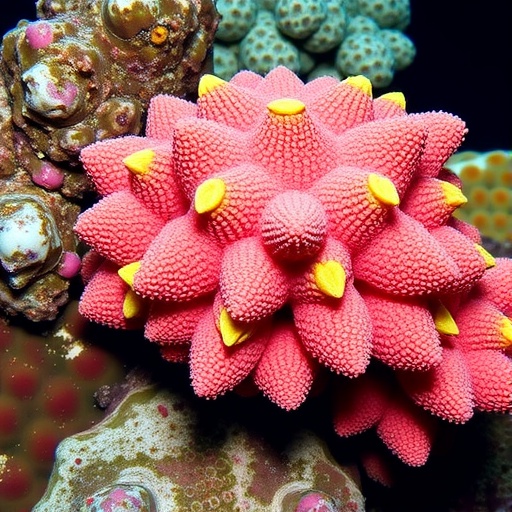
Scientists exploring the seamounts off Costa Rica’s Pacific coast have identified a bright yellow, tree-shaped coral so genetically and anatomically unusual that it has forced marine biologists to create an entirely new family. Named Laurinque elenya, the deep-sea octocoral grows in dense colonies between approximately 360 and 529 metres below the surface, where its golden branches rise from rocky seafloors covered by fields of brittle stars. The discovery, published in ZooKeys, offers a striking example of how much evolutionary diversity remains hidden in the deep ocean.
The coral was encountered during research expeditions to seamounts near Isla del Coco and along Costa Rica’s Pacific margin in 2019 and 2023. Scientists collected specimens with the remotely operated vehicle SuBastian, deployed from the research vessels Falkor and Falkor (too) by the Schmidt Ocean Institute. Some colonies exceeded a metre in height, forming what researchers described as expansive octocoral gardens. Their vivid yellow colour and branching architecture made them visually distinctive, but their true significance became clear only after detailed morphological and genetic investigations.
The colonies occupied rocky outcrops that were almost entirely blanketed by brittle stars. Thousands of the small, many-armed echinoderms created a shimmering seafloor, while the coral branches extended above them like miniature trees. This unusual setting inspired both parts of the scientific name. Laurinque is derived from “Laurinquë,” a Quenya word meaning “golden tree” in the Elvish language created by J.R.R. Tolkien. The species name elenya means “stellar” or “of the stars,” referring to the brittle-star fields surrounding the coral. Together, the name evokes a golden forest rising through a star-filled deep-sea landscape.
At first, the researchers expected the coral to belong to an already recognised group. Octocorals are colonial animals in the class Anthozoa, a major branch of the cnidarians that also includes sea anemones and stony corals. Unlike reef-building stony corals, octocorals typically possess eight-part symmetry in their polyps and often develop flexible, branching colonies. Their classification relies on a combination of features, including colony form, skeletal structures, polyp anatomy and DNA sequences. In the case of L. elenya, however, those lines of evidence repeatedly produced conflicting results.
The research team initially sequenced three genes commonly used to reconstruct relationships among corals. Each gene placed the species near a different, unrelated family. Such disagreement can occur when genetic markers have evolved at different rates or when ancient lineages diverged rapidly, leaving too little information in individual genes to resolve their relationships. For this coral, the conflict was unusually pronounced. Its external appearance also failed to match known genera convincingly, suggesting that the animal might represent a deeply isolated evolutionary branch rather than an unusual member of a familiar group.
To resolve the mystery, the scientists used phylogenomics, a method that compares hundreds of genes simultaneously instead of relying on a small number of genetic markers. By examining a much broader portion of the genome, researchers can identify evolutionary signals that may be obscured or distorted in individual genes. The analysis showed that Laurinque elenya is most closely related to the octocoral family Eunicellidae, but it is separated from that group by substantial genetic and anatomical differences. The evidence indicated that the coral could not be placed within any existing family.
The team therefore established Laurinqueidae as a new family, along with the new genus Laurinque and the species Laurinque elenya. Creating a new family is a significant taxonomic decision, especially among animals that have been studied for centuries. It means the organism is not simply a new species within a known branch, but represents an evolutionary lineage with characteristics distinct enough to deserve its own major division. The finding also demonstrates how DNA-based research can reveal relationships that are not apparent from outward appearance alone.
Lead researcher Dr Odalisca Breedy of the Universidad de Costa Rica first saw the coral gardens during the 2019 expedition. The landscape’s beauty initially inspired the eventual Elvish name, but Breedy said preliminary morphological work soon suggested that the coral did not correspond to any recognised genus or family. Additional samples collected in 2023 enabled a more comprehensive investigation, supported by molecular analyses conducted with collaborators Cathy McFadden, Catalina Murillo and Andrea Quattrini. Together, the anatomical and genomic evidence established the coral’s unique taxonomic position.
The discovery is also a reminder that deep-sea ecosystems remain poorly documented. Seamounts create isolated underwater elevations where currents, hard surfaces and food delivery can support specialised communities, including corals, sponges, brittle stars and other suspension-feeding animals. Coral gardens provide three-dimensional habitat in otherwise open environments, offering shelter and attachment surfaces for many species. Because these communities grow slowly and may be damaged by fishing gear, mining activity or other disturbances, they are considered vulnerable marine ecosystems. Finding a previously unknown coral family in a relatively accessible part of the eastern Pacific suggests that many more evolutionary lineages may still await discovery in the planet’s deep waters.
News Publication Date: 30-Jun-2026
Web References: ZooKeys: https://zookeys.pensoft.net/article/191899/ ; Schmidt Ocean Institute: https://schmidtocean.org/ ; Universidad de Costa Rica: https://www.ucr.ac.cr/
References: DOI: 10.3897/zookeys.1283.191899
Cite Scienmag News
Violet Maxwell. (August 11, 2026). New coral species discovered on Costa Rica’s deep-sea seamounts. Scienmag. https://scienmag.com/new-coral-species-discovered-on-costa-ricas-deep-sea-seamounts/
Violet Maxwell. "New coral species discovered on Costa Rica’s deep-sea seamounts." Scienmag, 11 August 2026, https://scienmag.com/new-coral-species-discovered-on-costa-ricas-deep-sea-seamounts/. Accessed 4 September 2026.
Violet Maxwell. "New coral species discovered on Costa Rica’s deep-sea seamounts." Scienmag. August 11, 2026. https://scienmag.com/new-coral-species-discovered-on-costa-ricas-deep-sea-seamounts/


