


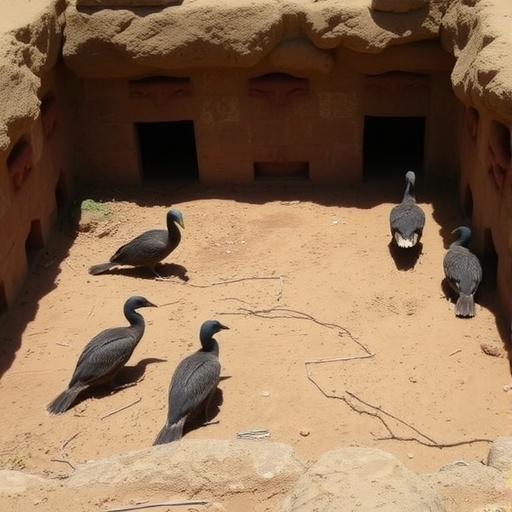
On the coast of Kenya, about fifteen kilometers north of Mombasa, lies the abandoned stone town of Mtwapa, once a thriving Swahili settlement of perhaps five thousand people at the mouth of Mtwapa Creek. New research published in African Archaeological Review presents the most detailed zooarchaeological investigation yet of feasting practices at the site’s Friday Congregation Mosque Complex, revealing how ritual meals sustained community identity across the turbulent fifteenth to seventeenth centuries—a period when Swahili stone towns were emptied and the first European colonizers reshaped the Indian Ocean world. The study, led by Max Price of Durham University together with Ellie Ager, Kris Kovarovic, Sibel Kusimba, and Chapurukha M. Kusimba, analyzed thousands of animal bones recovered from tombs and an abandoned guardhouse at the mosque complex, offering a rare window into the food of commemorative feasts during one of the most consequential transitions in East African history.
Feasting, defined by the researchers as ritualized collective consumption—the sharing of food among two or more people in an event marked as special—was far more than culinary indulgence in Swahili society. During the medieval Swahili period, roughly 800 to 1500 CE, stone towns emerged as political, economic, and ritual centers controlled by elites known as waungwana, who grew wealthy from regional and international trade and whose conversion to Islam connected them to transcontinental networks of believers. Food was central to their power. Historical accounts, including those of the fourteenth-century traveler Ibn Battuta, describe elaborate feasts used to entertain visitors and build influence. Nineteenth-century records describe families bankrupting themselves to supply enough rice, cattle, and goats for funerals, weddings, and circumcisions. Islam itself provided both new motives for feasting—weddings, funerals, and other life events framed within religious ideals—and a powerful interpretive framework, since feasts could be construed as acts of almsgiving fulfilling the obligation of zakat.
Mtwapa itself was an ideal setting for such displays. The walled town covered more than eight hectares and contained sixty-four stone houses, two cemeteries, and five mosques still standing when investigations began in 1986. Without a central administrative court like those at Gedi or Kilwa, the Friday Mosque Complex likely served religious, economic, and political functions simultaneously. Its layout reflected the hierarchical character of Swahili urbanism: an Eastern Gate led directly to the mosque and elite tombs, while a Western Gate gave access to the commoners’ cemetery and residential quarters. The complex featured extensive water infrastructure, including a large well connected by conduit to a cistern, or birka, supporting ritual purification for daily prayers and major communal events alike. Oral histories collected in 1991 from Mama Biimu, then the oldest resident and part-owner of Mtwapa, confirmed that the cemetery was reserved exclusively for the town’s elite—the Waungwana Wa Mtwapa, or Watwafi—while commoners were buried outside the walls.
The faunal remains analyzed in the study came from four excavation seasons spanning 1996 to 2011. The most important deposit was Locality 4, an eight-by-five-meter midden lying just beyond the mosque’s eastern gate. This midden accumulated inside a small stone guardhouse that had fallen into disuse and became a convenient dump site. Three radiocarbon dates place the deposits squarely in the fifteenth to seventeenth centuries. Several lines of evidence convinced the researchers that the material represented repeated feasting rather than ordinary refuse. Ethnohistorical accounts document ritual meal preparation and communal consumption to honor departed kin among Kenyan Swahili and Mijikenda communities. The sheer volume of faunal and ceramic remains was striking, and crucially, the ceramics consisted of local single-use coarse ware pottery lacking the smoke-stain patina typical of extended use—consistent with vessels made for a single event. A large proportion of the pottery derived from cooking and serving vessels, underscoring the culinary emphasis of the activities.
Twelve elite tombs east of the mosque were also excavated, and their stratified deposits contained abundant animal bones. The researchers considered and rejected the possibility that the fauna was merely fill redeposited during grave digging: the density of remains, particularly in Locality 4N, and the relatively limited fragmentation argued against it. Instead, the evidence points to offerings and feasting debris deposited over many generations. Excavation of Locality 4N, the only tomb with a large enough assemblage for temporal analysis, revealed distinct episodes of activity, and human remains of both sexes and all ages confirmed repeated family use of the tombs for interment. Given the exclusive nature of the elite cemetery, these appear to have been family-sponsored commemorations for the waungwana dead rather than public feasts open to all.
The methods were rigorous. Faunal remains were recovered using one-by-one-millimeter sieves, washed, and sorted at a field house before export under permit from the National Museums of Kenya. Identifications were made against reference collections at Harvard’s Museum of Comparative Zoology, Durham University’s Zooarchaeology Laboratory, and the Muséum National d’Histoire Naturelle in Paris. Fish were identified to family level using only four cranial elements—the premaxilla, maxilla, dentary, and angular-articular—while bovids were assigned to size classes following Brain’s standard framework, with sheep and goats differentiated using the criteria of Zeder and Lapham. The team also applied biometric techniques, including the log-size index, to cattle and chicken remains, preserving measurements following von den Driesch’s protocols.
The results paint a picture of feasting that was, taxonomically at least, surprisingly ordinary. Across all contexts, the main animals consumed were chickens, caprines—mostly goats, which outnumbered sheep twelve to three—and emperor fish of the family Lethrinidae. Cattle, often considered a high-status animal and a hallmark of feasting deposits elsewhere, were uncommon; caprines outnumbered cattle roughly six to one by specimen count, a ratio similar to that found in domestic refuse at the fourteenth-to-sixteenth-century site of Songo Mnara in Tanzania. Parrotfish and jackfish were also common among the fish, and nearly all identified species were reef-dwellers catchable with simple handlines rather than requiring the costly boats and tackle that elites had monopolized during the height of Swahili power. Sharks, dugongs, and sea turtles—markers of capital-intensive open-sea fishing—were present but rare, reaching far lower proportions than at Songo Mnara, where sharks constituted eleven percent of identified specimens.
Stratigraphic analysis of Locality 4N revealed a telling trend over time: the relative abundance of fish increased, and the ratio of caprine-sized to cattle-sized bovids grew as well. In the researchers’ memorable phrasing, Mtwapa’s feasts became “goatier and fishier” over the fifteenth to seventeenth centuries. This trajectory tracks the contraction of elite economic power as Portuguese incursions disrupted Indian Ocean trade networks and stone towns depopulated. Unable to fund spectacular offshore fishing ventures or procure large numbers of prestige cattle, the people who continued to gather at the mosque complex increasingly relied on humble, locally available foods. What marked these meals as special, the authors suggest, was not exotic ingredients but rather quantity, serving ware, preparation, spices, and—above all—the sacred context in which they were eaten, at the tombs of ancestors whose favorite foods in life may have been deliberately offered.
Perhaps the most startling findings were the animals forbidden under Islamic law. The assemblage contained remains of suids—including a nearly complete skeleton of a young piglet from Tomb 4K, bearing a cut mark on the scapula alongside carnivore puncture marks likely from a domestic cat—plus sea turtle bones, one plastron fragment with cut marks, and a small number of dugong specimens. Pork’s prohibition is unequivocal in Islamic scripture, making its presence in a mosque-associated context particularly striking. Yet the researchers caution against simple interpretations. Similar finds have been reported at Shanga, Unguja Ukuu, and even within a mosque at Songo Mnara. Religious identity, they argue, is constantly negotiated, and ethnographic work in the Lamu archipelago shows that Swahili communities there eat dugongs and sea turtles while maintaining other taboos. The remains might also represent non-Muslim participants, or in some cases intrusive animals—the giant pouched rat and domestic cat mandibles found together in one tomb probably belong to scavengers who died where they lived.
The study also yielded quieter surprises. A cluster of ring cowrie shells, Monetaria annulus, appeared in the earliest levels of Tomb 4N and nowhere else, likely left as offerings during commemorative visits—cowries having served as commodity money and ritual objects along the East African coast for centuries. Hundreds of pufferfish dermal spines, found in clusters suggesting only a few individuals, may likewise represent offerings rather than meals. The chicken bones proved biometrically fascinating: their size spread exceeded that of both ancient and modern Ethiopian comparative samples and could not be explained by sexual dimorphism alone, with tarsometatarsal spurs indicating nine males and twenty-three females. The researchers propose that at least two distinct populations, or breeds, of chickens were kept at the site—a possibility never before explored in Swahili zooarchaeology that they hope future ancient DNA or proteomic work will resolve.
Taken together, the Mtwapa assemblages tell a story of continuity and adaptation. Even as their town emptied and their economic reach contracted, the Watwafi returned to the Friday Mosque Complex to bury their dead, venerate ancestors, and share communal meals. The foods they ate became humbler over time, but the ritual itself endured, transforming an abandoned urban landscape into a living site of memory. Nearly forty years after Fleisher observed that the study of feasting had been surprisingly neglected for the ancient Swahili, this analysis demonstrates that the bones discarded around a mosque’s tombs can illuminate not only what people ate, but how communities preserved identity, negotiated faith, and honored their ancestors through two centuries of upheaval.
Cite Scienmag News
Courtney Benton. (September 4, 2026). Zooarchaeological Evidence of Feasting at Kenya’s Late Swahili Friday Mosque. Scienmag. https://scienmag.com/zooarchaeological-evidence-of-feasting-at-kenyas-late-swahili-friday-mosque/
Courtney Benton. "Zooarchaeological Evidence of Feasting at Kenya’s Late Swahili Friday Mosque." Scienmag, 4 September 2026, https://scienmag.com/zooarchaeological-evidence-of-feasting-at-kenyas-late-swahili-friday-mosque/. Accessed 4 September 2026.
Courtney Benton. "Zooarchaeological Evidence of Feasting at Kenya’s Late Swahili Friday Mosque." Scienmag. September 4, 2026. https://scienmag.com/zooarchaeological-evidence-of-feasting-at-kenyas-late-swahili-friday-mosque/


