


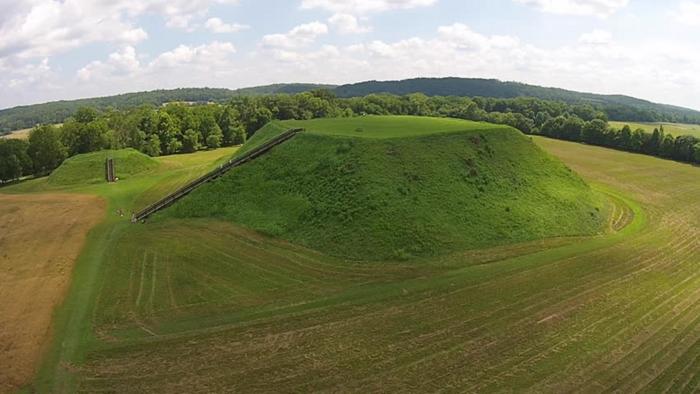
In a discovery that could reshape the history of ancient foodways in North America, researchers report that cacao may have been consumed at the Etowah site, a major Mississippian center in what is now Georgia, during the 12th century. The finding points to the possibility that people living hundreds of years ago in the southeastern United States had access to cacao, a plant native to tropical regions of the Americas and more commonly associated with ancient civilizations farther south. The study, titled “Cacao in the Mississippian World: Archaeogenomic evidence for T. cacao consumption at the Etowah Site, Georgia,” presents archaeogenomic evidence suggesting that Theobroma cacao was part of activity at Etowah, potentially in connection with communal feasting and elite gatherings.
Etowah was not an ordinary settlement. Located near present-day Cartersville, Georgia, the site included large earthen mounds, plazas, residences, ceremonial spaces and evidence of a socially complex society. It formed part of the wider Mississippian cultural world, whose communities flourished across much of eastern North America between roughly the ninth and sixteenth centuries. Mississippian societies cultivated maize, organized large public works and participated in extensive exchange networks. Their centers connected people across long distances through the movement of materials, foods, ornaments and ritual objects. Evidence for cacao at Etowah would therefore be significant not simply because of the plant itself, but because it could reveal a previously underappreciated dimension of interaction between North American societies and regions much farther south.
Cacao is the source of chocolate, but ancient cacao consumption was not identical to modern chocolate production. The seeds of Theobroma cacao are enclosed in pods and surrounded by a sweet, pulpy material. In ancient societies, cacao could be processed into beverages, fermented products or other preparations, often in ceremonial and social settings. The plant naturally grows in warm, humid environments, especially in parts of Central and South America. It does not thrive in the climate of Georgia, meaning that cacao identified at Etowah would almost certainly have arrived through exchange, travel or another form of long-distance contact. That possibility gives the finding its extraordinary reach: a tropical crop may have crossed hundreds or even thousands of miles before being used in a Mississippian city.
The new research relies on archaeogenomic evidence, a field that applies genetic analysis to materials recovered from archaeological contexts. Unlike conventional artifact studies, which may identify a vessel by its shape or decoration, archaeogenomics can sometimes detect biological traces left behind by ancient plants and animals. Such traces may survive in residues, sediments, food deposits or microscopic remnants associated with vessels and activity areas. Researchers compare recovered genetic fragments with reference sequences from known species, looking for patterns that can identify the biological source. In the case of cacao, the crucial question is whether molecular evidence associated with Etowah can be distinguished from unrelated plant material and connected specifically to T. cacao.
The study’s conclusion is carefully framed: cacao may have been consumed at Etowah, rather than the research claiming that every detail of its use is known. Archaeological evidence rarely preserves an ancient event in a complete and undisturbed form. Genetic material can be damaged by time, heat, moisture and microbial activity, while excavated deposits may contain mixtures accumulated over many years. Scientists must therefore evaluate the strength of a signal, the possibility of contamination and the archaeological context in which it appears. A credible identification depends on the agreement between laboratory results and the physical evidence surrounding them. When molecular findings are associated with a particular site and period, they can provide a powerful new line of evidence, but they still require cautious interpretation.
If cacao was present at Etowah in the 12th century, it may have been reserved for special occasions rather than consumed as an everyday staple. The scale and architecture of Etowah indicate that gatherings could bring together large numbers of people, creating opportunities for leaders to display wealth, organize ceremonies and reinforce social relationships. Rare foods and imported substances would have carried meaning beyond their nutritional value. Serving an unusual beverage or food could communicate hospitality, status and access to distant exchange networks. Cacao’s rarity in the southeastern United States would have made it particularly suitable for feasts, where the act of sharing an extraordinary substance could help establish alliances and express the authority of those who controlled its distribution.
The possibility also challenges older assumptions about the geography of ancient American interaction. Archaeological narratives have often emphasized regional exchange within North America, documenting the movement of copper, marine shell, stone, ceramics and other materials. Evidence for cacao would add a biological commodity with a very different ecological origin to that network. It would suggest that Mississippian communities were not isolated from the broader Indigenous world of the Americas, even when direct evidence of long-distance connections is difficult to identify. The movement of cacao does not necessarily prove continuous contact with Central or South American states, nor does it reveal who transported it or how the exchange was organized. It does, however, open a new possibility for investigating the scale, direction and social meaning of ancient connections.
The finding is especially important because food histories are often reconstructed from durable objects, while what people ate and drank can disappear almost completely. Pottery vessels, grinding stones and storage structures may survive, but the plants once processed inside them are frequently reduced to microscopic traces or invisible chemical residues. Genetic techniques can help recover part of that lost record. At the same time, the Etowah study illustrates why scientific interpretation works best when molecular data are integrated with archaeology, environmental history and Indigenous knowledge. Each discipline contributes a different perspective: genetics can identify biological material, archaeology can establish context, and cultural interpretation can help explain why a food may have mattered to the people who used it.
The research does not turn Etowah into a simple endpoint in a story of cacao traveling northward. Instead, it raises a series of questions that future investigations may be able to answer. Was cacao associated with particular vessels, buildings or burial contexts? Did its use occur only during a limited period, or was it part of a longer tradition? Was it consumed by political leaders, religious specialists or broader communities? Could similar molecular traces be detected at other Mississippian sites? Researchers may also examine whether the cacao evidence represents seeds, processed residues or another part of the plant, and whether additional genetic signatures can clarify its geographic origin. For now, the study offers a striking glimpse of a possible 12th-century encounter with a tropical crop at one of North America’s most important ancient urban centers, suggesting that the history of chocolate is considerably more expansive than familiar accounts often imply.
Cite Scienmag News
Courtney Benton. (August 28, 2026). Mississippians May Have Consumed Cacao at 12th-Century Feasts in Georgia. Scienmag. https://scienmag.com/mississippians-may-have-consumed-cacao-at-12th-century-feasts-in-georgia/
Courtney Benton. "Mississippians May Have Consumed Cacao at 12th-Century Feasts in Georgia." Scienmag, 28 August 2026, https://scienmag.com/mississippians-may-have-consumed-cacao-at-12th-century-feasts-in-georgia/. Accessed 3 September 2026.
Courtney Benton. "Mississippians May Have Consumed Cacao at 12th-Century Feasts in Georgia." Scienmag. August 28, 2026. https://scienmag.com/mississippians-may-have-consumed-cacao-at-12th-century-feasts-in-georgia/


