


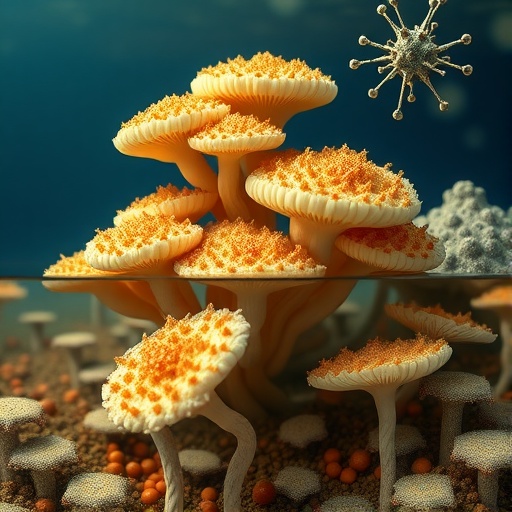
Marine fungi may be preserving a hidden record of ancient viral evolution, according to a study by S.K. Whitner, A.S. Amend and A.I. Culley published in npj Viruses. The research describes remnants of giant endogenous viral elements embedded in fungal genomes and reports evidence that these viral sequences and their fungal hosts have diversified together over evolutionary time. The findings expand the known role of fungi in viral history and suggest that marine fungal genomes could contain molecular traces of infections that occurred millions of years ago.
Endogenous viral elements are genetic sequences derived from viruses that have become incorporated into the chromosomes of their hosts. In some cases, these insertions are inherited across generations after a virus infects reproductive cells or cells that later contribute to reproduction. Most endogenous viral elements are incomplete and no longer capable of producing infectious particles. They may consist of damaged copies of viral genes, fragmented genomes or isolated regions that have been altered by mutation. Even when they are inactive, however, such sequences can remain valuable records of past interactions between viruses and cellular organisms.
The study focuses on what it describes as remnants of “giant” endogenous viral elements in marine fungi. Giant viruses are distinguished from many conventional viruses by their exceptionally large genomes, sometimes containing hundreds or even thousands of genes. Their genetic repertoires can include components associated with DNA replication, transcription and repair—functions traditionally considered characteristic of cellular organisms rather than viruses. Because giant viruses can carry unusual and rapidly evolving genes, identifying their remnants in host genomes is technically challenging. Viral sequences may be heavily degraded, rearranged or obscured by similarities to ordinary cellular genes.
Marine fungi provide an especially informative setting for investigating these ancient relationships. They inhabit seawater, sediments, decaying organic matter and organisms ranging from algae to animals, placing them in close contact with diverse viral communities. Fungal cells also possess complex genomes capable of retaining foreign DNA over long evolutionary periods. In these environments, viruses may repeatedly encounter the same fungal lineages, creating opportunities for viral sequences to enter host chromosomes and remain there. The study’s findings indicate that these inherited sequences are not merely isolated genomic curiosities but may reflect a prolonged history of interaction between marine fungi and large viruses.
To detect endogenous viral remnants, researchers generally compare genomic sequences against databases of known viruses and cellular organisms, while also examining the arrangement and composition of neighboring genes. A convincing viral signature may include clusters of genes with related functions, unusual combinations of genetic modules or sequence patterns that are more closely related to viral proteins than to fungal proteins. Because giant viruses share genes with their hosts and with other cellular organisms, researchers must distinguish genuine viral ancestry from ordinary fungal genes that happen to resemble viral sequences. Evolutionary reconstruction, genome organization and the presence of viral hallmark genes can all contribute to that assessment.
The reported co-diversification is particularly significant. In evolutionary biology, co-diversification occurs when the histories of two groups become linked, with changes in one lineage broadly corresponding to changes in another. If particular viral remnants are found in related fungal species and display patterns consistent with the branching of those fungi, the sequences may have been inherited from ancestral infections rather than acquired independently many times. This pattern can provide clues about the age and persistence of viral material, although reconstructing ancient events remains difficult because genomes are continually reshaped by mutation, recombination, gene loss and horizontal transfer.
The results also challenge the assumption that endogenous viral elements are primarily associated with animals and plants. Some of the best-known examples in biology include retroviral sequences embedded in vertebrate genomes, where ancient viral insertions have occasionally been repurposed for host functions. Fungi, by contrast, have been less extensively examined as repositories of viral history, particularly in marine ecosystems. The discovery of giant viral remnants in these organisms suggests that the fungal virome may be considerably more complex than measurements based only on currently infectious viruses would indicate.
For virologists, these sequences offer a form of evolutionary archive. Modern environmental surveys can reveal which viruses exist in seawater today, but they provide only a snapshot of an ecosystem that has changed over geological time. Endogenous elements add a historical dimension by preserving molecular traces of earlier infections within host DNA. They may help researchers estimate how long certain viral gene families have existed, identify ancient connections among apparently unrelated viruses and understand how viral genes have moved between viruses and cellular organisms. At the same time, the presence of a viral remnant does not necessarily mean that a fungus currently produces infectious virus; most such elements are likely inactive, incomplete or regulated by host defenses.
The study may also influence how scientists search for new viruses. Conventional virus discovery often relies on particles collected from environmental samples or on sequence matches to known viral proteins. Highly degraded endogenous elements can escape both approaches, especially when their genes have diverged beyond easy recognition. Marine fungal genomes could therefore become an important source of previously overlooked viral diversity. Further work will be needed to determine whether any of the identified remnants retain functional genes, whether they can affect fungal biology and how widespread similar elements are across marine and terrestrial fungi. Together, the findings position fungi as long-term participants in the evolution of giant viruses and reinforce the view that viral history is written not only in free-living particles, but also in the genomes of their hosts.
Cite Scienmag News
Roger Howard. (August 11, 2026). Marine fungi harbor giant endogenous viral remnants that co-diversified with their hosts. Scienmag. https://scienmag.com/marine-fungi-harbor-giant-endogenous-viral-remnants-that-co-diversified-with-their-hosts/
Roger Howard. "Marine fungi harbor giant endogenous viral remnants that co-diversified with their hosts." Scienmag, 11 August 2026, https://scienmag.com/marine-fungi-harbor-giant-endogenous-viral-remnants-that-co-diversified-with-their-hosts/. Accessed 4 September 2026.
Roger Howard. "Marine fungi harbor giant endogenous viral remnants that co-diversified with their hosts." Scienmag. August 11, 2026. https://scienmag.com/marine-fungi-harbor-giant-endogenous-viral-remnants-that-co-diversified-with-their-hosts/


