


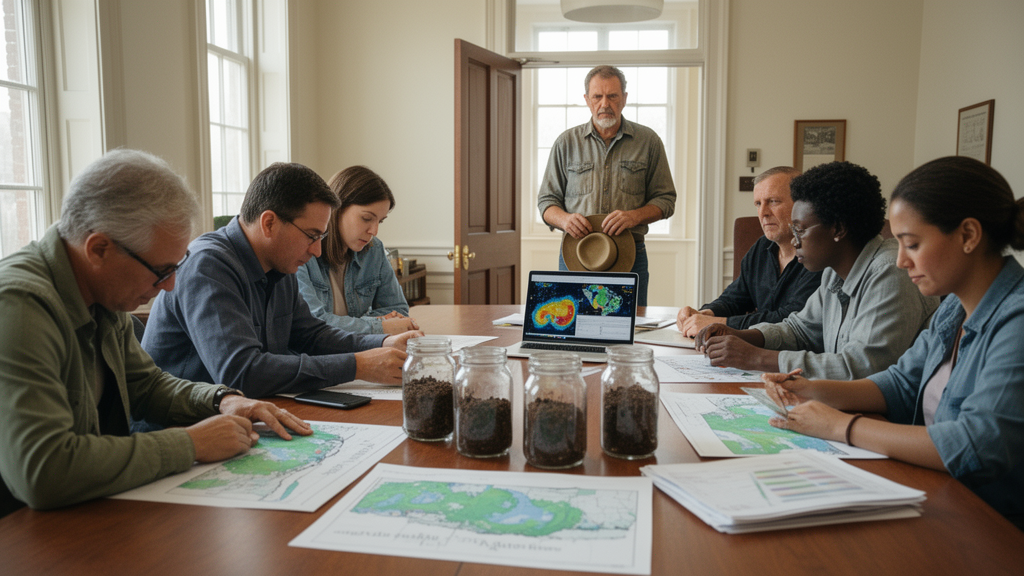
Climate adaptation around the world is largely failing. Recent progress reviews have found that most existing efforts to adapt to climate hazards do not sufficiently address risk, and that contemporary adaptation practice still favors incremental, top-down, technology-centered infrastructure projects that benefit powerful interests and leave the status quo untouched. In response, a growing body of scholarship argues that adaptation must become transformative: radically reshaping human-environment relations and the deeply embedded social, economic, and relational paradigms that determine who is vulnerable to climate risks in the first place. A new essay in PLOS Climate by Katherine Cann of SUNY Geneseo examines why the research methods championed as the pathway to that transformation—so-called engaged research—have so far fallen short of their own great expectations.
Engaged research, as defined by the National Science Foundation’s Advisory Committee for Environmental Research and Education, is research conducted through meaningful collaboration between scientists and non-scientist actors. It serves as an umbrella term for methodologies built on deeply collaborative knowledge production across disciplines, sectors, and domains. In adaptation science, the most common approach is knowledge co-production, an iterative model of engagement between researchers and invested stakeholders designed to make research outcomes more usable. The intellectual roots run deep: action research and participatory action research trace back to Kurt Lewin in the 1940s, Orlando Fals Borda and Anis Rahman in the 1960s, and Paulo Freire in the 1970s, all aiming to eliminate hierarchical divisions between researchers and research subjects through cycles of action and reflection.
The essay also situates co-production within a broader intellectual history. Normative co-production, common in sustainability studies, emerged in the 1970s through the work of Elinor and Vincent Ostrom. Descriptive co-production, linked to scholars of science and technology studies such as Sheila Jasanoff and Bruno Latour in the 1990s and early 2000s, highlights how social and political contexts shape scientific inquiry and are shaped by it in return. In the 1990s, post-normal science and Mode 2 science characterized knowledge production that embeds science within society, broadens participation, spans disciplinary boundaries, and introduces reflexivity into research. Together, these traditions are well suited to climate change, a wicked problem marked by high uncertainty and fraught decision stakes, because they can incorporate lived experience and governance context into scientific knowledge.
The turn toward engagement is accelerating. Attention to public participation in adaptation can be traced to Principle 10 of the 1992 Rio Declaration, which called explicitly for citizen engagement in climate actions, and a recent review found that scholarly attention to participation in adaptation has grown almost exponentially since 2000. Funders increasingly require deeper community engagement, and researchers have deployed creative methods including citizen science, participatory mapping and GIS, arts-based research, gaming in collaborative data analysis, community advisory boards, storytelling, participatory video, walking interviews, and photovoice to forefront local experiences of climate risk.
Yet scholars claim engaged research has been limited in scope, scale, and implementation, and has largely failed to achieve its potential for transforming science. Drawing on an informal three-year review of the most cited literature in adaptation, climate services, sustainability science, and environmental governance, Cann identifies four themes that capture the central tensions. The first is power and politics: although engaged research can shift power to actors historically excluded from science, power imbalances between institutional researchers and other stakeholders remain a persistent problem, and failure to address them can reproduce familiar harms such as knowledge extraction and data colonialism.
Moreover, because adaptation research is deeply political, efforts led by elite institutions often depoliticize the process, maintain the centrality of science-based frameworks, and force consensus, further marginalizing non-elite views. That depoliticization can produce maladaptive insights by avoiding critical engagement with the contexts in which ideas of climate risk and adaptation success are formed. Deeply reflexive engagement, by contrast, can encourage debate, allow contestation, or even invite resistance—outcomes the essay argues can drive more transformative adaptation.
The second and third themes concern knowledge and justice. Engaged research offers Indigenous and local knowledge systems the potential to drive adaptation science, yielding more comprehensive understandings of risk and more culturally appropriate outcomes, but incompatibilities with dominant scientific paradigms can leave that knowledge undervalued and exclude Indigenous communities from self-determination; equitable praxis may require scientists to take a supporting role under Indigenous and local leadership. On equity, the evidence is sobering: despite decades of pushing for participation, many avenues remain tokenistic, and there is limited evidence that engaged research meaningfully advances climate justice. Researchers call this the participation paradox—participatory methods are never neutral and may even limit dissent. A drought response planning process in Santiago, Chile, for example, characterized itself as participatory but was found to privilege elite views over marginalized communities after those communities pushed for national water reforms deemed too political by project coordinators.
The fourth theme is governance. Challenges such as stakeholder fatigue, uneven power dynamics, time, and cost can be mitigated through careful project design, and recommended strategies include granting equal control over funding, co-designing research questions, and collaborative dissemination. But even best practices can fail. A small grant program set up by university researchers in the Northeast United States to fund locally led adaptation projects encountered institutional difficulties expediting payments to partners, insufficient time to co-develop projects, and inadequate funding to meet data needs, despite a framework designed to build transparent, trusting relationships. There are success stories: in Cape Town, South Africa, a project combining storytelling with quantitative data collection enabled grassroots community groups to become trusted climate knowledge brokers invited by city officials to guide public policy.
From these themes, the essay proposes three areas of growth. First, researchers should interrogate the normative aims of their projects rather than treating engagement as a panacea, examining how seemingly stable understandings of climate risk and justice structure research design—a lesson drawn from descriptive co-production and recent work showing how boilerplate equity language in adaptation plans can limit targeted, multidimensional equity. Second, researchers should enable and evaluate social learning. Studies repeatedly find the most useful outcomes of engaged projects to be intangible ones: new interpersonal connections, network building, and fresh understandings of research problems. One grant program in the Great Lakes region found its most successful project was one where knowledge outputs were secondary to network development, a finding that forced the funder to rethink how it built impact. Reviews suggest that sustained, iterative, agency-enhancing processes fostering mutual learning, deliberation, contestation, and solidarity best enhance the political capabilities of marginalized populations.
Third, the essay argues that engaged research should be reframed as a governance process, not merely a knowledge generation process, with concrete examination of the roles of funders and convenors. Most recommendations address the on ramp of a project—building trust and transparent goals—while off ramps such as monitoring and evaluation are neglected. Questions about maintaining relationships after funding dissolves are virtually unaddressed, and it may be unethical to expect uncompensated non-institutional partners to keep dedicating time. Existing evaluation methods, limited to measurable metrics, consensus reliance, and short timeframes, may fail to capture the second and third order effects of transformative change. Funders also have a large role: small nonprofit partners are often required to front the costs of their engagement, which is impossible for some organizations, and with key U.S. climate research funding streams currently disappearing, the essay concludes that innovative funding mechanisms and expanded networks of knowledge production are urgently needed to build collective power for a transformative adaptation agenda.
Subject of Research: The role of engaged and participatory research methods in transformative climate adaptation science
Article Title: Engaged research and its implications for transformation in climate adaptation sciences
Article References: Cann, K. (2026). Engaged research and its implications for transformation in climate adaptation sciences. PLOS Climate, 5(10), e0001093. https://doi.org/10.1371/journal.pclm.0001093
Image Credits: AI Generated
DOI: 10.1371/journal.pclm.0001093
Keywords: climate adaptation, engaged research, co-production, participatory action research, climate services, Indigenous knowledge, climate justice, social learning, research governance, science and technology studies, equity, PLOS Climate
Cite Scienmag News
Gavin Prescott. (October 27, 2026). Why Collaborative Climate Research Keeps Falling Short of Transforming Adaptation. Scienmag. https://scienmag.com/why-collaborative-climate-research-keeps-falling-short-of-transforming-adaptation/
Gavin Prescott. "Why Collaborative Climate Research Keeps Falling Short of Transforming Adaptation." Scienmag, 27 October 2026, https://scienmag.com/why-collaborative-climate-research-keeps-falling-short-of-transforming-adaptation/. Accessed 27 October 2026.
Gavin Prescott. "Why Collaborative Climate Research Keeps Falling Short of Transforming Adaptation." Scienmag. October 27, 2026. https://scienmag.com/why-collaborative-climate-research-keeps-falling-short-of-transforming-adaptation/


