


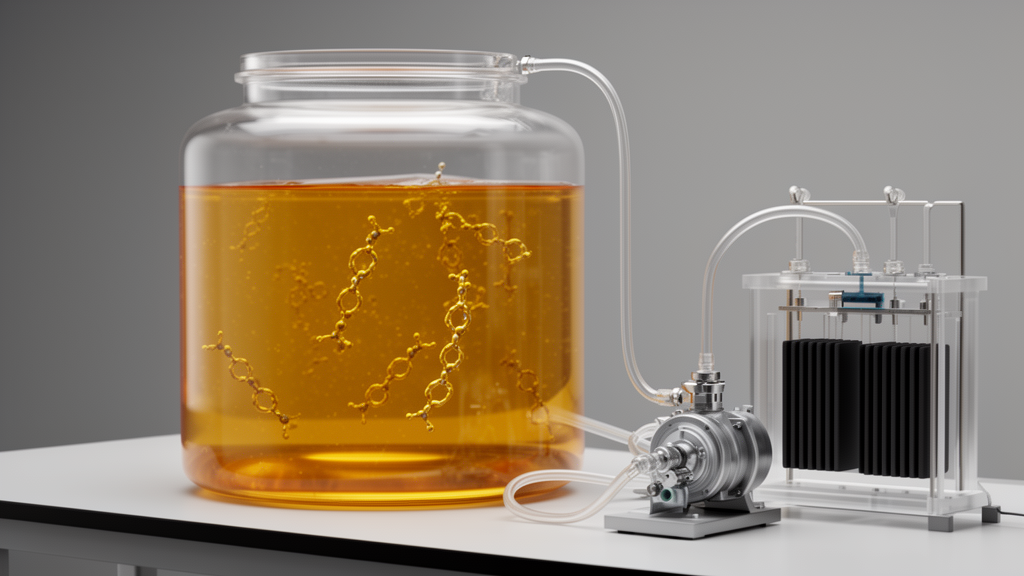
Aqueous redox flow batteries are widely regarded as promising candidates for large-scale grid energy storage, but researchers have struggled to find anolyte materials that combine high capacity, environmental compatibility, recyclability, low cost and long-term stability in a single system. A study published in Nature Sustainability reports a recyclable oligo(disulfide)-based anolyte that the authors say addresses this long-standing trade-off.
The new anolyte relies on robust sulfur–sulfur bonds as its redox-active sites. According to the paper, the material is synthesized by ring-opening polymerization of potassium-form endogenous thioctic acid, a route the authors describe as scalable for producing high-concentration redox-active species.
When paired with a sulfonated cobalt phthalocyanine catalyst, the oligo(disulfide) anolyte delivered a capacity density of 128 ampere-hours per litre with a 95.5% material utilization rate at a current density of 50 milliamperes per square centimetre, the researchers report.
Long-term stability was tested using a carbon-coated sulfonated poly(ether ether ketone) membrane with a sulfur–sulfur bond concentration of 0.25 M. In that configuration, the battery retained 98.1% of its capacity over 2,200 cycles while maintaining an energy efficiency of approximately 70% at 100 milliamperes per square centimetre.
The team also validated the scalability and closed-loop recyclability of the chemistry in a 63 watt-hour stack, demonstrating that the anolyte can be recovered and reused rather than discarded at end of life.
The closed-loop aspect is central to the design. Because the anolyte is built from an endogenous thioctic acid precursor through a polymerization route, the authors position oligo(disulfide)s as a circular redox platform in which the active material can be returned to its starting state after use.
The findings, the researchers write, establish oligo(disulfide)s as a robust and circular redox platform, providing a pathway toward more resource-efficient and sustainable grid-scale energy storage. The reported performance figures come from laboratory cell and small-stack testing described in the paper, and the abstract notes the work as a demonstration of scalability rather than a commercial deployment.
If the chemistry can be reproduced at larger scales, the combination of high capacity density, stable cycling and recyclability could help address one of the key barriers to wider implementation of aqueous flow batteries, which until now have lacked anolyte materials able to satisfy all of these competing requirements simultaneously.
Subject of Research: A recyclable oligo(disulfide) anolyte for aqueous redox flow batteries
Article Title: A circular oligo(disulfide) anolyte enables practical aqueous redox flow batteries
Article References: Chen, Q., Ou, H., Zhao, X., Jin, Y., Guo, W., & Fu, Y. (2026). A circular oligo(disulfide) anolyte enables practical aqueous redox flow batteries. Nature Sustainability. https://doi.org/10.1038/s41893-026-01970-0
Image Credits: AI Generated
DOI: 10.1038/s41893-026-01970-0
Keywords: aqueous redox flow batteries, oligo(disulfide), anolyte, grid energy storage, recyclability, closed-loop recycling, sulfur-sulfur bonds, cobalt phthalocyanine catalyst, energy efficiency, battery membranes, circular, oligo
Cite Scienmag News
Bethany Barker. (October 27, 2026). Recyclable oligo(disulfide) anolyte pushes aqueous flow batteries toward grid scale. Scienmag. https://scienmag.com/recyclable-oligodisulfide-anolyte-pushes-aqueous-flow-batteries-toward-grid-scale/
Bethany Barker. "Recyclable oligo(disulfide) anolyte pushes aqueous flow batteries toward grid scale." Scienmag, 27 October 2026, https://scienmag.com/recyclable-oligodisulfide-anolyte-pushes-aqueous-flow-batteries-toward-grid-scale/. Accessed 27 October 2026.
Bethany Barker. "Recyclable oligo(disulfide) anolyte pushes aqueous flow batteries toward grid scale." Scienmag. October 27, 2026. https://scienmag.com/recyclable-oligodisulfide-anolyte-pushes-aqueous-flow-batteries-toward-grid-scale/


