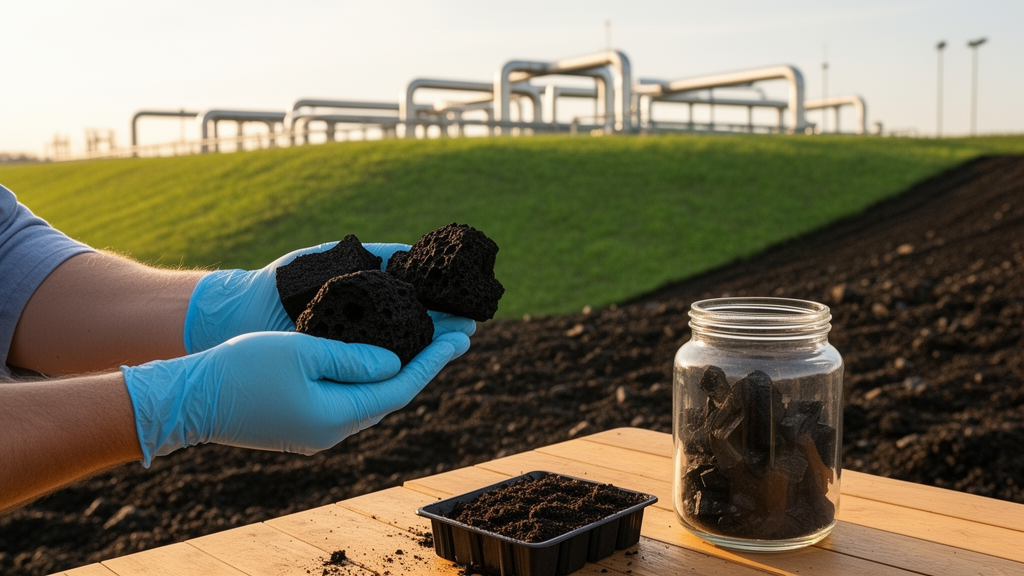
Landfills are one of the largest human-made sources of methane, a greenhouse gas that traps roughly 28 times more heat than carbon dioxide over the timescales used in international accounting. According to figures cited in a new laboratory study, landfill sites contribute approximately 18 to 20 percent of global methane emissions, and even where gas collection systems are installed, they typically capture only 50 to 60 percent of the gas generated, letting a substantial fraction escape into the atmosphere. That gap has pushed researchers to look for cheaper, simpler cover materials that can slow these fugitive emissions without demanding heavy engineering.
A team from Brazil has now reported detailed laboratory results on a candidate material drawn from an abundant tropical waste stream: coconut husk. In a study published in Environmental Advances, researchers led by Thiago de Sá Sena pyrolyzed dried coconut husks at 500 degrees Celsius, heating at 5 degrees Celsius per minute with a 60-minute residence time, to produce a coconut husk biochar, or CHB. The process yielded 33.3 percent biochar by mass, a figure the authors describe as moderate and consistent with values reported for other lignocellulosic residues under slow pyrolysis at similar temperatures. The resulting biochar had a low moisture content of 4.1 percent, an ash content of 6.12 percent, and a high volatile matter fraction of 71.71 percent, which the authors interpret as a sign of incomplete devolatilization typical of biochars made at low to intermediate temperatures.
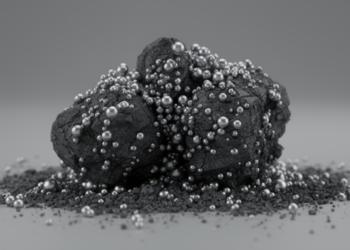
The physical texture of the biochar turned out to be central to how it behaves. Nitrogen adsorption analysis gave a relatively low specific surface area of 17 square meters per gram and a very small total pore volume of 0.005 cubic centimeters per gram, suggesting a poorly developed porous structure at the micropore and mesopore scales. But when the team probed the material with carbon dioxide adsorption at 273 Kelvin, a technique that reaches pores nitrogen cannot easily enter at cryogenic temperatures, it resolved a significant population of ultramicropores with a modal width of about 0.57 nanometers. Scanning electron microscopy, meanwhile, showed a highly porous, honeycomb-like architecture of interconnected voids formed during thermal decomposition, a stark contrast to the granular, relatively smooth morphology of the unamended landfill cover soil used in the experiments.
That soil came from the designated cover material deposit at the West of Caucaia Landfill in Caucaia, Brazil, a facility that receives roughly 4,500 tons of solid waste daily. Mineralogical analysis showed the soil is dominated by quartz and kaolinite, with an organic content of 3.44 percent, and it classifies as a clayey sand under the Unified Soil Classification System. The researchers mixed the biochar into this soil at rates of 2.5, 5.0, 7.5, and 10.0 percent by dry weight, then ran the mixtures through a battery of standardized geotechnical tests, each performed in duplicate, covering particle size, plasticity, compaction, consolidation, and direct shear strength.
The geotechnical screening narrowed the field quickly. All mixtures met the fine-content requirements of the United States Environmental Protection Agency and the Brazilian environmental agency CETESB for cover materials, though none reached the stricter 50 percent minimum set by the Ontario Ministry of Agriculture, Food and Rural Affairs. Adding biochar lowered particle specific gravity and bulk density, raised the optimum moisture content from 13.48 percent in the raw soil to 19.19 percent at 7.5 percent biochar, and reduced maximum dry density. Liquid limit and plasticity index generally rose with biochar content, but at 7.5 percent the soil shifted to a silty sand classification and at 10 percent it became non-plastic, failing the adopted criteria. On that basis, the team selected 5.0 percent as the highest amendment rate that preserved the clayey sand classification and satisfied the plasticity requirements, and carried that mixture forward into consolidation, shear, and adsorption testing.
The mechanical results favored moderate doses. In consolidation tests, the compression index fell from 0.17 in the unamended soil to 0.09 and 0.10 at 2.5 and 5.0 percent biochar, indicating reduced compressibility, while the coefficient of compressibility dropped from 8.61 times ten to the minus five per kilopascal to 4.46 and 4.84 times ten to the minus five. At 7.5 percent, however, those parameters rose again, which the authors attribute to excessive biochar disrupting the soil matrix. Direct shear tests told a similar story: cohesion climbed steadily from 26.68 kilopascals in the raw soil to 44.28 kilopascals at 7.5 percent biochar, a 65.99 percent increase, while the internal friction angle barely moved, holding between 34.77 and 34.82 degrees. The authors suggest that because their biochar particles were limited to 2.00 millimeters or smaller, the particles acted as void-filling binders rather than the strength-reducing inclusions reported in some earlier studies that used coarser biochar.
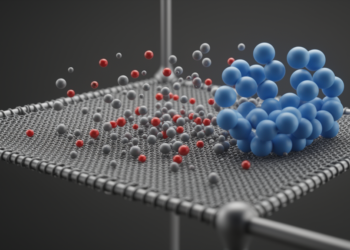
Gas adsorption was where the coconut husk biochar most clearly distinguished itself. In volumetric tests at 298 Kelvin, the biochar took up roughly 24.5 cubic centimeters of carbon dioxide per gram at pressures approaching one bar, about an order of magnitude more than the raw soil, whose uptake stayed below about 2.5 cubic centimeters per gram. Microcalorimetry showed the biochar adsorbed 1.37 millimoles of carbon dioxide per gram versus 0.64 millimoles of methane per gram, roughly a twofold preference for carbon dioxide that the authors attribute to its greater polarizability and quadrupole moment. Adsorption enthalpies declined with loading, from 41 to 22 kilojoules per mole for carbon dioxide and from 40 to 12 kilojoules per mole for methane on the biochar, pointing to energetically heterogeneous adsorption sites. Crucially, when the 5 percent amended soil was tested, its methane uptake at about one bar was only 0.025 millimoles per gram, confirming that the biochar fraction, not the soil, is the active adsorbent phase.
The chemical environment of the amended soils also shifted in ways the authors consider relevant to cover performance. The raw soil was alkaline at pH 8.24, and the biochar itself was slightly more alkaline at 8.88, yet mixing the two drove pH progressively toward neutral, from 7.07 at 2.5 percent biochar to 6.54 at 10 percent. The authors note that the optimal pH range for methanotrophic bacteria is generally reported between 5.5 and 8.5, so the observed modulation creates a chemically favorable setting, though they are careful to stress that no biological activity was measured in this study. Electrical conductivity rose with biochar content, with the biochar itself measuring 1,190 microsiemens per centimeter, but all values remained well below the 4,000 microsiemens per centimeter threshold above which osmotic stress may inhibit methanotrophic activity, although the authors flag possible salt accumulation as a long-term concern in settings with limited leaching.
The study’s authors are explicit about what their results do and do not establish. The work was conducted entirely at laboratory scale, on a single soil from a single Brazilian landfill, with biochar produced under one pyrolysis regime. In landfill settings, they note, methane and carbon dioxide mitigation typically proceeds through a combination of physical adsorption and biological oxidation, and while the biochar’s physicochemical effects appear theoretically conducive to microbial activity, further biological testing is needed to confirm whether the measured adsorption improvements translate into enhanced methane oxidation rates. They recommend future work on the effects of pyrolysis temperature on gas adsorption, along with model-scale and field-scale trials to assess long-term performance under real landfill conditions.
Even with those caveats, the findings sketch a coherent picture of a low-cost, locally sourced amendment that can pull double duty. A 5 percent dose of finely ground coconut husk biochar reduced compressibility, increased cohesion, kept the soil within regulatory classification limits, and contributed a measurable, biochar-driven gas adsorption capacity, all while nudging soil chemistry toward conditions associated with methane-oxidizing microbes. As regulators and landfill operators search for ways to curb the roughly half of generated gas that collection systems miss, the study suggests that the humble coconut husk, charred and stirred into cover soil, may earn a place in the toolkit, provided the laboratory promise survives contact with the field.
Subject of Research: Laboratory evaluation of coconut husk biochar-amended landfill cover soils for gas adsorption and geotechnical performance
Article Title: Biogas Adsorption and Geotechnical Performance of Coconut Husk Biochar-Amended Soils for Landfill Biocover Systems
Article References: Sena, T. D. S., Soares, A. B., Tavares, V. L., & Maia, D. A. S. (2026). Biogas Adsorption and Geotechnical Performance of Coconut Husk Biochar-Amended Soils for Landfill Biocover Systems. Environmental Advances, Article 100774. https://doi.org/10.1016/j.envadv.2026.100774
Image Credits: AI Generated
DOI: 10.1016/j.envadv.2026.100774
Keywords: coconut husk biochar, landfill biocover, methane emissions, carbon dioxide adsorption, geotechnical performance, soil compressibility, shear strength, pyrolysis, ultramicropores, methanotrophic bacteria, landfill cover soil, greenhouse gas mitigation
Cite Scienmag News
Sloane Callahan. (October 27, 2026). Coconut Husk Biochar Shows Promise for Trapping Landfill Gases in Soil Covers. Scienmag. https://scienmag.com/coconut-husk-biochar-shows-promise-for-trapping-landfill-gases-in-soil-covers/
Sloane Callahan. "Coconut Husk Biochar Shows Promise for Trapping Landfill Gases in Soil Covers." Scienmag, 27 October 2026, https://scienmag.com/coconut-husk-biochar-shows-promise-for-trapping-landfill-gases-in-soil-covers/. Accessed 27 October 2026.
Sloane Callahan. "Coconut Husk Biochar Shows Promise for Trapping Landfill Gases in Soil Covers." Scienmag. October 27, 2026. https://scienmag.com/coconut-husk-biochar-shows-promise-for-trapping-landfill-gases-in-soil-covers/