


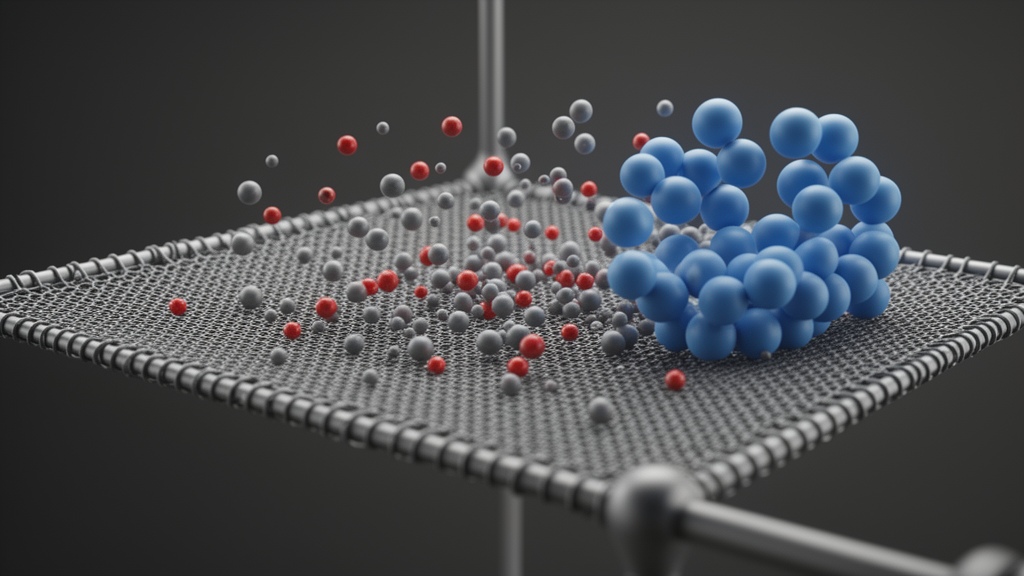
Researchers report graphene–amorphous carbon bilayer membranes that combine molecular-level thinness, precise sub-nanometre porosity and exceptional mechanical robustness, addressing a longstanding trilemma in separation science. The work, published in Nature Sustainability, targets membrane-based carbon capture as an energy-efficient and scalable alternative to conventional chemical absorption of CO2.
The membranes were produced through a graphene-guided polymer conversion approach. Leveraging a super-spreading effect, the team coated graphene with a uniform, ultra-smooth polymer-derived carbon layer as thin as 2 nanometres. Controlled pyrolysis of the polymer precursor then generated a carbon network featuring narrowly distributed, high-precision ultramicropores.
Mechanical performance was a central design goal. The resulting carbon films achieved a high Young’s modulus of approximately 26.8 gigapascals, providing the structural integrity needed for films only a few nanometres thick to remain robust during separation.
In gas separation tests, the graphene–amorphous carbon membranes exhibited sharp molecular sieving, with selectivity greater than 60 for CO2/N2, greater than 70 for H2/CO2 and greater than 70 for CO2/CH4. These selectivities indicate that the ultramicropores discriminate between molecules on the basis of subtle differences in size and shape.
Alongside this selectivity, the membranes delivered an exceptional CO2 permeance of up to 5,000 gas permeation units, which the authors report as surpassing existing benchmarks.
The combination of structural integrity and separation performance, the authors state, enables efficient carbon capture across varied flue gas, syngas and natural gas streams.
The study positions graphene–amorphous carbon membranes as a versatile, energy-efficient platform for sustainable molecular separations.
The reported performance figures come from the published abstract of the Nature Sustainability paper by Shilin Guo, Yueqing Shen, Jing Zhao and colleagues, with corresponding contributions from teams including those of Zhongyi Jiang, Guangwei He, Runnan Zhang and Kumar Varoon Agrawal.
Subject of Research: Development of molecularly thin graphene–amorphous carbon bilayer membranes for selective CO2 separation
Article Title: Efficient carbon dioxide separation with molecularly thin bilayer carbon membranes
Article References: Guo, S., Shen, Y., Zhao, J., Ma, H., He, M., Fu, J., Zhang, D., Feng, S., Yuan, S., Zhang, H., Zhao, Q., Pan, Q., Xie, E., Wang, S., Song, S., Gong, X., Zeng, Y., Zhang, R., Agrawal, K. V., … Jiang, Z. (2026). Efficient carbon dioxide separation with molecularly thin bilayer carbon membranes. Nature Sustainability. https://doi.org/10.1038/s41893-026-01973-x
Image Credits: AI Generated
DOI: 10.1038/s41893-026-01973-x
Keywords: carbon capture, graphene, amorphous carbon, membranes, molecular sieving, CO2 separation, ultramicropores, gas permeance, pyrolysis, Nature Sustainability, energy efficiency, flue gas
Cite Scienmag News
Sloane Callahan. (October 27, 2026). Molecularly Thin Bilayer Carbon Membranes Deliver Sharp CO2 Sieving. Scienmag. https://scienmag.com/molecularly-thin-bilayer-carbon-membranes-deliver-sharp-co2-sieving/
Sloane Callahan. "Molecularly Thin Bilayer Carbon Membranes Deliver Sharp CO2 Sieving." Scienmag, 27 October 2026, https://scienmag.com/molecularly-thin-bilayer-carbon-membranes-deliver-sharp-co2-sieving/. Accessed 27 October 2026.
Sloane Callahan. "Molecularly Thin Bilayer Carbon Membranes Deliver Sharp CO2 Sieving." Scienmag. October 27, 2026. https://scienmag.com/molecularly-thin-bilayer-carbon-membranes-deliver-sharp-co2-sieving/


