

Tuesday, October 27, 2026
Science
No Result
View All Result
  • Login
  • HOME
  • SCIENCE NEWS
  • CONTACT US
  • HOME
  • SCIENCE NEWS
  • CONTACT US
No Result
View All Result
Scienmag
No Result
View All Result
Home Science News Climate

Acetamiprid Resistance in Cowpea Aphid Carries Measurable Fitness Costs, Study Finds

October 27, 2026
in Climate
Sloane Callahan
By Sloane Callahan Scienmag Editorial Profile - Climate Mitigation
Reading Time: 3 mins read
0
Acetamiprid Resistance in Cowpea Aphid Carries Measurable Fitness Costs, Study Finds

Acetamiprid Resistance in Cowpea Aphid Carries Measurable Fitness Costs, Study Finds

65
SHARES
587
VIEWS
Share on FacebookShare on Twitter
ADVERTISEMENT

The cowpea aphid, Aphis craccivora, is a major sucking pest of legume crops, and neonicotinoid insecticides such as acetamiprid are widely used against it. According to a new study published in Ecotoxicology, sustained exposure to acetamiprid has now been linked to the development of resistance in this aphid, and the researchers set out to characterize how that resistance develops and what it costs the insect.

The team selected an acetamiprid-resistant strain over 20 generations in the laboratory and compared it with a susceptible strain. After the selection period, the resistant strain showed a 25.57-fold increase in the LC50, the concentration killing half of the tested aphids, relative to the susceptible strain. The realized heritability of resistance was estimated at 0.21, indicating that the trait can be passed to subsequent generations at a moderate rate.

Resistance did not come free. The resistant strain showed reduced overall fitness, measured at 0.69, and several population-growth parameters were markedly lower than in the susceptible strain. These included the net reproduction rate, the mean relative growth rate, the intrinsic rate of increase, and the finite rate of increase, all of which were reduced in the acetamiprid-resistant aphids.

At the biochemical level, the researchers found upregulation of two major detoxification enzyme systems. Genes encoding cytochrome P450 monooxygenases, specifically CYP18A1 and CYP4CJ14, and glutathione S-transferases, specifically GSTS3 and GSTO1, were upregulated under acetamiprid exposure, and this was accompanied by enhanced enzyme activity. In contrast, carboxylesterase activity showed no significant correlation with acetamiprid susceptibility, suggesting it plays little role in the observed resistance.

To probe the contribution of these enzymes further, the researchers used two known enzyme inhibitors. This synergistic effect supports the idea that these enzyme families contribute to the resistance phenotype.

The study also included an in silico component. Molecular docking analyses modeled how acetamiprid interacts with the cytochrome P450 and glutathione S-transferase proteins in the presence of piperonyl butoxide and diethyl maleate. According to the authors, the docking results suggest that the interactions of these inhibitors with the two enzyme types contribute to the resistance mechanism observed experimentally.

The work was conducted by Ahmed A. A. Aioub, Sarah I. Z. Abdel-Wahab, and colleagues, and published in the journal Ecotoxicology on 22 October 2026 as Volume 35, article number 184. The study design covered resistance risk assessment, fitness costs, cross-resistance evaluation, biochemical and molecular characterization, and computational docking, all centered on a single aphid species under laboratory conditions.

The authors state that their findings offer key insights into acetamiprid resistance in Aphis craccivora and could support the development of resistance-management strategies and decision-making tools. Because the results come from laboratory selection over 20 generations of one pest species, translating them to field settings will require further work, but the identification of specific detoxification genes and the fitness costs associated with resistance provide concrete targets for monitoring and managing acetamiprid resistance in legume-growing systems.

Subject of Research: Development of acetamiprid resistance in the cowpea aphid Aphis craccivora, including fitness costs, heritability, and biochemical mechanisms

Article Title: Unraveling acetamiprid resistance in Aphis craccivora (Hemiptera: Aphididae): resistance risk assessment, fitness costs, cross-resistance, biochemical and molecular characterization, and in silico docking study

Article References: Aioub, A. A. A., Hashem, A. S., Ahmed, H. H. R., Alkeridis, L. A., Al-Shahari, E. A., Shukry, M., Hamada, H. M. A., Sayed, S., El-Harairy, A., & Abdel-Wahab, S. I. Z. (2026). Unraveling acetamiprid resistance in Aphis craccivora (Hemiptera: Aphididae): resistance risk assessment, fitness costs, cross-resistance, biochemical and molecular characterization, and in silico docking study. Ecotoxicology, 35(9), Article 184. https://doi.org/10.1007/s10646-026-03163-z

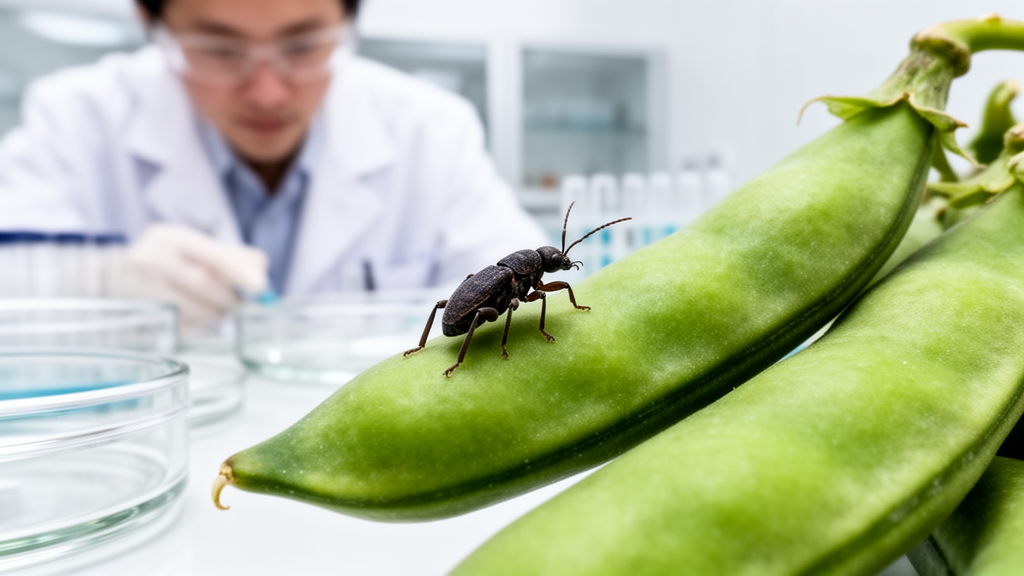
Image Credits: AI Generated

DOI: 10.1007/s10646-026-03163-z

Keywords: acetamiprid, Aphis craccivora, neonicotinoid resistance, cowpea aphid, fitness costs, heritability, cytochrome P450, glutathione S-transferase, piperonyl butoxide, diethyl maleate, molecular docking, insecticide resistance management

Cite Scienmag News

Sloane Callahan. (October 27, 2026). Acetamiprid Resistance in Cowpea Aphid Carries Measurable Fitness Costs, Study Finds. Scienmag. https://scienmag.com/acetamiprid-resistance-in-cowpea-aphid-carries-measurable-fitness-costs-study-finds/


Sloane Callahan. "Acetamiprid Resistance in Cowpea Aphid Carries Measurable Fitness Costs, Study Finds." Scienmag, 27 October 2026, https://scienmag.com/acetamiprid-resistance-in-cowpea-aphid-carries-measurable-fitness-costs-study-finds/. Accessed 27 October 2026.

Sloane Callahan. "Acetamiprid Resistance in Cowpea Aphid Carries Measurable Fitness Costs, Study Finds." Scienmag. October 27, 2026. https://scienmag.com/acetamiprid-resistance-in-cowpea-aphid-carries-measurable-fitness-costs-study-finds/

Tags: acetamipridAcetamiprid resistance in cowpea aphidAphis craccivorabiochemical mechanisms of insecticide resistancecowpea aphidcytochrome P450diethyl maleateecological consequences of insecticide resistanceeffects of resistance on aphid reproductive ratesfitness costsfitness costs of insecticide resistanceglutathione S-transferaseheritabilityheritability of pesticide resistance traitsimpact of pesticide resistance on aphid population dynamicsinsecticide resistance developmentinsecticide resistance managementlaboratory selection for aphid resistancemolecular dockingneonicotinoid resistanceneonicotinoid resistance in pestspiperonyl butoxideresistance management in legume pestssustainability of neonicotinoid use in agriculture
Share26Tweet16
Previous Post

Floralozone Shows Cardioprotective Effects in Doxorubicin-Induced Heart Failure in Rats

Next Post

Immune cells in the liver shield against alcohol-related damage, mouse study finds

Related Posts

Weather Data Alone Struggles to Predict Building Heating Demand, Norwegian Machine Learning Study Finds
Climate

Weather Data Alone Struggles to Predict Building Heating Demand, Norwegian Machine Learning Study Finds

October 27, 2026
Simple Wind Speed Descriptors Enough for Accurate Turbine Fatigue Load Models, Preprint Finds
Climate

Simple Wind Speed Descriptors Enough for Accurate Turbine Fatigue Load Models, Preprint Finds

October 27, 2026
Machine learning maps where Dhaka is most likely to flood after rain
Climate

Machine learning maps where Dhaka is most likely to flood after rain

October 27, 2026
When Does Causal Inference Need Extra Variables? Humid Forest Study Offers an Answer
Climate

When Does Causal Inference Need Extra Variables? Humid Forest Study Offers an Answer

October 27, 2026
Six decades of phosphorus rules traced in Germany’s Ruhr River catchment
Climate

Six decades of phosphorus rules traced in Germany’s Ruhr River catchment

October 27, 2026
Cool-Season Smog Rises Reliably in Thailand’s Industrial East, Five-Year Study Finds
Climate

Cool-Season Smog Rises Reliably in Thailand’s Industrial East, Five-Year Study Finds

October 27, 2026
Next Post
Immune cells in the liver shield against alcohol-related damage, mouse study finds

Immune cells in the liver shield against alcohol-related damage, mouse study finds

  • Mothers who receive childcare support from maternal grandparents show more optimized

    Mothers who receive childcare support from maternal grandparents show more parental warmth, finds NTU Singapore study

    27656 shares
    Share 11059 Tweet 6912
  • University of Seville Breaks 120-Year-Old Mystery, Revises a Key Einstein Concept

    1061 shares
    Share 424 Tweet 265
  • Bee body mass, pathogens and local climate influence heat tolerance

    682 shares
    Share 273 Tweet 171
  • Researchers record first-ever images and data of a shark experiencing a boat strike

    546 shares
    Share 218 Tweet 137
  • Groundbreaking Clinical Trial Reveals Lubiprostone Enhances Kidney Function

    531 shares
    Share 212 Tweet 133
Science

Embark on a thrilling journey of discovery with Scienmag.com—your ultimate source for cutting-edge breakthroughs. Immerse yourself in a world where curiosity knows no limits and tomorrow’s possibilities become today’s reality!

RECENT NEWS

  • Immune cells in the liver shield against alcohol-related damage, mouse study finds
  • Acetamiprid Resistance in Cowpea Aphid Carries Measurable Fitness Costs, Study Finds
  • Floralozone Shows Cardioprotective Effects in Doxorubicin-Induced Heart Failure in Rats
  • Male or Female? Plant Sex Shapes Photosynthesis in Surprising Ways

Categories

  • Agriculture
  • Anthropology
  • Archaeology
  • Athmospheric
  • Biology
  • Biotechnology
  • Blog
  • Bussines
  • Cancer
  • Chemistry
  • Climate
  • Earth Science
  • Editorial Policy
  • Marine
  • Mathematics
  • Medicine
  • Pediatry
  • Policy
  • Psychology & Psychiatry
  • Science Education
  • Science News
  • Social Science
  • Space
  • Technology and Engineering

Subscribe to Blog via Email

Enter your email address to subscribe to this blog and receive notifications of new posts by email.

Join 5,151 other subscribers

© 2025 Scienmag - Science Magazine

Welcome Back!

Login to your account below

Forgotten Password?

Retrieve your password

Please enter your username or email address to reset your password.

Log In
No Result
View All Result
  • HOME
  • SCIENCE NEWS
  • CONTACT US

© 2025 Scienmag - Science Magazine

Discover more from Science

Subscribe now to keep reading and get access to the full archive.

Continue reading