


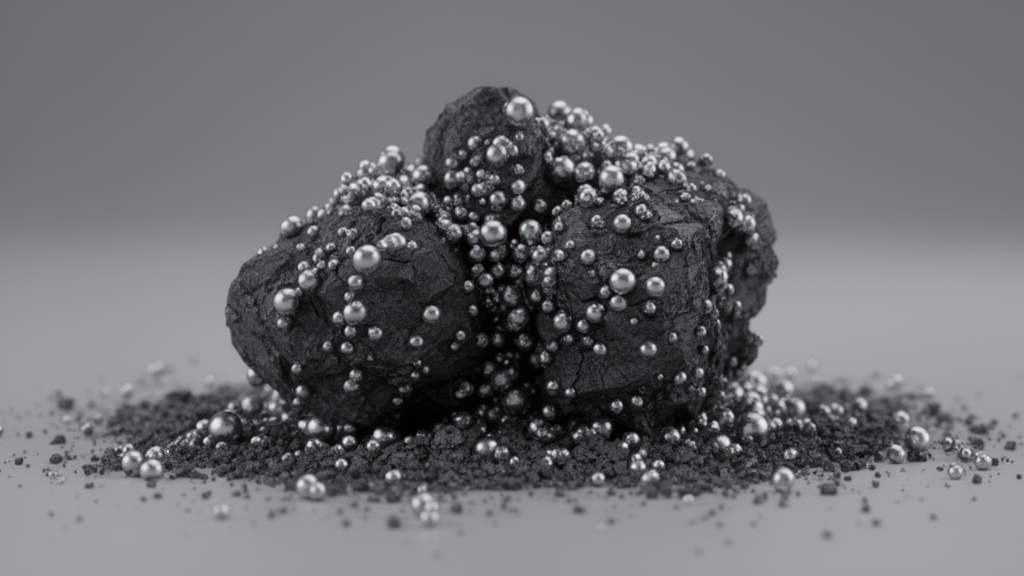
Researchers have reported the synthesis of silicon–graphite composites for lithium-ion battery anodes using a scalable method inspired by the spherical natural graphite (SNG) transformation process. The work, published in Clean Technologies and Environmental Policy, describes composites prepared by mixing 10 wt.% nano-silicon with either flake or spherical natural graphite, then processing the blends through a hybridizing apparatus that dispersed the silicon nanoparticles within the graphite host.
The team compared two composite types against a simple mixture of nano-Si and spherical natural graphite, characterizing the materials with scanning electron microscopy, transmission electron microscopy, X-ray diffraction, BET surface area analysis, particle size distribution measurements, and coin cell electrochemical testing. All of the composites demonstrated specific capacities near 600 mAh/g, a level the authors note aligns with existing literature and primarily reflects the silicon content of the materials rather than the processing route.
Microscopy proved decisive for understanding performance differences. SEM analysis highlighted that effective dispersion of the nano-silicon is crucial for providing cycling stability to the composites. In a finding the authors describe as surprising, the functional binders known in the field for enhancing electrode robustness were not as advantageous when the composites were highly dispersed, suggesting that good dispersion may reduce the need for such additives in these formulations.
Another notable observation came from the internal structure of the graphite particles: the nano-silicon was found to infiltrate the spherical natural graphite particles almost to their core, indicating that the graphite possesses extensive open porosity. Beyond this fundamental insight into how silicon and graphite interact during composite formation, the authors state that the process developed in the study provides a scalable way to prepare Si-graphite composites that performed similarly to other types of Si-graphite composites reported elsewhere.
Subject of Research: A scalable powder transformation method for fabricating silicon–graphite composite anodes for lithium-ion batteries
Article Title: Fabrication of high-capacity silicon–graphite composite for Li-ion battery applications anodes using established powder transformation techniques
Article References: Toupin, M., Perrin-Sarazin, F., Nguyen, M., Yim, C.-H., Naboka, O., Couillard, M., & Abu-Lebdeh, Y. (2026). Fabrication of high-capacity silicon–graphite composite for Li-ion battery applications anodes using established powder transformation techniques. Clean Technologies and Environmental Policy, 28(11), Article 284. https://doi.org/10.1007/s10098-026-03591-9
Image Credits: AI Generated
DOI: 10.1007/s10098-026-03591-9
Keywords: lithium-ion batteries, silicon-graphite composite, anodes, spherical natural graphite, nano-silicon, powder processing, electrochemical testing, battery materials, energy storage, composite fabrication, Fabrication, high-capacity
Cite Scienmag News
Faith Mcneil. (October 27, 2026). Silicon–graphite composite anodes made with scalable powder process hit near 600 mAh/g. Scienmag. https://scienmag.com/silicon-graphite-composite-anodes-made-with-scalable-powder-process-hit-near-600-mah-g/
Faith Mcneil. "Silicon–graphite composite anodes made with scalable powder process hit near 600 mAh/g." Scienmag, 27 October 2026, https://scienmag.com/silicon-graphite-composite-anodes-made-with-scalable-powder-process-hit-near-600-mah-g/. Accessed 27 October 2026.
Faith Mcneil. "Silicon–graphite composite anodes made with scalable powder process hit near 600 mAh/g." Scienmag. October 27, 2026. https://scienmag.com/silicon-graphite-composite-anodes-made-with-scalable-powder-process-hit-near-600-mah-g/


