


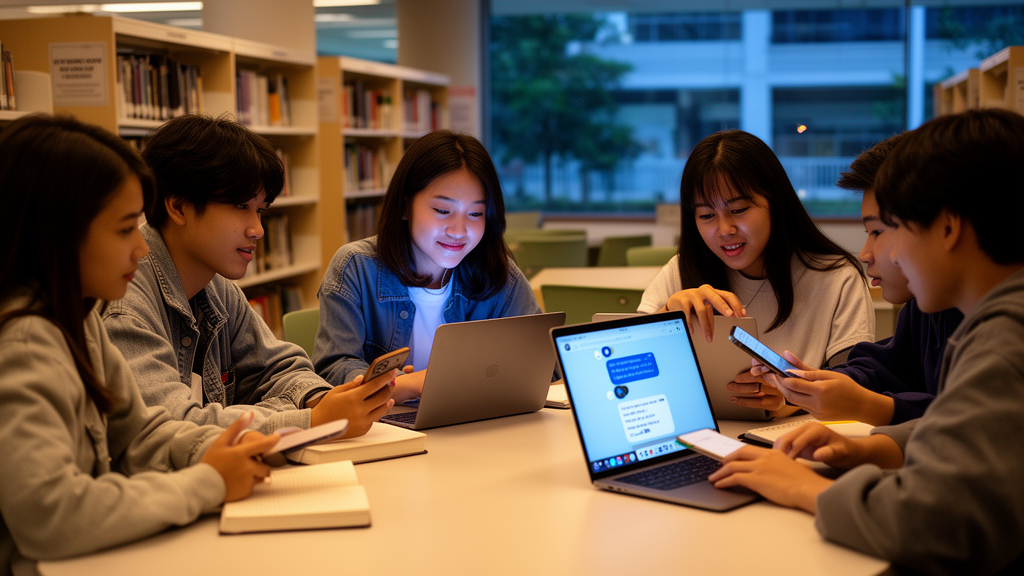
Generation Z undergraduates at an international college in Thailand rely on AI chatbots overwhelmingly for academic work, but a substantial minority have also crossed into more personal territory, using the same conversational systems for advice, emotional support and companionship. That is the central picture emerging from an exploratory mixed-methods study published in Heliyon, in which researchers surveyed 144 students aged 18 to 24 about how, how often and why they use AI chatbots, and what they would want those systems to become.
The survey ran from 25 September to 19 October 2024 and was distributed through in-class announcements to 320 students, alongside campus posters. Because the posters may have reached students beyond the classroom invitation, the researchers could not compute an exact response rate; the 149 responses they received correspond to an upper-bound figure of 46.6 percent relative to the 320 students invited in class. Five respondents were excluded because they did not meet the approved age criterion of 18 to 25 years, leaving an analytic sample of 144. The respondents were mostly business students: international business, finance, marketing and related majors accounted for 83.3 percent of the sample, and third-year students formed the largest single group at 48.6 percent.
Usage patterns pointed firmly toward the chatbot as a study tool. Academic assistance was selected as a reason for use by 133 respondents, or 92.4 percent, followed by professional or work-related tasks at 52.8 percent and personal productivity at 34.0 percent. Personal advice or support was chosen by 27.8 percent, entertainment by 16.7 percent and casual conversation by just 8.3 percent. Weekly use was the most common frequency, reported by 59 respondents, with 43 using chatbots daily. Most sessions were short: 75 respondents reported sessions of 10 to 30 minutes and 42 reported less than 10 minutes, a pattern the authors read as consistent with specific, bounded tasks rather than extended engagement.
Yet the companion mode was far from absent. A total of 77 respondents, 53.5 percent, said they had used AI chatbots or assistants for personal matters, advice or companionship at some point, and 21 respondents reported using AI companions daily, roughly one respondent in seven. The authors are careful about what these numbers mean: because the data are cross-sectional, they describe the co-occurrence of academic and personal uses at a single point in time, not a sequence in which one mode leads to the other. The study’s title, referring to a movement from assistants to companions, describes a conceptual continuum of modes of use observed at one moment, not a measured change in behavior over time.
To probe adoption attitudes, the researchers asked seven Likert-scale items adapted from the Technology Acceptance Model and the Unified Theory of Acceptance and Use of Technology, covering perceived usefulness for emotional well-being and social interaction, ease of use, peer influence, resource availability and recommendation intention. An exploratory factor analysis, using iterated principal axis factoring with oblimin rotation and retention decisions guided by parallel analysis and the minimum average partial test, suggested two provisional dimensions. The first, labeled perceived relational value and social endorsement, grouped emotional well-being support, social interaction enhancement, peer influence and recommendation intention, with acceptable internal consistency. The second, practical accessibility, grouped ease of use, learning straightforwardness and resource availability, with more modest reliability.
The pattern of responses across these items was telling. Agreement was strongest and most concentrated for the practical-accessibility items, indicating that most students perceive few technical or practical barriers to using chatbots. Agreement was weaker and more dispersed for the relational items, where responses clustered around neutral and disagreement. In the open-ended data, this contest appeared directly: personal, emotional and conversational support was cited by 26 of 127 substantive motivation responses, or 20.5 percent, while reservations and reasons for non-use were cited almost as often, at 25 responses or 19.7 percent. The most common reservation was a preference for human relationships, followed by the view that AI companionship is inauthentic or impersonal, doubts about AI’s capacity to handle emotional problems, lack of perceived need and academic-integrity concerns.
Information seeking and convenience was actually the most frequent open-ended motivation, at 27.6 percent, with one respondent describing chatbots as a “faster answer than google, safari.” Students who valued the emotional side often did so because it felt judgment-free and private; one wrote that they sought “Personal advice that you don’t want to be judged upon.” The coding was conducted at the level of individual responses with the assistance of a large language model, with every assigned code checked by a researcher and a random subsample of roughly a quarter of responses independently coded by a second researcher, yielding near-perfect agreement. The authors note that the open-ended item asked specifically about AI companions, which explains why academic support accounted for only 16.5 percent of open-ended responses even though it dominated the closed-ended reasons for use.
When asked what would make AI companions more appealing, 117 respondents gave substantive answers, and human-like interaction was the single most frequent category, at 39.3 percent. Students asked for real-time voice conversation, emotional understanding, human-like personality and friendship, and in a few cases physical embodiment or avatars. Enhanced technical capabilities and accuracy, including image and video analysis, PDF and handwriting reading, mathematical accuracy and up-to-date information, followed at 22.2 percent, with academic and learning support such as citations, plagiarism checking and grammar correction at 13.7 percent. Nine respondents, 7.7 percent, said no additional features were wanted or expressed reservations about AI companionship as such, one writing that they did not think any feature would make them want a deep conversation with AI. The authors interpret this as a dual expectation: students want capable practical tools and more natural interaction, but many also draw explicit boundaries around how far that interaction should go.
The study is explicit about its limits. It was conducted at a single institution where business disciplines dominated the sample; participation was voluntary, so self-selection bias cannot be ruled out; the data are self-reported and cross-sectional; and the seven adoption items were adapted rather than drawn from a validated instrument, making the two-factor structure provisional, with a one-factor solution a defensible alternative given that some retention criteria favored it. The authors frame their contribution as exploratory evidence on how functional, social, emotional and relational expectations intersect in student chatbot use, not as a confirmatory test of the Technology Acceptance Model, and they call for longitudinal designs, larger multi-institutional samples and validated measures in future work.
The practical implications the authors draw are directed at universities, developers and policymakers. Institutions, they argue, should treat chatbot adoption as both a learning opportunity and a governance challenge, providing AI literacy training on prompt formulation, source verification and the evaluation of AI-generated outputs, and developing clear academic-integrity guidelines that distinguish support from substitution. Because some students use chatbots for personal advice or companion-like interaction, the authors caution that such tools should not be treated as replacements for academic advisors, counselors or peer support networks. For developers, the findings point to demand for citation transparency, multimodal document analysis and carefully designed conversational features that maintain boundaries between supportive interaction and simulated emotional dependency, alongside privacy controls for students who disclose sensitive information. At the policy level, they recommend transparent institutional frameworks covering data handling, privacy and acceptable use, with guidance on overreliance and on preserving student agency in AI-assisted learning.
Subject of Research: An exploratory mixed-methods survey of AI chatbot adoption and companion-style use among Generation Z undergraduates in Thailand
Article Title: From assistants to companions: An exploratory mixed-methods study of AI chatbot adoption among Generation Z students in Thailand
Article References: Dehouche, N., & Wei, X. (2026). From assistants to companions: An exploratory mixed-methods study of AI chatbot adoption among Generation Z students in Thailand. Heliyon, 12(16), Article e45640. https://doi.org/10.1016/j.heliyon.2026.e45640
Image Credits: AI Generated
DOI: 10.1016/j.heliyon.2026.e45640
Keywords: AI chatbots, Generation Z, Thailand, higher education, Technology Acceptance Model, companion AI, emotional support, survey research, academic integrity, human-AI interaction, generative AI, student adoption
Cite Scienmag News
Drew Townsend. (October 27, 2026). Thai Gen Z students use AI chatbots mainly for study, with a companion side emerging. Scienmag. https://scienmag.com/thai-gen-z-students-use-ai-chatbots-mainly-for-study-with-a-companion-side-emerging/
Drew Townsend. "Thai Gen Z students use AI chatbots mainly for study, with a companion side emerging." Scienmag, 27 October 2026, https://scienmag.com/thai-gen-z-students-use-ai-chatbots-mainly-for-study-with-a-companion-side-emerging/. Accessed 27 October 2026.
Drew Townsend. "Thai Gen Z students use AI chatbots mainly for study, with a companion side emerging." Scienmag. October 27, 2026. https://scienmag.com/thai-gen-z-students-use-ai-chatbots-mainly-for-study-with-a-companion-side-emerging/


