


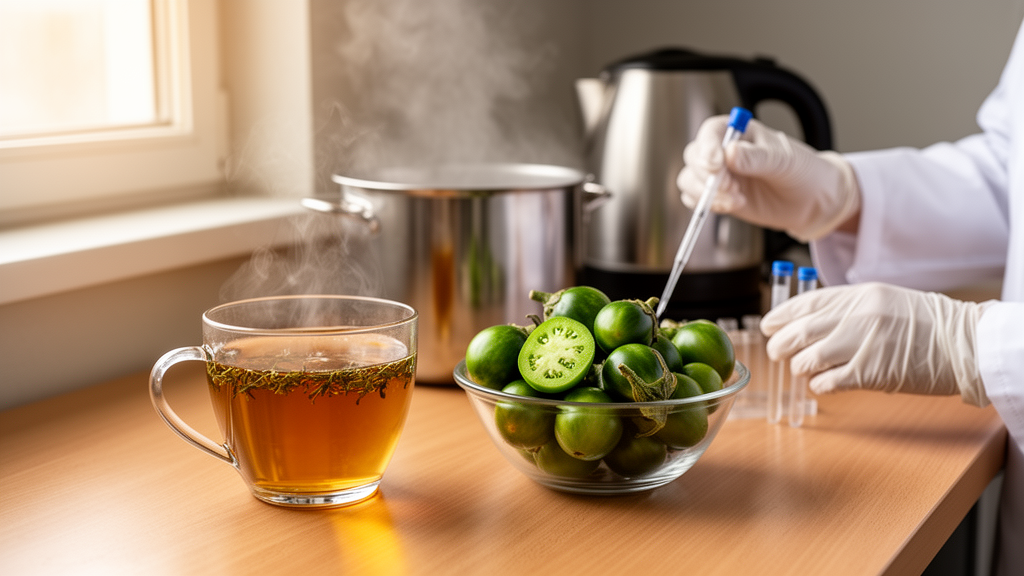
In the streets of Ebolowa, Yaoundé, and Douala, a steaming cup of a cloudy, aromatic brew is offered to guests as a gesture of hospitality, poured for women who have just given birth, and sipped slowly during long, rambling conversations known locally as palabras. The drink is called mendím me zoñ, a traditional Cameroonian herbal tea built around eggplants, and until now it has remained almost entirely invisible to the scientific literature. A new study published in Heliyon has, for the first time, systematically documented how this beverage is produced, why people drink it, and how acceptable it is to the palate, revealing that the way the tea is cooked and the number of ingredients used can dramatically change both its sensory appeal and its content of bioactive compounds.
The research team, led by Mang Yannick Dimitry and colleagues, conducted a household survey between July and September 2024 in Ebolowa, in the South region of Cameroon, and in surrounding villages. They interviewed 150 female producers and 400 consumers of the tea. Among the consumers, 58 percent were male and 42 percent female, while every single producer surveyed was a woman. Most participants had lived in the study area since birth, half lived in rural villages and half in the city, and the average age was 36.2 years. The researchers also measured the body mass index of each consumer, finding that 24.5 percent were overweight and 19.5 percent were obese, figures that would later prove relevant to understanding who drinks the tea and why.
The survey revealed a rich but unstandardized production landscape. Eggplants are the backbone of the recipe, and two species are used: Solanum torvum, preferred by 73.33 percent of producers, and Solanum aethiopicum, used by 26.66 percent. The choice of species was significantly associated with where producers lived and how old they were. Roughly 93 percent of rural producers favored Solanum torvum, compared with just over half of urban producers, while younger producers tended toward the less bitter Solanum aethiopicum. About 11 percent of producers mix both fruits. Beyond the eggplants, every producer without exception added lemongrass (Cymbopogon citratus), two-thirds included leaves of Plectranthus glandulosus, known locally as meva’a, and about a third added the pungent fruits of Capsicum chinense.
Statistical clustering of the producers’ recipes showed that they fall into three distinct formulations. The largest group, 56.15 percent of producers, used every ingredient: lemongrass, pepper, meva’a, and olom. A second group, 33.74 percent, omitted the olom bark, and the smallest group, 10.11 percent, used only lemongrass and pepper. The production process itself also splits into two paths. In the first, the eggplants are steamed in a covered stainless-steel pot over a tripod for roughly 15 to 23 minutes, depending on the fire. In the second, the fruits are boiled in water for about 20 minutes and then rinsed, a step producers say reduces bitterness. In both cases the cooked eggplants are then combined with the other ingredients in about 2.5 liters of water, boiled for another 20 minutes, crushed by hand with a wooden spatula, and sieved through a wooden sieve with a one-millimeter mesh before serving or storage in a vacuum flask.
Why do people drink it? The consumers’ answers were dominated by perceived health motivations rather than flavor alone. Just over half, 51.25 percent, cited perceived benefits for blood pressure, 41.75 percent cited glucose-lowering potential, 39 percent cited improved digestion, 37.75 percent weight management, 34.5 percent cough relief, 24.25 percent diuretic effects, and 12.5 percent aphrodisiac motivations. These motivations shifted sharply with age and body size. Among people over 35, the tea was consumed mainly for metabolic concerns such as blood pressure comfort and glucose regulation, while the youngest group, aged 15 to 25, drank it mainly for cough relief, weight management, and digestive comfort. Statistically, age correlated positively with motivations for blood pressure comfort, aphrodisiac expectations, and digestive improvement, and body mass index correlated positively with consumption frequency, weight-management motivations, and perceived digestion regulation. Most respondents drank the tea in the morning or afternoon, and nearly one in five consumed it every day of the week.
To test whether the tea actually pleases the palate, the researchers organized a hedonic sensory evaluation. Fifty untrained panelists, 25 women and 25 men aged 18 to 42, recruited from a teachers’ training college in Ebolowa, rated six coded samples on a nine-point scale covering color, odor, taste, flavor, and overall acceptability. The samples came from a factorial design crossing the two cooking processes with the three ingredient formulations. The results were unambiguous: the tea produced by steaming with the full complement of ingredients, sample P1F1, scored highest, with a taste score of 7.50, meaning liked moderately, and the best overall acceptability. The production process significantly affected taste, flavor, and overall acceptability, with boiling reducing taste and flavor scores by about 11.53 percent, although it left color and odor unchanged. Reducing the number of ingredients in the recipe cut sensory scores by roughly 25 percent on average.
The chemical analysis told a parallel story. Total phenolic content, measured as gallic acid equivalents, ranged from 1.95 to 3.42 grams per 100 milliliters in steamed samples but only 1.12 to 2.26 grams per 100 milliliters in boiled ones. Total flavonoid content and total tannin content followed the same pattern, both significantly lower in the boiled teas. The authors attribute this to the elimination or alteration of phenolic compounds during the boiling and crushing steps of the second process. Principal component analysis showed that the first principal component, which captured 87.42 percent of the variability between teas, was strongly and positively associated with general acceptability, odor, taste, color, and all three classes of bioactive compounds, and the two components together explained 93.66 percent of the variation. Strong positive correlations between overall acceptability and taste, odor, and flavor suggested that preference for the top-rated samples was driven mainly by their aroma and flavor.
The study’s authors are careful to draw a clear line between perception and proof. The health benefits reported by consumers are perceived benefits, gathered through surveys, and the study measured only the tea’s basic chemical content, not any clinical effect. As the authors themselves emphasize, although individual ingredients such as lemongrass, Plectranthus glandulosus, and Scorodophloeus zenkeri have shown antioxidant or anti-inflammatory activities in previous laboratory studies, the present work does not directly demonstrate clinical efficacy of the traditional mixture. The reliance on survey data, with responses potentially shaped by personal experience, is acknowledged as a limitation, and the authors call for comprehensive phytochemical profiling and in vitro or in vivo biological analyses before any health claims can be evaluated.
Nevertheless, the findings carry practical weight. The most accepted formulation, steamed and made with the maximum number of ingredients, is also the richest in phenolic compounds, suggesting that traditional full-recipe preparation preserves both flavor and phytochemical content better than simplified or boiled versions. The authors note that the operations are entirely manual and rely on household utensils, and they propose that optimizing the process, including standardized drying stages, could lead to homogeneous, easy-to-use tea bags that would allow this once-obscure regional beverage to reach a far larger audience. For a drink that has been offered to honored guests in southern Cameroon for generations, science has finally taken its first careful sip.
Subject of Research: Traditional production, consumer perceptions, and sensory and phytochemical characterization of the Cameroonian herbal tea mendím me zoñ.
Article Title: Knowledge and perception of producers and consumers on the production process, perceived health benefits, and sensory properties of “ mendím me zoñ ”, a traditional Cameroonian herbal tea
Article References: Dimitry, M. Y., Thérèse, B. A. M., Ulrich, O. E. P., Edith, D. M. J., Armand, A. B., Elie, F., & Nicolas, N. Y. (2026). Knowledge and perception of producers and consumers on the production process, perceived health benefits, and sensory properties of “mendím me zoñ”, a traditional Cameroonian herbal tea. Heliyon, 12(16), Article e45633. https://doi.org/10.1016/j.heliyon.2026.e45633
Image Credits: AI Generated
DOI: 10.1016/j.heliyon.2026.e45633
Keywords: mendím me zoñ, Cameroon, herbal tea, eggplant, Solanum torvum, sensory evaluation, total phenolic content, consumer survey, traditional food, food processing, bioactive compounds, Heliyon
Cite Scienmag News
Drew Townsend. (October 27, 2026). Steamed or Boiled? Science Maps Cameroon’s Beloved Eggplant Herbal Tea for the First Time. Scienmag. https://scienmag.com/steamed-or-boiled-science-maps-cameroons-beloved-eggplant-herbal-tea-for-the-first-time/
Drew Townsend. "Steamed or Boiled? Science Maps Cameroon’s Beloved Eggplant Herbal Tea for the First Time." Scienmag, 27 October 2026, https://scienmag.com/steamed-or-boiled-science-maps-cameroons-beloved-eggplant-herbal-tea-for-the-first-time/. Accessed 27 October 2026.
Drew Townsend. "Steamed or Boiled? Science Maps Cameroon’s Beloved Eggplant Herbal Tea for the First Time." Scienmag. October 27, 2026. https://scienmag.com/steamed-or-boiled-science-maps-cameroons-beloved-eggplant-herbal-tea-for-the-first-time/


