


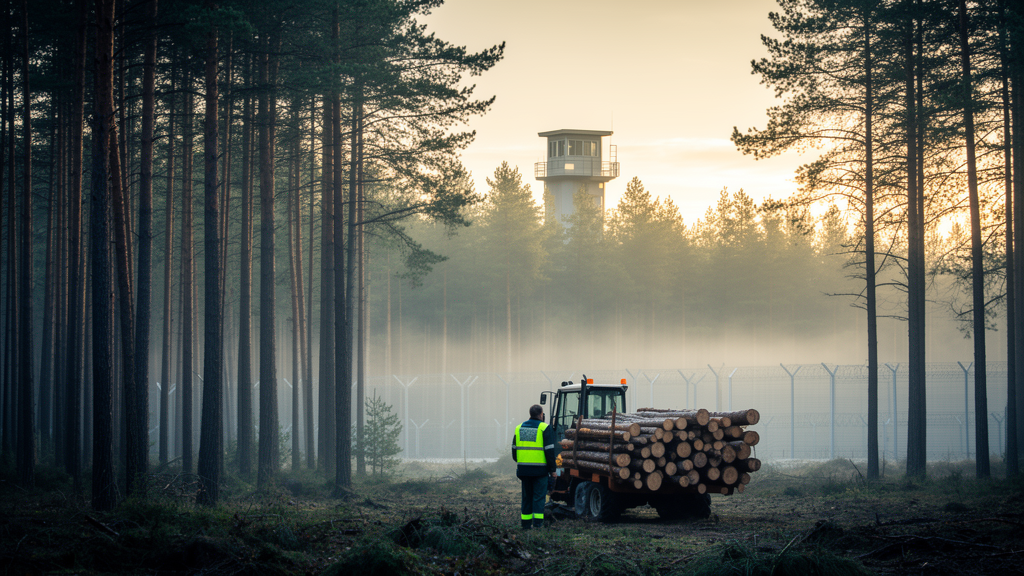
Forests across the Baltic Sea region are no longer being framed merely as carbon sinks, biodiversity reservoirs or industrial raw material sources. According to a new study published in the journal Energy, Sustainability and Society, they are increasingly treated as strategic security resources, as Estonia, Latvia, Lithuania, Finland and Sweden reorganize their energy and climate planning in response to Russia’s 2022 invasion of Ukraine and the sanctions that followed on Russian and Belarusian wood and energy.
The study, led by Alessandra Giolo and Johanna Thunborg with colleagues including Vilis Brukas, Antti Mutanen and Sari Karvinen, is described as the first to examine the 2024 updates to the National Energy and Climate Plans (NECPs) of these five countries through the combined lenses of climate security and nexus thinking, an approach that treats energy, land, ecosystems and society as interconnected systems. The researchers combined a structured qualitative content analysis of the five plans, coded in NVivo software, with 22 semi-structured interviews conducted in the first half of 2025 with stakeholders from both the public and private sectors across the five countries.
The NECPs are ten-year planning documents in which European Union Member States set out how they intend to meet the bloc’s 2030 energy and climate targets, including cutting net emissions by at least 55 percent, across five dimensions: decarbonisation, energy efficiency, energy security, internal market integration, and research and innovation. Initial drafts were submitted in 2018, and the latest updates followed in 2024, two years after the invasion upended Europe’s energy markets and severed established wood supply chains.
The analysis found that all five countries are turning to domestic bioenergy to replace Russian fuels, relying mainly on forest residues and low-grade wood for district heating and combined heat and power. The Baltic states link their forests primarily to energy sovereignty, grid integration with continental Europe and rural jobs, while Sweden and Finland embed forests in longer-term strategies for the bioeconomy, carbon sinks, hydrogen and carbon capture. Most plans favour directing high-quality timber toward material products and reserving residues for energy.
Yet the plans only partly reflect the new geopolitical reality. Many concrete adjustments, the study concludes, are happening in practice, outside the formal NECP framework. Swedish state aid for nuclear energy and results-based procurement of bioenergy with carbon capture and storage, Finland’s sector-neutral roadmaps and hydrogen programme, and Estonia’s digital forest monitoring all operate at the periphery of the plans rather than within their core. The researchers characterize this not as a gap but as a coordination challenge, noting that climate, energy and human security are treated as parallel rather than potentially conflicting goals.
The country contrasts are marked. Latvia’s plan pivots from net import dependence toward low-carbon electricity exports, scaling wind and solar while substituting natural gas in district heating with biomethane, renewable hydrogen and advanced biofuels. Lithuania pursues some of the region’s most ambitious targets, aiming for a 55 percent renewable share of gross final energy, 100 percent renewable electricity and 90 percent renewable district heating by 2030, after having fully converted Vilnius’s heating from natural gas to biofuel. Estonia, shaped by its legacy dependence on oil shale, plans a phased retirement of direct oil-shale combustion alongside a 65 percent renewable share target and Baltic grid synchronisation through the EstLink 3 interconnector and a fourth Estonia–Latvia line.
Interviewees underscored both the progress and the strains. A Latvian participant noted that wood and wood biomass from Belarus stopped entirely due to sanctions, while another warned that increasing biomass demand is raising logging volumes and that most forest biomass for energy is exported rather than used domestically. Lithuanian stakeholders pointed out that a new Forest Law with more protected areas is expected to cut the biomass available from forests by roughly 20 percent, and that the embargo has removed more than 20 million cubic metres of wood from the market, creating a barrier for industrial investment. In Sweden, observers noted that the country’s plan is quite general and may slow onshore wind development, with nuclear power likely to dominate future investment.
Finland illustrates the trade-offs most starkly. New methods in the national greenhouse gas inventory, updated data on forest growth and changed harvesting volumes have shifted Finnish forests from a significant net carbon sink to a source of emissions, a reduction attributed to increased harvesting, diminished forest growth and emissions from drained peatland forests. The Finnish NECP acknowledges that the measures of its Climate Plan for the Land Use Sector fall far short of reaching the EU LULUCF target or the country’s 2035 carbon-neutrality goal, and the plan lacks a with-additional-measures scenario. The current government, changed in 2024, has signalled it will not limit forest use and intends to strengthen the role of technological sinks, while a new energy and climate strategy is being developed.
The study identifies coordination failures at several levels: vertically between EU objectives and national implementation, horizontally among energy, forest, climate, biodiversity and industrial policies, across the three security dimensions, and regionally among neighbouring states that address shared wood and energy market disruptions unevenly and mainly through markets rather than coordinated planning. This multi-level fragmentation, the authors argue, extends earlier findings on EU forest policy fragmentation, which stems partly from the fact that EU treaties give the bloc no competence for a common forest policy, leaving its forest governance indirect and dependent on climate, energy and environment policy.
The researchers propose that forest, energy, biodiversity, climate and trade policy be governed together. Useful steps include harmonised EU-wide reporting of fuelwood use to address persistent data gaps and the underestimation of fuelwood consumption highlighted by the European Commission’s Joint Research Centre, stronger cascading-use rules prioritising material use of wood, adaptive biomass limits tied to carbon-sink and biodiversity indicators, building renovation to cut heat demand, and closer Baltic–Nordic cooperation on supply risks. The authors caution that energy-security policies could unintentionally intensify logging, weaken carbon sinks and shift environmental pressures abroad, and they note that their findings rest on official plan texts and a purposive, non-representative sample of 22 interviews, capturing policy framings and stakeholder interpretations rather than the full range of implementation practices.
Subject of Research: How the 2024 NECP updates of five Baltic and Nordic EU states reframe forests and bioenergy in terms of energy and climate security after Russia's invasion of Ukraine
Article Title: Adaptation of EU policy during geopolitical change: the impact on forest use, bioenergy, and climate security in the Baltic region
Article References: Giolo, A., Thunborg, J., Brukas, V., Mutanen, A., & Karvinen, S. (2026). Adaptation of EU policy during geopolitical change: the impact on forest use, bioenergy, and climate security in the Baltic region. Energy, Sustainability and Society, 16(1), Article 52. https://doi.org/10.1186/s13705-026-00617-4
Image Credits: AI Generated
DOI: 10.1186/s13705-026-00617-4
Keywords: bioenergy, forest policy, energy security, Baltic Sea region, NECP, carbon sinks, Russia sanctions, climate security, nexus thinking, EU policy, district heating, LULUCF
Cite Scienmag News
Denise Maddox. (October 27, 2026). Forests Become Security Assets as Baltic States Rethink Bioenergy After Ukraine War. Scienmag. https://scienmag.com/forests-become-security-assets-as-baltic-states-rethink-bioenergy-after-ukraine-war/
Denise Maddox. "Forests Become Security Assets as Baltic States Rethink Bioenergy After Ukraine War." Scienmag, 27 October 2026, https://scienmag.com/forests-become-security-assets-as-baltic-states-rethink-bioenergy-after-ukraine-war/. Accessed 27 October 2026.
Denise Maddox. "Forests Become Security Assets as Baltic States Rethink Bioenergy After Ukraine War." Scienmag. October 27, 2026. https://scienmag.com/forests-become-security-assets-as-baltic-states-rethink-bioenergy-after-ukraine-war/


