


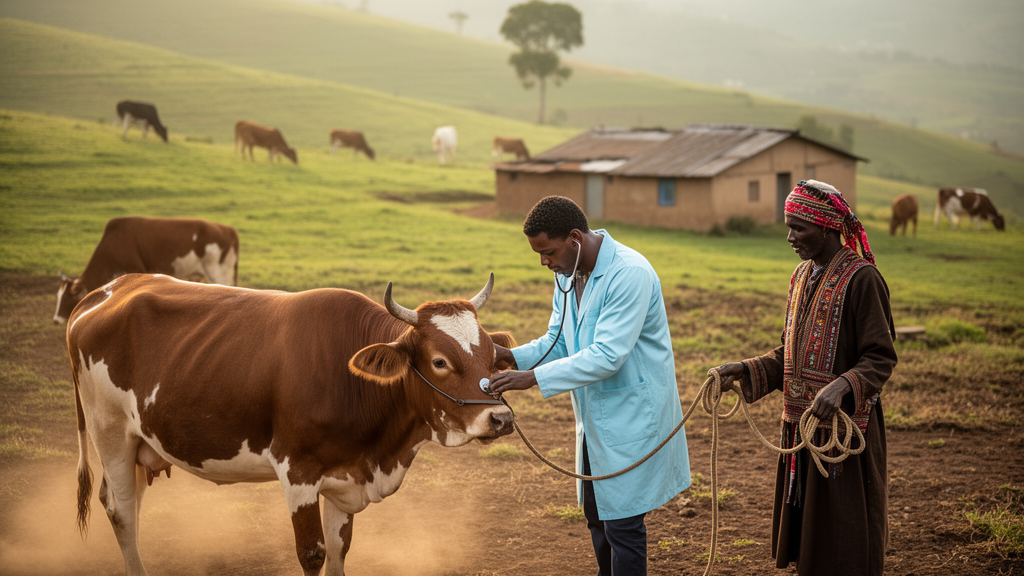
Bovine tuberculosis remains entrenched in Ethiopian cattle, infecting an estimated 7.86 percent of animals nationwide, according to a systematic review and meta-analysis of 34 studies published between 2015 and 2025.
The new analysis, published in Discover Public Health, aggregated cross-sectional studies identified through PubMed, Scopus, Web of Science, Google Scholar, and African Journals Online, with searches covering January 30, 2015 to December 25, 2025. The authors screened 598 initially identified articles, excluded 368 as duplicates and another 176 after title and abstract review, and removed 20 more for reasons including incomplete outcomes and publication dates before 2015. The remaining 34 studies met the inclusion criteria, which required cross-sectional designs reporting on Mycobacterium bovis using standardized diagnostic methods.
The pooled figure conceals enormous variation. Individual studies reported animal-level prevalence ranging from 0.0 percent to 39.3 percent, and the between-study heterogeneity statistic reached I2 = 99.2 percent, about as high as heterogeneity measures can go. A prediction interval stretching from 0 to 35.12 percent underscored the point: the prevalence a future study might plausibly report spans nearly the entire observed range. The authors used a random-effects model with DerSimonian and Laird estimation precisely because of this variability, and they caution that the pooled estimate should be read with that uncertainty in mind.
Some of that heterogeneity has identifiable sources. Subgroup analyses found statistically significant differences by diagnostic method (Q = 42.87, P < 0.0001) and by study location (Q = 17.90, P = 0.0013), but not by study setting or publication year. Studies using the comparative intradermal tuberculin test reported the highest pooled prevalence at 8.26 percent, followed by detailed meat inspection at 7.59 percent, while the single study using polymerase chain reaction reported just 2.26 percent. Because these tests differ substantially in sensitivity and specificity, the authors warn that differences across diagnostic methods may reflect measurement performance rather than true differences in disease burden.
Geography mattered as well. In meta-regression, study location was the only moderator significantly associated with variability in the univariable models, explaining 15.30 percent of between-study heterogeneity, and the multivariable model raised that figure to 27.85 percent. Studies in northern Ethiopia showed significantly lower pooled prevalence than those in the center of the country. The central region, including Addis Ababa, Bishoftu, and Adama, generally reported higher estimates, a pattern the authors link to the concentration of intensive dairy production, greater cattle density, and widespread use of exotic and crossbred dairy cattle there. Intensive systems increase animal-to-animal contact, and the frequent movement of breeding stock from central dairy farms may help disseminate infection to newer dairy areas.
Age emerged as a strong predictor: adult cattle had 1.40 times the odds of infection compared with young animals (95 percent CI: 1.11 to 1.75), and old cattle had more than twice the odds (OR: 2.14; 95 percent CI: 1.67 to 2.75). The authors attribute this pattern to the chronic nature of bovine tuberculosis, whose long incubation period allows infection to accumulate as animals experience repeated exposure to Mycobacterium bovis over their lifetimes.
Breed and body condition also shaped risk. Local cattle had significantly lower odds of infection than exotic breeds (OR: 0.53; 95 percent CI: 0.45 to 0.63), a finding consistent with the view that indigenous Bos indicus cattle are better adapted and possibly more resistant to endemic infections than exotic Bos taurus dairy breeds. But the authors note the association is likely multifactorial, since exotic cattle are predominantly kept in intensive systems with higher stocking densities, prolonged indoor housing, and frequent animal movements, all of which favor transmission. Cattle in medium body condition had 39 percent lower odds of infection than those in poor condition (OR: 0.61; 95 percent CI: 0.52 to 0.70), and those in good condition had 48 percent lower odds (OR: 0.52; 95 percent CI: 0.43 to 0.62). The authors caution this association may run in both directions: poor nutrition impairs cell-mediated immunity, but progressive emaciation is also a consequence of advanced tuberculosis itself.
Cattle in medium-sized herds had 1.66 times the odds of infection compared with small herds (95 percent CI: 1.19 to 2.31), while cattle in large herds had more than fourfold higher odds (OR: 4.31; 95 percent CI: 3.13 to 5.93). Female cattle also carried higher odds than males (OR: 0.67 for males; 95 percent CI: 0.59 to 0.77), though the authors interpret this as a management effect rather than biological susceptibility, since females are retained in dairy herds for longer productive lifespans while males are often sold or slaughtered younger, shortening their period at risk.
The review’s methods included several robustness checks. Leave-one-out sensitivity analysis showed the pooled estimate remained stable when any single study was removed, and a Baujat plot identified one study, by Almaw and colleagues, as an influential outlier whose exclusion modestly reduced between-study heterogeneity (τ2 = 0.0130 and I2 = 98.0 percent) without materially changing the pooled estimate. Publication bias was assessed with funnel plot inspection, Egger’s regression test (t = −0.19, p = 0.8472), and Begg’s rank correlation test (z = 1.71, p = 0.0881), none of which detected statistical evidence of small-study effects.
The limitations are substantial and the authors state them plainly. Despite subgroup analyses and meta-regression, most heterogeneity remained unexplained, and some subgroup estimates, notably for PCR-based diagnosis and western Ethiopia, rested on a single study and should not be generalized. Variables such as production system, biosecurity practices, agroecological conditions, and wildlife-livestock interactions were not consistently reported in the primary studies and could not be synthesized quantitatively. Ethiopia has the largest cattle population in Africa, more than 70 million animals, and livestock contributes roughly 45 percent of agricultural GDP, yet the country lacks a comprehensive national bovine tuberculosis control program. Mycobacterium bovis accounts for an estimated 1 to 2 percent of human tuberculosis cases worldwide, a share that can rise considerably where raw milk consumption and close human-livestock contact are common. The authors argue their findings support risk-based surveillance targeting older cattle, exotic breeds, animals in poor condition, and large intensive herds, alongside stronger farm biosecurity, regulated cattle movement, and integrated One Health coordination between veterinary and public health sectors.
Subject of Research: Pooled prevalence and risk factors for bovine tuberculosis in Ethiopian cattle, 2015 to 2025
Article Title: A Systematic review and meta-analysis of bovine tuberculosis prevalence in Ethiopia from 2015 to 2025
Article References: Wassie, A. T., Ambaw, Y. G., Kallu, S. A., Wubaye, A. M., Endalamew, S. G., & Assefa, A. Y. (2026). A Systematic review and meta-analysis of bovine tuberculosis prevalence in Ethiopia from 2015 to 2025. Discover Public Health, 23(1), Article 1724. https://doi.org/10.1186/s12982-026-02974-z
Image Credits: AI Generated
DOI: 10.1186/s12982-026-02974-z
Keywords: bovine tuberculosis, Ethiopia, Mycobacterium bovis, meta-analysis, systematic review, cattle, prevalence, risk factors, zoonosis, dairy farming, One Health, livestock
Cite Scienmag News
William Thompson. (October 27, 2026). Bovine tuberculosis infects nearly 8 percent of Ethiopia’s cattle, review finds. Scienmag. https://scienmag.com/bovine-tuberculosis-infects-nearly-8-percent-of-ethiopias-cattle-review-finds/
William Thompson. "Bovine tuberculosis infects nearly 8 percent of Ethiopia’s cattle, review finds." Scienmag, 27 October 2026, https://scienmag.com/bovine-tuberculosis-infects-nearly-8-percent-of-ethiopias-cattle-review-finds/. Accessed 27 October 2026.
William Thompson. "Bovine tuberculosis infects nearly 8 percent of Ethiopia’s cattle, review finds." Scienmag. October 27, 2026. https://scienmag.com/bovine-tuberculosis-infects-nearly-8-percent-of-ethiopias-cattle-review-finds/


