

Tuesday, October 27, 2026
Science
No Result
View All Result
  • Login
  • HOME
  • SCIENCE NEWS
  • CONTACT US
  • HOME
  • SCIENCE NEWS
  • CONTACT US
No Result
View All Result
Scienmag
No Result
View All Result
Home Science News Chemistry

Cellulose-supported TiO2 catalyst degrades antibiotic ofloxacin under direct sunlight

October 27, 2026
in Chemistry, Technology and Engineering
Bethany Barker
By Bethany Barker Scienmag Editorial Profile - Catalysis
Reading Time: 3 mins read
0
Cellulose-supported TiO2 catalyst degrades antibiotic ofloxacin under direct sunlight

Cellulose-supported TiO2 catalyst degrades antibiotic ofloxacin under direct sunlight

65
SHARES
587
VIEWS
Share on FacebookShare on Twitter
ADVERTISEMENT

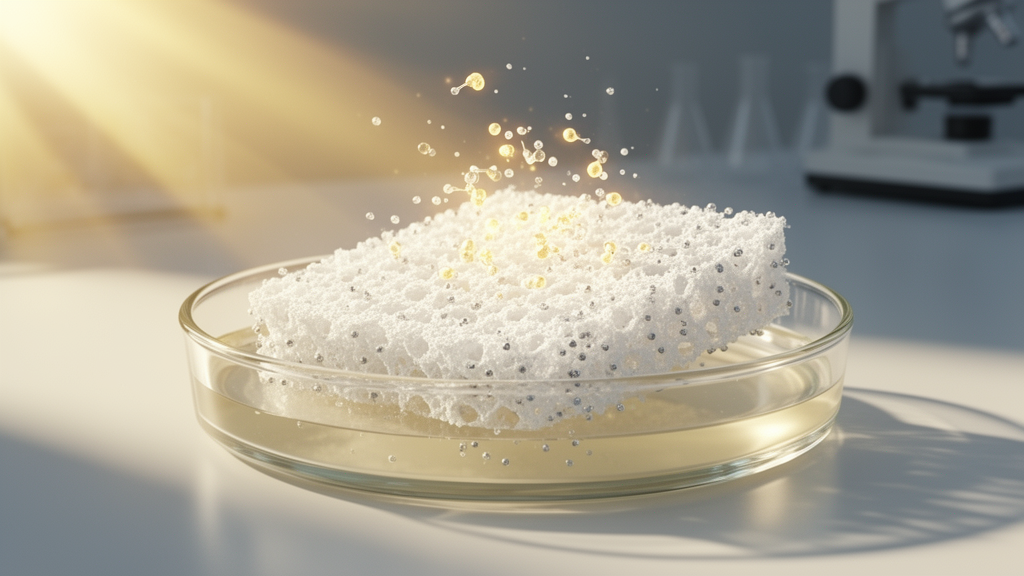
Ofloxacin, a fluoroquinolone antibiotic that resists biodegradation and contributes to antimicrobial resistance in aquatic environments, can be nearly completely broken down by a new sunlight-driven photocatalyst, according to a peer-reviewed accepted study published in Discover Chemical Engineering. The work, shared early with a permanent DOI and subject to final edits, reports that cellulose nanocrystal-supported TiO2 nanocomposites degraded approximately 98.6% of the antibiotic under direct sunlight.

The research team, comprising Abhijit Saha, Murali Mohan Seepana and Swambabu Varanasi, created the sustainable photocatalytic system by anchoring titanium dioxide onto cellulose nanocrystals. This support changed the optical properties of the catalyst in a way that matters for solar applications: the nanocomposite showed a lower band gap of 2.99 electronvolts, compared with 3.29 electronvolts for pristine TiO2, promoting better absorption of sunlight.

Under optimized conditions of 250 milligrams per litre catalyst dosage, pH 7 and 300 minutes of irradiation, the system achieved its peak performance, with the degradation following pseudo-first-order kinetics. The authors note that the findings indicate the potential of these nanocomposites as reusable photocatalysts for sunlight-driven antibiotic degradation in complex wastewater matrices.

A central result of the study concerns which reactive species actually drives the chemistry. Reactive-species scavenging experiments showed that photogenerated holes governed the degradation process, while superoxide radicals provided a secondary oxidative route. This hole-driven mechanism gives the nanocomposite its name in the paper’s title and distinguishes its operating chemistry from catalysts dominated by other radical pathways.

The degradation was not merely a fragmentation of the parent molecule into smaller pollutants. Liquid chromatography tandem mass spectrometry analysis confirmed multiple degradation pathways that finally led to mineralization, with 73.82% removal of total organic carbon. In other words, most of the organic carbon originally present in the antibiotic was converted out of organic form during treatment.

Performance in realistic conditions was also tested. In an ofloxacin-spiked complex wastewater matrix, the catalyst achieved approximately 94% degradation at laboratory scale, a result the authors describe as promising for hospital wastewater applications.

The study reports that cellulose nanocrystal incorporation improves catalyst recovery, and the catalyst retained 81.2% degradation efficiency after five reuse cycles. The authors also highlight the catalyst’s good stability and reusability over multiple cycles.

The study’s scope deserves careful reading. All results come from laboratory-scale experiments with ofloxacin-spiked matrices rather than continuous treatment of real wastewater streams, and the published version remains subject to further edits before the final Version of Record appears. The authors frame the work as indicating potential rather than demonstrating full-scale readiness.

By combining a bio-based support material with a lowered band gap, a hole-dominated mechanism and demonstrated reuse over five cycles, the CNC-TiO2 system offers a documented laboratory benchmark for sunlight-driven degradation of one of the more persistent antibiotic classes found in aquatic environments.

Subject of Research: Sunlight-driven photocatalytic degradation of the antibiotic ofloxacin using cellulose nanocrystal-supported TiO2 nanocomposites

Article Title: Hole-driven solar photocatalysis of ofloxacin using cellulose nanocrystal-supported TiO2 nanocomposites

Article References: Saha, A., Seepana, M. M., & Varanasi, S. (2026). Hole-driven solar photocatalysis of ofloxacin using cellulose nanocrystal-supported TiO2 nanocomposites. Discover Chemical Engineering. https://doi.org/10.1007/s43938-026-00154-8

Image Credits: AI Generated

DOI: 10.1007/s43938-026-00154-8

Keywords: ofloxacin, photocatalysis, TiO2, cellulose nanocrystals, antibiotic degradation, wastewater treatment, solar photocatalysis, photogenerated holes, mineralization, fluoroquinolone antibiotics, catalyst reusability, antimicrobial resistance

Cite Scienmag News

Bethany Barker. (October 27, 2026). Cellulose-supported TiO2 catalyst degrades antibiotic ofloxacin under direct sunlight. Scienmag. https://scienmag.com/cellulose-supported-tio2-catalyst-degrades-antibiotic-ofloxacin-under-direct-sunlight/


Bethany Barker. "Cellulose-supported TiO2 catalyst degrades antibiotic ofloxacin under direct sunlight." Scienmag, 27 October 2026, https://scienmag.com/cellulose-supported-tio2-catalyst-degrades-antibiotic-ofloxacin-under-direct-sunlight/. Accessed 27 October 2026.

Bethany Barker. "Cellulose-supported TiO2 catalyst degrades antibiotic ofloxacin under direct sunlight." Scienmag. October 27, 2026. https://scienmag.com/cellulose-supported-tio2-catalyst-degrades-antibiotic-ofloxacin-under-direct-sunlight/

Tags: antibiotic degradationAntimicrobial Resistanceantimicrobial resistance mitigation through photocatalysiscatalyst reusabilitycellulose nanocrystalscellulose nanocrystals as catalyst supportscellulose-supported TiO2 nanocompositesenhanced photocatalytic activity under sunlightfluoroquinolone antibioticsmineralizationofloxacinPhotocatalysisphotogenerated holespseudo-first-order kinetics in photocatalytic degradationreactive species in photocatalytic antibiotic breakdownremoval of ofloxacin from wastewatersolar photocatalysissolar-active nanocomposites forSunlight-driven photocatalyst for antibiotic degradationsustainable nanomaterials for water treatmentTiO2TiO2 nanocatalysts with lower band gap for environmental remediationwastewater treatment
Share26Tweet16
Previous Post

AI Reads Police Logs to Count Vulnerability, But Only With Heavy Human Correction

Next Post

Digital Skills and Distance Shape Financial Inclusion in Rural Punjab, Survey Finds

Related Posts

Explainable AI models track EV battery health over 6G networks
Technology and Engineering

Explainable AI models track EV battery health over 6G networks

October 27, 2026
Semi-analytical model maps heat transport in Maxwell nanofluid over stretching sheet
Technology and Engineering

Semi-analytical model maps heat transport in Maxwell nanofluid over stretching sheet

October 27, 2026
Graph Neural Networks and IoT Data Score Teaching Quality with 98% Accuracy
Technology and Engineering

Graph Neural Networks and IoT Data Score Teaching Quality with 98% Accuracy

October 27, 2026
IoT Sensors and Hybrid Machine Learning Model Predict Solar Panel Faults Before They Strike
Technology and Engineering

IoT Sensors and Hybrid Machine Learning Model Predict Solar Panel Faults Before They Strike

October 27, 2026
Waste Drink Cartons Turned Into Catalysts That Strip Sulfur From Tire Pyrolysis Oil
Chemistry

Waste Drink Cartons Turned Into Catalysts That Strip Sulfur From Tire Pyrolysis Oil

October 27, 2026
New Single Index Ranks Manufactured Sands for Concrete Suitability
Technology and Engineering

New Single Index Ranks Manufactured Sands for Concrete Suitability

October 27, 2026
Next Post
Digital Skills and Distance Shape Financial Inclusion in Rural Punjab, Survey Finds

Digital Skills and Distance Shape Financial Inclusion in Rural Punjab, Survey Finds

  • Mothers who receive childcare support from maternal grandparents show more optimized

    Mothers who receive childcare support from maternal grandparents show more parental warmth, finds NTU Singapore study

    27656 shares
    Share 11059 Tweet 6912
  • University of Seville Breaks 120-Year-Old Mystery, Revises a Key Einstein Concept

    1061 shares
    Share 424 Tweet 265
  • Bee body mass, pathogens and local climate influence heat tolerance

    682 shares
    Share 273 Tweet 171
  • Researchers record first-ever images and data of a shark experiencing a boat strike

    546 shares
    Share 218 Tweet 137
  • Groundbreaking Clinical Trial Reveals Lubiprostone Enhances Kidney Function

    531 shares
    Share 212 Tweet 133
Science

Embark on a thrilling journey of discovery with Scienmag.com—your ultimate source for cutting-edge breakthroughs. Immerse yourself in a world where curiosity knows no limits and tomorrow’s possibilities become today’s reality!

RECENT NEWS

  • Rebuilding Aghdam: how a destroyed city is testing sustainable urban recovery
  • Scientists can predict low birthweights in West Africa up to a year ahead using climate data
  • Explainable AI models track EV battery health over 6G networks
  • Nurses Emerge as Key Players in Taming Targeted Cancer Therapy Side Effects

Categories

  • Agriculture
  • Anthropology
  • Archaeology
  • Athmospheric
  • Biology
  • Biotechnology
  • Blog
  • Bussines
  • Cancer
  • Chemistry
  • Climate
  • Earth Science
  • Editorial Policy
  • Marine
  • Mathematics
  • Medicine
  • Pediatry
  • Policy
  • Psychology & Psychiatry
  • Science Education
  • Science News
  • Social Science
  • Space
  • Technology and Engineering

Subscribe to Blog via Email

Enter your email address to subscribe to this blog and receive notifications of new posts by email.

Join 5,151 other subscribers

© 2025 Scienmag - Science Magazine

Welcome Back!

Login to your account below

Forgotten Password?

Retrieve your password

Please enter your username or email address to reset your password.

Log In
No Result
View All Result
  • HOME
  • SCIENCE NEWS
  • CONTACT US

© 2025 Scienmag - Science Magazine

Discover more from Science

Subscribe now to keep reading and get access to the full archive.

Continue reading