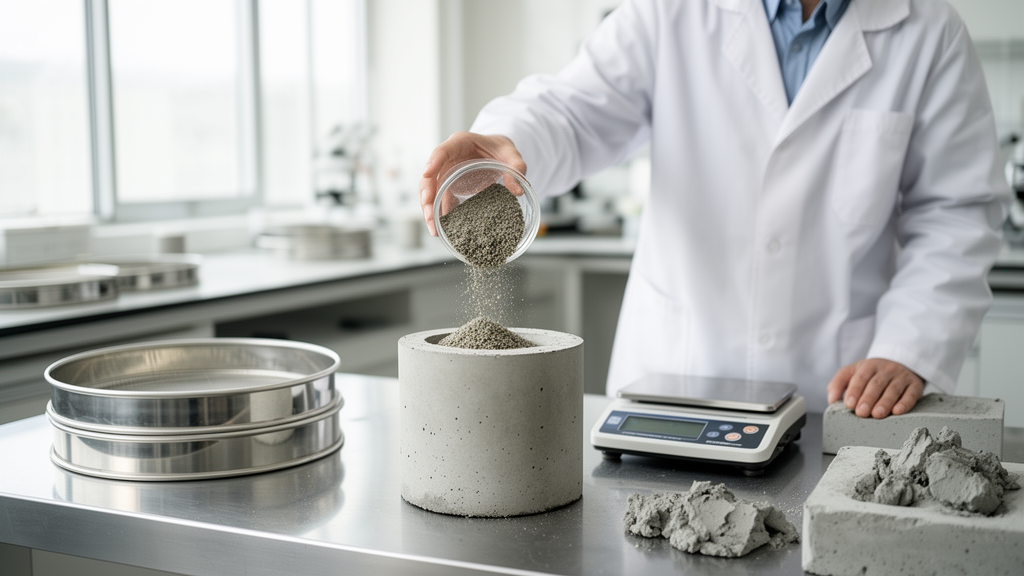
As natural river sand becomes scarcer and environmentally harder to extract, the construction industry has turned increasingly to crushed stone manufactured sand, commonly known as M-sand, as a fine aggregate for concrete and mortar. A new study published in Discover Civil Engineering proposes a practical answer to one of the persistent problems with this substitute material: its variability. Researchers have introduced a Composite Particle Size–Absorption Index, or CPSAI, a single dimensionless number that condenses four routinely measured laboratory parameters into one score that ranks M-sand sources by their likely suitability for concrete work.
The problem the index addresses is well known to materials engineers. Conventional standards such as ASTM C33 and IS 383 specify grading requirements for aggregates, but they focus mainly on definite grading zones and do not provide a unified indicator that captures the combined effects of coarseness, fines and absorption on suitability for concrete. In routine mix design practice, fine aggregate evaluation is typically limited to sieve analysis, water absorption and specific gravity, and these parameters are generally interpreted independently rather than as a combined picture of material behaviour.
The proposed CPSAI integrates four inputs: the fineness modulus, which describes the overall coarseness or fineness of the sand; the percentage of material passing the 600-micrometre sieve, representing the intermediate and coarser fine fraction; the percentage passing the 150-micrometre sieve, representing micro-fines; and water absorption, which reflects the porosity of the aggregate. Each parameter is normalized against the minimum and maximum values in the dataset, and the four normalized values are averaged to yield a single score. In the current formulation all four parameters carry equal weight, a choice the authors justify on the grounds of methodological simplicity and interpretability at the preliminary screening stage, rather than any claim of optimized predictive accuracy.
Each component of the index corresponds to a distinct aspect of aggregate behaviour. A higher fineness modulus generally indicates coarser sand, which may improve strength but reduce workability, while a lower value indicates finer sand that improves workability but may raise water demand and paste requirement. The 600-micrometre fraction affects particle packing, void ratio and the balance between coarse and fine particles. Micro-fines below 150 micrometres strongly influence water demand, cohesion and durability, because excess fines increase surface area and paste requirement. Water absorption governs the effective water–cement ratio during mixing, directly affecting workability, strength development and durability performance.
To test the index, the researchers examined twenty M-sand samples from different sources in the laboratory, measuring particle size distribution, fineness modulus, the two sieve fractions and water absorption following standard aggregate testing procedures. The calculated CPSAI values ranged from 0.230 to 0.927, a spread wide enough to allow meaningful classification. Based on the distribution of values and supported by strength trends, the team adopted preliminary suitability categories: a high CPSAI of 0.70 or above indicating excellent or very good sand, a medium range of 0.50 to 0.70 indicating moderate to good sand, and a low category below 0.50 indicating poor sand.
The validation step involved mortar rather than concrete. Mortar specimens were prepared with Ordinary Portland Cement 43 grade and each M-sand sample as fine aggregate, mixed at a 1:3 cement-to-sand ratio by weight with a constant water–cement ratio of 0.48. Fifty-millimetre cube specimens were cast, cured at approximately 27 degrees Celsius, and tested in compression at 28 days in accordance with ASTM C109, with three specimens tested per sample and averages, standard deviations and coefficients of variation calculated. The statistical analysis revealed a strong positive correlation between CPSAI and 28-day mortar compressive strength, with a Pearson correlation coefficient of 0.8958 and a coefficient of determination of 0.8024, meaning roughly 80 percent of the variation in mortar compressive strength was explained by the index in this dataset.
The physical interpretation of that correlation follows from aggregate behaviour. Sands with higher CPSAI values generally showed moderate fineness modulus values and lower percentages of micro-fines, characteristics typically associated with improved packing density and reduced effective water demand in mortar mixtures. Conversely, lower CPSAI values were associated with poorer particle packing and higher fines or absorption effects, which the authors link to reduced strength development. High-category samples exhibited balanced particle size distribution and relatively low water absorption, while medium-category samples showed moderate deviations such as slightly higher micro-fines content or increased absorption, suggesting they remain usable but may require adjustments in water content or admixture dosage. Low-category samples combined unfavourable traits such as excessive micro-fines, high absorption or imbalanced grading, and the authors do not recommend them for direct use without treatment measures such as washing, sieving or blending with higher-quality material.
A sensitivity analysis reinforced the internal logic of the index. By systematically varying micro-fines content, water absorption and grading characteristics within their observed practical ranges, the researchers showed that increases in water absorption or micro-fines content reduce CPSAI, and that deviations in grading balance, whether excessive coarseness or higher fines content, also lower the score. The authors note that a detailed parametric sensitivity model with graphical representation was beyond the primary scope of the study, and they recommend a more rigorous quantitative sensitivity analysis supported by experimental datasets in future work.
The team is explicit about the limits of what the index can claim. CPSAI is intended as a preliminary comparative screening tool, not a direct predictor of concrete performance. The validation reported here rests on mortar compressive strength at a single age under fixed mix proportions, not on comprehensive concrete performance tests covering workability or durability. The thresholds separating high, medium and low categories are derived from the spread of the twenty-sample dataset and are described as preliminary and dataset-dependent; for larger datasets or samples from different geological sources, the normalization bounds and the resulting CPSAI spread may differ, so the thresholds should be recalibrated before the index is applied elsewhere. The authors also note that the study focused on grading characteristics and water absorption, and that parameters such as specific gravity and bulk density were not incorporated, nor were advanced microstructural characterization techniques such as SEM, XRD or FTIR.
Even with those caveats, the practical appeal is clear. Because CPSAI is built from tests that most materials laboratories already perform as a matter of routine, it can be implemented without new equipment or procedures, giving engineers a fast way to rank competing sand sources during early-stage material evaluation. The authors suggest that future versions of the index could incorporate additional parameters such as specific gravity, particle shape, angularity, flakiness and methylene blue value, or adopt weighted formulations derived from correlations with concrete performance metrics including compressive strength, workability and durability. Full validation against concrete performance, they state, remains a subject of ongoing and future research, and the index should be read as a decision-support tool for preliminary assessment rather than a substitute for full mix design testing.
Subject of Research: A composite index combining grading and water absorption parameters to screen manufactured sand for concrete.
Article Title: Composite particle size–absorption index (CPSAI) for preliminary assessment of crushed stone manufactured sand for concrete applications
Article References: Khan, R. A. (2026). Composite particle size–absorption index (CPSAI) for preliminary assessment of crushed stone manufactured sand for concrete applications. Discover Civil Engineering, 3(1), Article 269. https://doi.org/10.1007/s44290-026-00666-w
Image Credits: AI Generated
DOI: 10.1007/s44290-026-00666-w
Keywords: manufactured sand, concrete, fine aggregate, CPSAI, water absorption, fineness modulus, compressive strength, mortar, screening tool, construction materials, sieve analysis, Composite
Cite Scienmag News
Denise Maddox. (October 27, 2026). New Single Index Ranks Manufactured Sands for Concrete Suitability. Scienmag. https://scienmag.com/new-single-index-ranks-manufactured-sands-for-concrete-suitability/
Denise Maddox. "New Single Index Ranks Manufactured Sands for Concrete Suitability." Scienmag, 27 October 2026, https://scienmag.com/new-single-index-ranks-manufactured-sands-for-concrete-suitability/. Accessed 28 October 2026.
Denise Maddox. "New Single Index Ranks Manufactured Sands for Concrete Suitability." Scienmag. October 27, 2026. https://scienmag.com/new-single-index-ranks-manufactured-sands-for-concrete-suitability/