Robots are unlike any other artificial intelligence system, argue Stephane Doncieux, Raja Chatila, Sirko Straube and Frank Kirchner in a position paper published in the journal AI Perspectives. Because robots are physical agents wired directly into the real world through their sensors and actuators, they act without any human mediation: sensor data flows into their decision systems, and chosen actions go straight to their motors. That closed loop with the physical environment, the authors write, is precisely what makes robotics both a special challenge for AI and the natural place to build technology designed around human needs.
The paper contrasts robots with typical AI systems such as search engines, recommendation tools and translation software, where a human launches the request and receives the result. Such systems are not active in the real world; only the human is. A robot, by contrast, perceives its surroundings, decides and acts, and its actions change the environment and shape its future perceptions. This direct coupling raises problems most AI never faces: errors can be amplified over time or create oscillations, robots move in continuous environments that are often underactuated like cars or redundant like humanoids, and their own noisy sensors leave them with only partial observability of the world.
Yet embodiment also creates unique opportunities. The authors highlight morphological computation, the ability of materials themselves to take over processes normally attributed to control software: grasping with soft, granular jamming grippers requires almost no computation compared with rigid fingers. Embodiment may also help solve one of AI’s oldest puzzles, symbol grounding. Instead of relying on huge text datasets, a robot can push an object and observe what moved, learning object boundaries through what researchers call interactive perception. Concepts become easier to grasp through interaction: a chair is sittable, a button pushable, an object graspable, a notion known as affordance.
The core of the paper is a set of requirements for human-centered robotics. Since every human is different and conditions change, such robots must be robust and adaptive, able to learn from experience rather than repeat failures infinitely. The authors argue that adaptation should sit on the robot’s side, not the human’s, citing autonomous vacuum cleaners that still stumble in uncontrolled homes and leave users to diagnose and rework their own environments. Reinforcement learning is a powerful route to versatility, they note, but notoriously difficult in robotics because of continuous, partially observable, noisy settings, and large state and action spaces make discovering good behaviors harder. One proposed direction is open-ended learning, where robots build their own state and action spaces on the fly, guided by intrinsic motivations in a process inspired by child development.
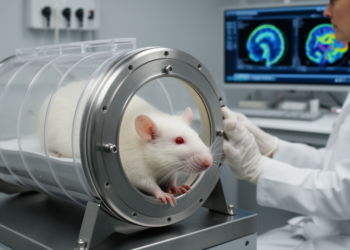
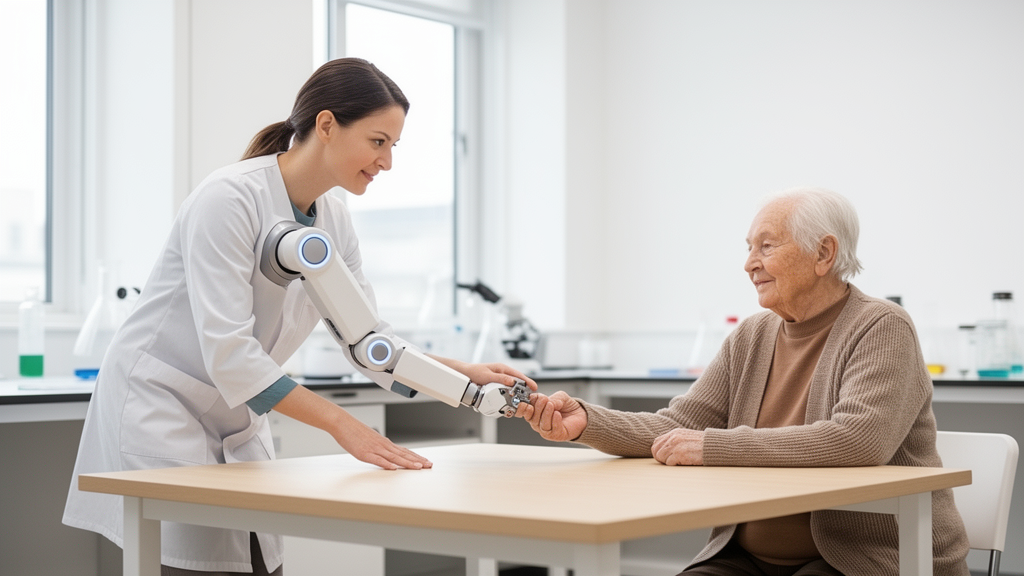
Interaction with humans takes three forms: physical, verbal and non-verbal. Physical interaction has advanced through compliant mechanical designs, spring-like elements in actuators, torque control and fast external-force reaction algorithms. Safety is treated on three levels: compliant mechanisms that absorb impact energy, nested position-and-torque control loops that make the robot retract when force limits are violated, and environmental monitoring with cameras and range finders that progressively slow the robot as a person approaches. In rehabilitation, the authors describe experimental studies in which AI methods predict the lateral readiness potential from the human electro-encephalogram up to 200 milliseconds before a deliberate movement, allowing an exoskeleton to perform the intended motion so the user experiences it as consciously self-performed.
Verbal interaction brings its own difficulties. Natural language commands are convenient for non-expert or physically impaired users, but robots must connect words to their own sensorimotor flow: an order like “go through the door” requires identifying the actual door nearby. Language is not static, evolving through social interaction, and varies across regions, so a human-centered robot must adapt its language to its interlocutor. The grounding problem, associating words with raw sensorimotor data, remains one of AI’s long-standing challenges, and building robots that autonomously construct grounded symbols, what the authors call symbol emergence, remains an open research problem.
Non-verbal communication, including kinesics, proxemics, haptics and chronemics, represents a significant part of meaning between humans, and nonverbal cues have been shown to help children learn new words from robots. Robot appearance matters too: humanlike shapes influence response delays, distance and embarrassment, and Mori’s uncanny valley theory, in which near-human robots provoke eeriness and rejection, has received mixed empirical support, with some experiments validating it and others contradicting it.
For robots and humans to work as teams, the robot must understand human intentions through probabilistic reasoning over actions, posture, gestures and facial expressions, plan with uncertainty using approaches such as markovian processes, and supervise joint tasks. Learning from humans ranges from demonstration, such as teaching a robot to pack shoes in a box when exact modeling proved impossible, to remarkably subtle signals: the authors describe using the error potential, a brain response generated subconsciously when a mismatch between expected and actual input occurs, as a reinforcement signal to improve an already trained robot online, since it arises before conscious awareness and requires no verbalization.
Making robots understandable to humans is equally hard, the authors stress, because multi-level control hierarchies involving deep neural networks are extremely difficult even for experts to interpret. Proposed solutions include robots verbally explaining their actions, expressive faces and gestures, and shared gesture or graphical alphabets emerging from real-world practice, though long-term studies of explanation-based approaches have not been carried out. Finally, the paper confronts ethics: transformation of work, surveillance and privacy, affective attachment to robots, human augmentation, android identity, sexbots and autonomous weapons. The authors argue that full algorithmic formalization of ethics is impossible because human moral judgment is not amenable to computation, and endorse value-based design in which human designers resolve ethical issues beforehand, pointing to frameworks such as the HLEG-AI’s 2019 requirements for trustworthy AI, from human oversight and robustness to transparency, fairness and accountability, while noting that translating such principles into practice remains unresolved.
Subject of Research: Human-centered AI and robotics requirements, interaction modalities and ethical questions
Article Title: Human-centered AI and robotics
Article References: Doncieux, S., Chatila, R., Straube, S., & Kirchner, F. (2022). Human-centered AI and robotics. AI Perspectives, 4(1), Article 1. https://doi.org/10.1186/s42467-021-00014-x
Image Credits: AI Generated
DOI: 10.1186/s42467-021-00014-x
Keywords: human-centered AI, robotics, human-robot interaction, reinforcement learning, symbol grounding, physical interaction, verbal interaction, non-verbal communication, rehabilitation exoskeletons, learning from demonstration, robot ethics, trustworthy AI
Cite Scienmag News
Denise Maddox. (October 28, 2026). Research report: Human-centered AI and robotics. Scienmag. https://scienmag.com/research-report-human-centered-ai-and-robotics/
Denise Maddox. "Research report: Human-centered AI and robotics." Scienmag, 28 October 2026, https://scienmag.com/research-report-human-centered-ai-and-robotics/. Accessed 29 October 2026.
Denise Maddox. "Research report: Human-centered AI and robotics." Scienmag. October 28, 2026. https://scienmag.com/research-report-human-centered-ai-and-robotics/