

Tuesday, October 27, 2026
Science
No Result
View All Result
  • Login
  • HOME
  • SCIENCE NEWS
  • CONTACT US
  • HOME
  • SCIENCE NEWS
  • CONTACT US
No Result
View All Result
Scienmag
No Result
View All Result
Home Science News Climate

Future Climates Could Reshape How Building-Integrated Solar Performs

October 27, 2026
in Climate
Sloane Callahan
By Sloane Callahan Scienmag Editorial Profile - Climate Mitigation
Reading Time: 2 mins read
0
Future Climates Could Reshape How Building-Integrated Solar Performs

Future Climates Could Reshape How Building-Integrated Solar Performs

65
SHARES
587
VIEWS
Share on FacebookShare on Twitter
ADVERTISEMENT

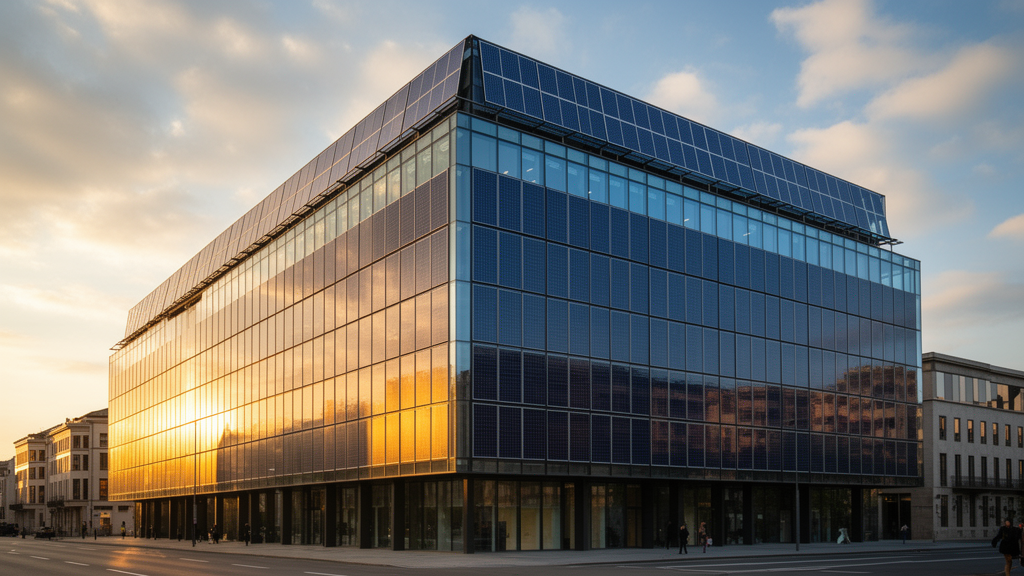
Building-integrated photovoltaics (BIPV) are widely promoted as a way to cut building energy use and carbon emissions, but most design optimization studies rely on historical weather datasets that may not reflect the conditions buildings will actually face. A new computational study finds that this gap matters: conventional EPW weather files systematically under-predict the modeled performance of BIPV envelope systems, particularly in Berlin and Los Angeles.

Researchers led by Elyas Hannoufa and Eric Johlin developed a multi-objective optimization framework that uses future climate projections from the CanESM5 model under the SSP3-7.0 scenario. They examined two system configurations—awning shades and thin-film window coatings—in four cities with diverse climates: Berlin, Los Angeles, Chicago and Singapore. The optimization integrated electricity generation, thermal loads and daylighting quality to capture building-level trade-offs, comparing results from conventional EPW files, NASA 2023 historical data and projected 2046–2050 conditions.

Under the 2046–2050 projected conditions, all four cities showed modeled performance gains for optimized BIPV systems: substantial in Berlin, Chicago and Los Angeles, and marginal in Singapore, with the largest absolute gains in Los Angeles. The study also found that by 2050, unshaded windows transition to being consistently detrimental for the building energy balance, strengthening the case for active envelope treatments.

Perhaps the most counterintuitive result concerns thin-film window coatings. The optimization achieved its best outcomes at high absorptance, in the 80–90% range, contrary to current low-absorption design practice. This suggests that under warmer projected climates, coatings that absorb more solar energy—when optimized alongside electricity generation, thermal loads and daylighting—can outperform the low-absorption designs favored today.

The authors emphasize that these findings apply within the CanESM5 SSP3-7.0 scenario examined, and that the results are model projections rather than measurements of installed systems. Even so, the work indicates that projected climate conditions can substantially reshape the modeled performance landscape of BIPV systems. The researchers argue that building design optimization should incorporate forward-looking climate projections rather than relying solely on historical datasets, and that BIPV is likely to grow in importance for climate-adaptive and resilient urban buildings.

Subject of Research: Modeling the performance of optimized building-integrated photovoltaic systems under projected future climate conditions

Article Title: Climate change impacts on the predicted performance of optimized building-integrated photovoltaics

Article References: Hannoufa, E., & Johlin, E. (2026). Climate change impacts on the predicted performance of optimized building-integrated photovoltaics. PLOS Climate, 5(10), e0001087. https://doi.org/10.1371/journal.pclm.0001087

Image Credits: AI Generated

DOI: 10.1371/journal.pclm.0001087

Keywords: building-integrated photovoltaics, climate change, SSP3-7.0, CanESM5, building energy performance, window coatings, awning shades, daylighting, thermal loads, climate adaptation, urban buildings, energy modeling

Cite Scienmag News

Sloane Callahan. (October 27, 2026). Future Climates Could Reshape How Building-Integrated Solar Performs. Scienmag. https://scienmag.com/future-climates-could-reshape-how-building-integrated-solar-performs/

Sloane Callahan. "Future Climates Could Reshape How Building-Integrated Solar Performs." Scienmag, 27 October 2026, https://scienmag.com/future-climates-could-reshape-how-building-integrated-solar-performs/. Accessed 27 October 2026.

Sloane Callahan. "Future Climates Could Reshape How Building-Integrated Solar Performs." Scienmag. October 27, 2026. https://scienmag.com/future-climates-could-reshape-how-building-integrated-solar-performs/


Tags: awning shadesBIPV system performance in diverse climatesbuilding energy performancebuilding-integrated photovoltaicsCanESM5Climate Adaptationclimate adaptation strategies for building envelopesclimate changeclimate change and building energy efficiencyclimate projections for BIPV optimizationcomputational modeling of climate-resilient building designdaylightingenergy modelingEPW weather data limitationsfuture climate impact on solar performancemulti-objective optimization for solar systemsprojected changes in window shading and energy balanceSSP3-7.0thermal loadsthermal loads and daylighting in buildingsurban buildingsurban climate variations affecting solar energywindow coatings
Share26Tweet16
Previous Post

Retinal Collapse in HIV and Diabetes Points to Organ Burden, Not CD4 Counts

Next Post

Dragon’s Blood Resin Shows Preclinical Promise for Protecting Post-Stroke Memory

Related Posts

Forests Become Security Assets as Baltic States Rethink Bioenergy After Ukraine War
Climate

Forests Become Security Assets as Baltic States Rethink Bioenergy After Ukraine War

October 27, 2026
Why Collaborative Climate Research Keeps Falling Short of Transforming Adaptation
Climate

Why Collaborative Climate Research Keeps Falling Short of Transforming Adaptation

October 27, 2026
Desert Shrub Rings Reveal How Monsoon and Westerlies Shape Northwest China’s Climate
Climate

Desert Shrub Rings Reveal How Monsoon and Westerlies Shape Northwest China’s Climate

October 27, 2026
Same plant, different fate: climate sensitivity shifts from region to region
Climate

Same plant, different fate: climate sensitivity shifts from region to region

October 27, 2026
Recyclable oligo(disulfide) anolyte pushes aqueous flow batteries toward grid scale
Climate

Recyclable oligo(disulfide) anolyte pushes aqueous flow batteries toward grid scale

October 27, 2026
Fifty Years of Plant Mapping Show Biodiversity Hotspots in Southwest Germany Are Eroding
Climate

Fifty Years of Plant Mapping Show Biodiversity Hotspots in Southwest Germany Are Eroding

October 27, 2026
Next Post
Dragon’s Blood Resin Shows Preclinical Promise for Protecting Post-Stroke Memory

Dragon's Blood Resin Shows Preclinical Promise for Protecting Post-Stroke Memory

  • Mothers who receive childcare support from maternal grandparents show more optimized

    Mothers who receive childcare support from maternal grandparents show more parental warmth, finds NTU Singapore study

    27656 shares
    Share 11059 Tweet 6912
  • University of Seville Breaks 120-Year-Old Mystery, Revises a Key Einstein Concept

    1061 shares
    Share 424 Tweet 265
  • Bee body mass, pathogens and local climate influence heat tolerance

    682 shares
    Share 273 Tweet 171
  • Researchers record first-ever images and data of a shark experiencing a boat strike

    546 shares
    Share 218 Tweet 137
  • Groundbreaking Clinical Trial Reveals Lubiprostone Enhances Kidney Function

    531 shares
    Share 212 Tweet 133
Science

Embark on a thrilling journey of discovery with Scienmag.com—your ultimate source for cutting-edge breakthroughs. Immerse yourself in a world where curiosity knows no limits and tomorrow’s possibilities become today’s reality!

RECENT NEWS

  • Rebuilding Aghdam: how a destroyed city is testing sustainable urban recovery
  • Scientists can predict low birthweights in West Africa up to a year ahead using climate data
  • Explainable AI models track EV battery health over 6G networks
  • Nurses Emerge as Key Players in Taming Targeted Cancer Therapy Side Effects

Categories

  • Agriculture
  • Anthropology
  • Archaeology
  • Athmospheric
  • Biology
  • Biotechnology
  • Blog
  • Bussines
  • Cancer
  • Chemistry
  • Climate
  • Earth Science
  • Editorial Policy
  • Marine
  • Mathematics
  • Medicine
  • Pediatry
  • Policy
  • Psychology & Psychiatry
  • Science Education
  • Science News
  • Social Science
  • Space
  • Technology and Engineering

Subscribe to Blog via Email

Enter your email address to subscribe to this blog and receive notifications of new posts by email.

Join 5,151 other subscribers

© 2025 Scienmag - Science Magazine

Welcome Back!

Login to your account below

Forgotten Password?

Retrieve your password

Please enter your username or email address to reset your password.

Log In
No Result
View All Result
  • HOME
  • SCIENCE NEWS
  • CONTACT US

© 2025 Scienmag - Science Magazine

Discover more from Science

Subscribe now to keep reading and get access to the full archive.

Continue reading