


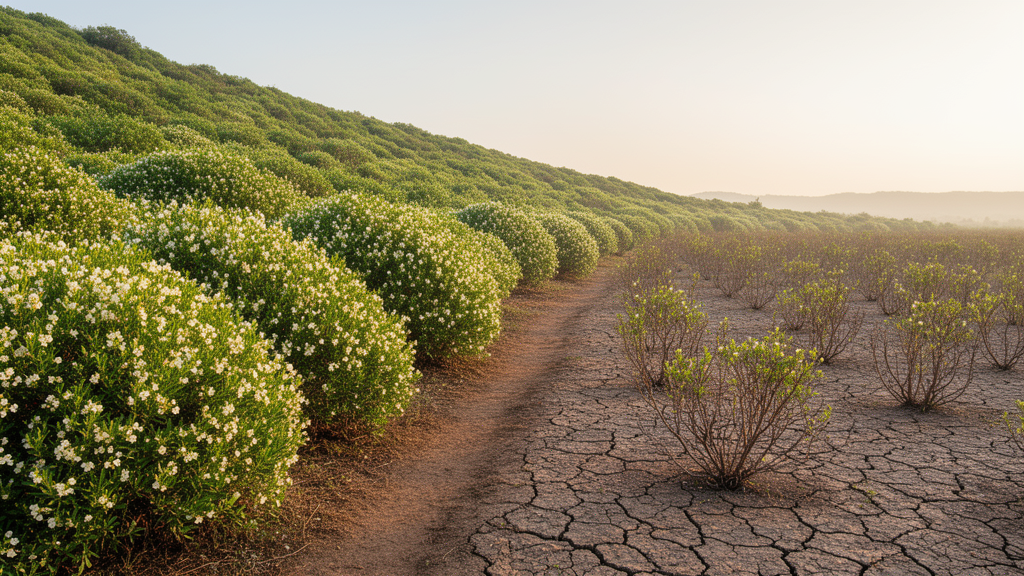
A new analysis of vascular plants across the United States has found that the fate of an individual species under climate change tends to be a regional phenomenon rather than a national one. According to the study, published in the journal Ecography, a plant species found in the Southwest may be more vulnerable to a warming climate than the very same species in the Midwest, or vice versa. The finding carries a practical message for conservation: focusing on regional rather than national data yielded the most reliable results for understanding which species are most in need of protection, and where that protection should be directed.
The research was led by Weiqing Qu, a Ph.D. student in the School of Integrative Biology at the University of Illinois Urbana-Champaign, and co-led by Jason Bried, a research scientist in the School of Integrative Biology and in the Illinois Natural History Survey at the U. of I. The INHS is a division of the Prairie Research Institute at Illinois. The work was supported by the U.S. Environmental Protection Agency, and the authors declare no conflict of interest.
To structure the analysis, the team relied on regional zones that had been delineated more than a decade earlier by the U.S. Geological Survey National and Regional Climate Adaptation Science Centers, a multi-institutional project initiated by the U.S. Department of the Interior to protect the country’s natural and cultural resources from the dramatic effects of climate change. The study included seven of these CASC regional zones: Midwest, North Central, Northeast, Northwest, South Central, Southeast and Southwest. Each region in the contiguous United States includes between three and 14 states and is defined by state boundaries.
Qu and her colleagues chose to focus on vascular plants because, as she explained, they are taxonomically, functionally and genetically diverse, and very sensitive to climate change. They are also well documented across the lower 48 states, which makes it easy to collect and analyze their abundance in different regions. The researchers wanted to determine how best to evaluate plant vulnerability to climate change using the data that are already available, Qu said.
The method itself is deliberately simple in its data requirements. “All we need for this method is two data sets: plant geographic occurrence records and climate niche breadth,” Qu said. The underlying assumption is that if a plant occupies a broader climate niche, it may be less sensitive to climate change. From these inputs, the team calculated what they call the “intrinsic climate sensitivity” of each plant species analyzed. The study included 384 species found in each of the seven CASC regions, and 22 species that occur in every one of the 48 states that make up the CASC regions.
The logic behind the climate niche assumption is straightforward. Plants found across a wide range of elevations or latitudes may experience a broader range of climatic conditions, potentially making them less sensitive to climate change, Qu said. In regions with diverse elevations, cooler areas may provide potential refuges for some plant species as temperatures rise. A species that can persist from a lowland valley to a mountaintop, in other words, already tolerates a wider slice of the climate spectrum than one confined to a narrow band of conditions.
After determining species’ climate sensitivity in different states and regions, the team compared those values. They found that each species’ climate sensitivity tended to be more similar within a CASC region than across regions, confirming that vulnerability is patterned geographically rather than being a fixed property of a species across its entire range. They also found that plants that occupy a broader swath of territory in regions with a lot of geographic diversity, or in areas with a glacial history, tend to be less vulnerable to climate change.
Why would glacial history matter for how a plant responds to a warming world? These differences may reflect evolutionary and biogeographic histories, Qu said. Historical glacial activity or landscape diversity may have influenced how plants dispersed, recolonized different regions and occupied a range of environmental conditions. Such processes could help explain why the same species exhibits different levels of climate sensitivity across geographic regions. In areas shaped by past glaciations, species may have repeatedly moved, re-established and adapted to varied conditions, leaving them today with broader tolerances than relatives of the same species elsewhere.
To put their rankings in context, the researchers compared their intrinsic climate sensitivity rankings with state conservation status rankings, another method used to evaluate threats to plant persistence. Their findings largely paralleled the state rankings while streamlining the process. State conservation status rankings are a useful tool for determining which species are of most concern for conservation, and these rankings dovetail with national and international rankings of extinct, endangered, rare or threatened species and are used in those assessments.
Yet the established ranking systems have practical drawbacks. State and national conservation rankings rely on a more time-consuming process of evaluating a variety of factors that may influence a plant’s status, and this sometimes leads to gaps in the data, Qu said. For example, some states, including Illinois, use a protocol developed by NatureServe, a source of biodiversity data that, according to its website, works with 60 network organizations and nearly 1,000 conservation professionals to collect, analyze and deliver biodiversity knowledge that informs conservation action. NatureServe’s process for plants involves analyzing each species’ widest distribution, population size, number of occurrences, short-term and long-term trends and known threats. The data are reliable and trusted by conservationists, but some plants in some states have not been ranked, Qu noted.
That is where the new approach offers an advantage. “With our method, we can fill in the missing data,” Qu said. “This approach is also useful for seeing how individual species’ climate sensitivity varies across regions and which environmental factors are associated with those differences.” Because the method requires only occurrence records and climate niche breadth, it can be applied where the slower, multi-factor assessments have not yet reached, while still producing results that track closely with the rankings conservation managers already use.
The study also reframes how researchers think about vulnerability itself. “Previously, we put a lot of emphasis on how different species respond to climate change, but in this study, we’re focusing on whether the same species shows different levels of climate sensitivity across different regions,” Qu said. “We are emphasizing that a one-size-fits-all strategy doesn’t work. Understanding these regional differences can help practitioners direct conservation resources to where they are most needed.” And to do that, she said, “we need to have a region-specific conservation strategy.”
The paper, “Spatial variation and predictors of plant species’ intrinsic climate sensitivity across the conterminous United States,” was published online on October 6, 2026, with the DOI 10.1002/ecog.08894.
Subject of Research: Regional variation in the intrinsic climate sensitivity of vascular plant species across the conterminous United States
Article Title: Study finds plant climate sensitivity varies by region
Article References: Study finds plant climate sensitivity varies by region. Original publication (Bibliographic details unavailable.)
Image Credits: AI Generated
DOI: Not provided
Keywords: climate change, vascular plants, climate sensitivity, conservation, Ecography, CASC regions, climate niche breadth, biogeography, glacial history, NatureServe, University of Illinois, biodiversity
Cite Scienmag News
Margaret Porter. (October 27, 2026). Same plant, different fate: climate sensitivity shifts from region to region. Scienmag. https://scienmag.com/same-plant-different-fate-climate-sensitivity-shifts-from-region-to-region/
Margaret Porter. "Same plant, different fate: climate sensitivity shifts from region to region." Scienmag, 27 October 2026, https://scienmag.com/same-plant-different-fate-climate-sensitivity-shifts-from-region-to-region/. Accessed 27 October 2026.
Margaret Porter. "Same plant, different fate: climate sensitivity shifts from region to region." Scienmag. October 27, 2026. https://scienmag.com/same-plant-different-fate-climate-sensitivity-shifts-from-region-to-region/


