


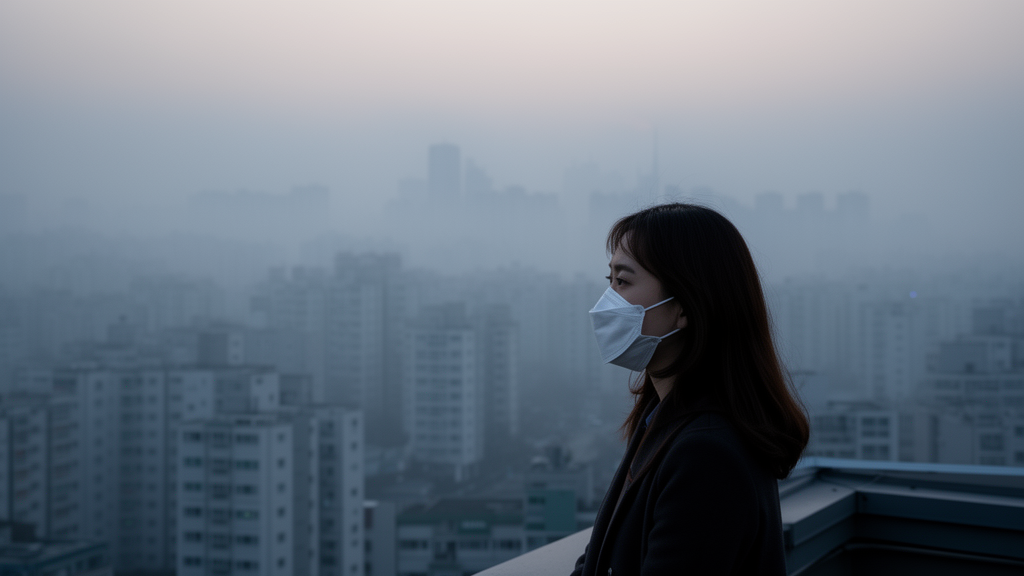
Fine particulate matter, known to scientists as PM2.5, is among the most insidious pollutants in the modern atmosphere. These particles, measuring 2.5 micrometers or less across, are small enough to slip past the body’s natural defenses, penetrate deep into the lungs, and even cross into the bloodstream. Decades of epidemiological research have linked chronic exposure to premature death from cardiovascular and respiratory disease, and South Korea, with its dense industrial corridors and periodic episodes of severe haze, has long wrestled with how to manage the threat. But knowing that air pollution kills is only half the policy problem. The other half is economic: how much is society actually willing to pay to reduce that risk? A new study published in the journal Air Quality, Atmosphere & Health by Hyunji Lee, Daeyoung Kwon, Sangwon Choi, and Brian H.S. Kim set out to answer precisely that question, and its findings carry weight far beyond the Korean peninsula.
The research team employed a survey-based technique known as the double-bounded dichotomous choice contingent valuation method, or CVM, one of the most widely used tools in environmental economics for pricing goods that never appear on any market. Clean air is a classic example of such a non-market good: no one buys a unit of reduced mortality risk at a store, yet people clearly value it. Contingent valuation works by constructing a hypothetical market. Respondents are asked whether they would pay a specific amount for a defined improvement in this case, a policy that reduces mortality risk by one in ten thousand. In the double-bounded variant, a follow-up question adjusts the offered amount depending on the first answer, tightening the statistical bounds around each household’s true willingness to pay and yielding far more precise estimates than a single yes-or-no question.
The headline numbers are striking. The researchers found that the average South Korean household would be willing to pay 41,643 Korean won per year, roughly 29.75 US dollars, for a policy that cuts PM2.5-related mortality risk by one in ten thousand. Scaling that per-household figure against the size of the risk reduction yields a Value of a Statistical Life, or VSL, of approximately 416.4 million won, or about 297,428 US dollars. The VSL is a cornerstone metric in health and safety economics; it does not assign a price to any identifiable person’s life, but rather measures how much a population collectively values small reductions in the probability of death. Regulators around the world use VSL estimates to weigh the costs of pollution controls, traffic safety measures, and workplace protections against the mortality benefits they deliver.
When the per-household values are extrapolated across the entire nation, the aggregate picture becomes dramatic. The study calculates a total annual social benefit of approximately 681.9 billion won, equivalent to roughly 487 million US dollars, for achieving the specified mortality risk reduction. That figure represents the economic dividend that cleaner air would deliver to Korean society each year, and it provides policymakers with a concrete benchmark. If a proposed regulation, such as stricter emissions standards for factories or tighter controls on construction dust, costs less than this aggregate benefit to implement, the economic case for action becomes compelling. In effect, the study converts an abstract public health aspiration into the language of cost-benefit analysis that finance ministries and legislatures understand.
Perhaps the most intriguing finding, however, concerns not money but information. The analysis revealed that household willingness to pay was significantly influenced by income, which is consistent with standard economic theory, since richer households can afford to spend more on risk reduction. But the strongest and most notable driver was public awareness of existing environmental policies and access to information about air quality. Households that knew more about what their government was already doing, and that had better access to pollution data, expressed systematically higher valuations for further improvements. This suggests that willingness to pay is not a fixed psychological constant but a socially conditioned variable, shaped by how transparently governments communicate and how engaged citizens are with environmental issues.
The implications of that awareness effect ripple outward in two directions. First, it means that public engagement campaigns and information disclosure programs are not merely decorative additions to environmental policy; they are critical co-factors that can amplify the perceived value of clean air interventions and, by extension, the political feasibility of funding them. A government that invests in real-time air quality monitoring, accessible public dashboards, and clear communication about policy goals may simultaneously raise the societal benefit it can claim for its pollution control programs. Second, the finding offers a caution: if citizens distrust or remain unaware of existing policies, their stated willingness to pay may understate the true social value of clean air, leading to systematic underinvestment in mitigation.
Methodologically, the study sits within a rich tradition of Korean and international research on the economics of air pollution. Earlier Korean studies estimated willingness to pay for reductions in coarse particulate matter, examined averting expenditures on protective masks and air purifiers, and applied contingent valuation to Seoul’s air quality. Internationally, comparable work in Beijing, Tehran, and China’s Jing-Jin-Ji region has documented similarly substantial public valuations of particulate matter risk reductions, while global assessments by the OECD and the Global Burden of Disease project have framed air pollution as one of the largest environmental health burdens worldwide. The new Korean estimates add a carefully constructed, nationally relevant data point to this comparative landscape, one that reflects both the country’s distinctive pollution profile and its citizens’ evolving environmental consciousness.
The technical rigor of the double-bounded design deserves emphasis, because contingent valuation has historically faced skepticism about hypothetical bias, the tendency of survey respondents to overstate what they would actually pay in a real transaction. By using two linked binary choices per respondent, the method narrows each individual’s valuation interval and allows researchers to model responses with econometric frameworks rooted in the utility theory first formalized for discrete choice contexts by Hanemann in the 1980s. The researchers also had to grapple with protest zero bids, responses in which people reject the payment premise altogether, often because they believe polluters or the government, not citizens, should bear the cost. How such protests are treated can materially shift the final estimate, and the Korean literature has developed dedicated protocols for identifying and handling them.
For South Korea specifically, the timing of this valuation is significant. The country has experienced recurring springtime haze episodes, driven by a combination of domestic emissions from industry, power generation, and transportation, and transboundary transport of pollutants from neighboring regions. Public concern over fine dust has become a fixture of Korean civic life, with mask-wearing and air purifier purchases now routine household responses. By quantifying the mortality-related benefits of risk reduction in monetary terms, the study gives Korean policymakers a defensible economic foundation for investments in cleaner production technologies, emissions controls, and cross-border cooperation. The authors frame their results as a pathway for aligning public health objectives with sustainable development goals, a framing that resonates as nations weigh climate and air quality policies against economic growth pressures.
Ultimately, the study’s broader lesson may be its most viral takeaway: the value of clean air is not an abstraction that only economists can compute, but a measurable quantity that ordinary households reveal every time they answer a survey, buy an air purifier, or demand better information from their government. A single household’s 29.75 dollars a year may seem modest, but multiplied across millions of homes, it becomes nearly half a billion dollars of annual social value attached to a one-in-ten-thousand reduction in pollution mortality. That arithmetic transforms air quality from a public health talking point into a bankable policy asset, and it sends a clear signal to governments everywhere: investing in transparency and public engagement is not just good governance, it is a direct multiplier on the economic returns of every clean air program they fund.
Subject of Research: Economic valuation of mortality risk reductions from PM2.5 air pollution in South Korea using contingent valuation
Article Title: Valuing clean air: economic assessment of mortality risks from PM2.5 in South Korea
Article References: Lee, H., Kwon, D., Choi, S., & Kim, B. H. S. (2026). Valuing clean air: economic assessment of mortality risks from PM2.5 in South Korea. Air Quality, Atmosphere & Health, 19(11), Article 240. https://doi.org/10.1007/s11869-026-02062-w
Image Credits: AI Generated
DOI: 10.1007/s11869-026-02062-w
Keywords: PM2.5, air pollution, contingent valuation, willingness to pay, value of statistical life, South Korea, environmental economics, health economics, mortality risk, environmental policy, public awareness, air quality
Cite Scienmag News
Russell Cooper. (October 19, 2026). What Is Clean Air Worth? South Korea Puts a Price Tag on PM2.5 Deaths. Scienmag. https://scienmag.com/what-is-clean-air-worth-south-korea-puts-a-price-tag-on-pm2-5-deaths/
Russell Cooper. "What Is Clean Air Worth? South Korea Puts a Price Tag on PM2.5 Deaths." Scienmag, 19 October 2026, https://scienmag.com/what-is-clean-air-worth-south-korea-puts-a-price-tag-on-pm2-5-deaths/. Accessed 19 October 2026.
Russell Cooper. "What Is Clean Air Worth? South Korea Puts a Price Tag on PM2.5 Deaths." Scienmag. October 19, 2026. https://scienmag.com/what-is-clean-air-worth-south-korea-puts-a-price-tag-on-pm2-5-deaths/


