


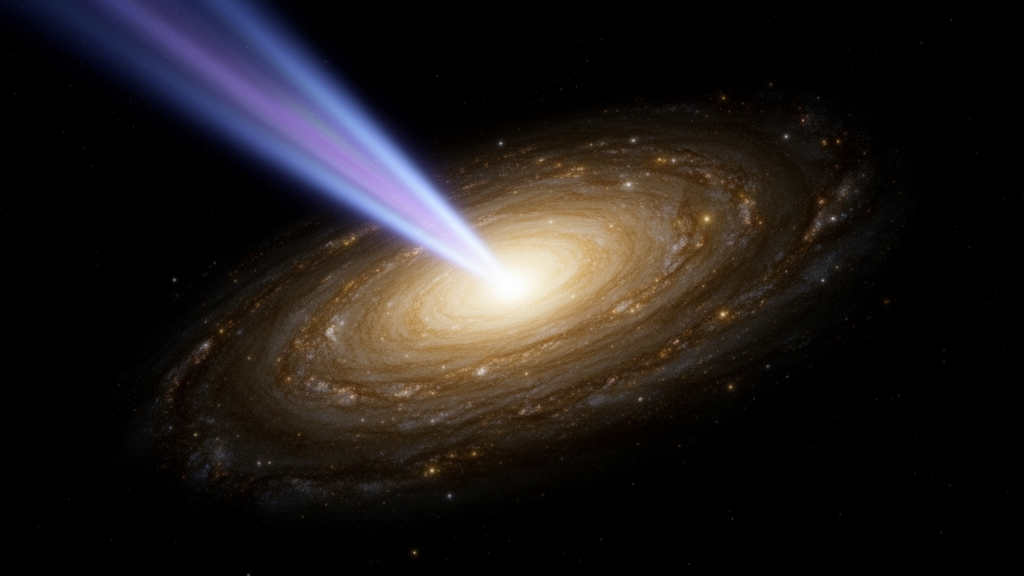
More than three decades after the Hubble Space Telescope first revealed a glowing jet of plasma blasting out of the elliptical galaxy NGC 3862, a new study has brought the most powerful observatories in existence to bear on this cosmic particle accelerator. The research, published in Astrophysics and Space Science, combines fresh infrared imaging from the James Webb Space Telescope with a deep, eight-observation dataset from the Chandra X-ray Observatory to tackle one of the most stubborn puzzles in high-energy astrophysics: what actually makes the X-rays in the jets of relatively nearby active galaxies?
The jet in question belongs to 3C 264, the radio designation for NGC 3862, a giant elliptical galaxy sitting roughly 290 million light-years away in the constellation Leo. Like many galaxies hosting active galactic nuclei, NGC 3862 harbors a supermassive black hole at its center that is actively feeding, launching a narrow, magnetized stream of relativistic particles thousands of light-years into space. Because the jet is close enough to be spatially resolved — meaning astronomers can actually trace its knots and structure rather than seeing it as a single point of light — it serves as a natural laboratory for testing theories of how jets shine across the electromagnetic spectrum.
The new analysis, led by Olivia Evans, used JWST’s Near-Infrared Camera, or NIRCam, to image the jet in the near-infrared for the first time with such sensitivity. The instrument detected the jet along the same northeast structure that had previously been traced at radio, optical, and X-ray wavelengths, confirming that the emission seen by Webb comes from the same physical plasma beam. Among the filters used, the F070W band produced the clearest near-infrared morphology of the jet, giving researchers a new window onto the population of electrons spiraling in the jet’s magnetic field.
The measured brightnesses tell a quantitative story. Across the full extent of the jet, the team found a flux density of 44.5 millijanskys at 4.89 gigahertz in radio observations from the Very Large Array, 93.1 microjanskys in the F070W near-infrared band, and 201 microjanskys in the F444W band. Those numbers, combined with archival Hubble imaging, allowed the construction of a spectral energy distribution — a kind of fingerprint showing how the jet’s output changes with frequency — stretching from radio waves all the way to X-rays.
On the X-ray side, the study stacked eight Chandra Advanced CCD Imaging Spectrometer observations taken with the ACIS-S instrument, totaling 119 kiloseconds of exposure time. That depth was essential because the jet’s X-ray emission is faint and sits dangerously close to the blinding glare of the galaxy’s active nucleus. The team carefully corrected for the wings of the telescope’s point-spread function — the halo of light that spills from the bright central source into surrounding pixels — before extracting a clean jet signal. The result was a 0.5 to 2 kiloelectronvolt jet flux of (8.97 ± 0.36 statistical ± 1.52 systematic) × 10⁻¹⁴ erg per square centimeter per second, modeled as an absorbed power law with photon index 2.25.
With the full radio-to-X-ray spectrum in hand, the key diagnostic emerged: the spectral energy distribution steepens by Δα = 0.75 between the radio-to-optical portion and the X-ray portion. In synchrotron theory, such a steepening is the hallmark of an aging electron population. Electrons spiraling in magnetic fields radiate away energy fastest at the highest frequencies, so the highest-energy emission fades first, causing the spectrum to bend downward. A smooth, continuous steepening of this kind is exactly what one expects if the same electrons that produce radio and optical light also produce the X-rays through synchrotron radiation, pushed to even higher energies.
To be thorough, the study tested the leading alternative: inverse-Compton models, in which low-energy photons are boosted to X-ray energies by scattering off the jet’s relativistic electrons. Three flavors were considered under standard assumptions of energy equipartition and no relativistic beaming. First-order synchrotron self-Compton, where the jet’s own synchrotron photons are scattered; inverse-Compton scattering of the cosmic microwave background, the relic radiation of the Big Bang; and inverse-Compton scattering of starlight from the host galaxy were all evaluated. The verdict was stark: every one of these mechanisms underpredicts the observed X-ray flux by at least four orders of magnitude — a factor of ten thousand or more. For 3C 264, the inverse-Compton channel, at least in its conventional form, simply cannot supply the X-rays.
That leaves synchrotron emission as the favored explanation, a conclusion with broad implications. For years, astronomers have debated whether the X-rays in the kiloparsec-scale jets of low-redshift radio galaxies come from a second synchrotron component, from IC/CMB scattering, or from something else entirely. The IC/CMB model, in particular, had been attractive because it naturally explains X-rays in some high-redshift quasars, but it carries a testable consequence: if the X-rays are beamed inverse-Compton emission, the jet must be moving extremely close to the speed of light along our line of sight, and the X-ray knots should appear to move superluminally. Studies of other nearby jets, including M87 and 3C 273, have already strained that model, and the new 3C 264 result adds another data point against it.
The authors are careful about the limits of the conclusion. While synchrotron emission is favored, the study cannot entirely rule out a strongly beamed IC/CMB scenario — but only under a specific and demanding condition: the pattern speed of the fastest-moving optical knots would have to trace the bulk speed of the X-ray-emitting flow. In other words, the visible knots would need to be faithful tracers of the underlying plasma motion, a condition that observations of other jets suggest is often not the case, since pattern speeds and true fluid speeds can differ substantially. Future proper-motion measurements of 3C 264’s knots, tracking how fast they crawl across the sky over years of monitoring, could settle the question definitively.
What makes the result especially striking is the observing strategy behind it. JWST was designed primarily to probe the deep universe — the first galaxies, forming stars, exoplanet atmospheres — yet its extraordinary sensitivity in the near-infrared turns out to be a powerful tool for dissecting the faint plasma tails of nearby active galaxies. Combined with Chandra’s unmatched X-ray resolution and the venerable radio data from the VLA, the study demonstrates how multiwavelength archaeology, stitching together archives and new observations, can crack problems that no single telescope could solve alone. For 3C 264, the message is clear: the X-rays from its jet most likely come from electrons still being accelerated within the beam itself, a reminder that even in the nearest radio galaxies, the physics of relativistic jets continues to surprise.
Subject of Research: Multiwavelength analysis of the resolved relativistic jet in the active galaxy 3C 264 to determine the origin of its X-ray emission
Article Title: JWST and deep Chandra observations of the resolved jet in 3C 264
Article References: Evans, O. (2026). JWST and deep Chandra observations of the resolved jet in 3C 264. Astrophysics and Space Science, 371(10), Article 121. https://doi.org/10.1007/s10509-026-04654-5
Image Credits: AI Generated
DOI: 10.1007/s10509-026-04654-5
Keywords: 3C 264, NGC 3862, astrophysical jets, JWST, Chandra X-ray Observatory, synchrotron emission, inverse Compton scattering, active galactic nuclei, X-ray astronomy, near-infrared astronomy, spectral energy distribution, supermassive black hole
Cite Scienmag News
Grant Pearson. (October 19, 2026). Webb and Chandra Team Up to Solve the X-Ray Mystery of a Galaxy Jet. Scienmag. https://scienmag.com/webb-and-chandra-team-up-to-solve-the-x-ray-mystery-of-a-galaxy-jet/
Grant Pearson. "Webb and Chandra Team Up to Solve the X-Ray Mystery of a Galaxy Jet." Scienmag, 19 October 2026, https://scienmag.com/webb-and-chandra-team-up-to-solve-the-x-ray-mystery-of-a-galaxy-jet/. Accessed 19 October 2026.
Grant Pearson. "Webb and Chandra Team Up to Solve the X-Ray Mystery of a Galaxy Jet." Scienmag. October 19, 2026. https://scienmag.com/webb-and-chandra-team-up-to-solve-the-x-ray-mystery-of-a-galaxy-jet/


