


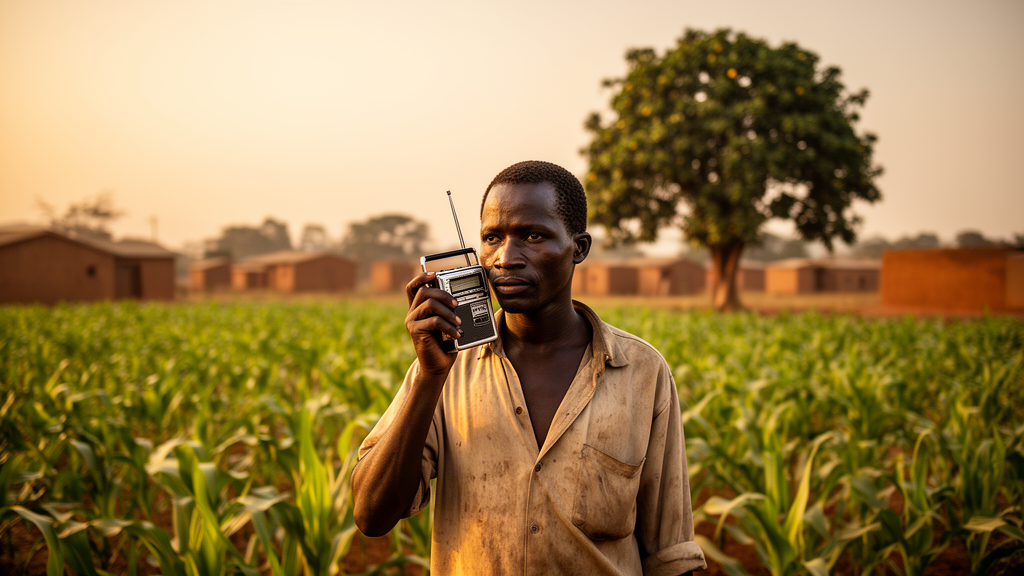
In the drought-prone savannas of Northern Ghana, the difference between a failed maize crop and a decent harvest may hinge not on the quality of a weather forecast, but on the channel through which it travels. A new study of 412 smallholder farmers across the Tolon, Mion and Nanton districts, published in Environmental Challenges, finds that the most effective climate communication is a hybrid affair: radio and agricultural extension agents carry the reach and the trust, while digital platforms deliver the speed that farmers say they cannot yet fully access. The research, led by Tijani Inusah Iddrisu of the University for Development Studies together with Eliasu Mumuni and Paul Kwame Nkegbe, argues that climate services fail not because the science is wrong, but because the delivery system is a one-way street.
The team used an explanatory sequential mixed-methods design, first running a cross-sectional survey across twelve farming communities and then following up with 23 key informant interviews involving farmers, extension agents, NGO workers, media practitioners and a telecom provider. Farmers rated twelve communication channels on a five-point effectiveness scale, and the rankings were analysed with the Friedman test, a non-parametric procedure suited to ordinal data in which the same respondents rate multiple items. The differences between channels were highly significant, with a Friedman chi-square of 2265.61 across 11 degrees of freedom and p below .001, and Kendall’s coefficient of concordance of 0.50 indicating moderate agreement among farmers about which channels deserve their confidence.
Radio emerged as the most effective channel overall, with a mean effectiveness score of 3.72, ahead of friends and family at 3.27, extension services and farmer-based meetings at 3.08 each, and phone calls at 3.04. The pattern reflects radio’s unmatched reach in rural communities and its ability to broadcast in Dagbani, the local language, translating complex meteorological jargon into terms farmers can act on. But the trust rankings told a subtler story. Extension services took the top mean rank of 10.58, with radio close behind at 10.37, a difference the post-hoc pairwise comparisons with Holm correction showed was not statistically significant. Farmer-based organisations and NGOs formed a statistically similar middle tier, while phones, social media, print media, online platforms and weather calendars clustered at the bottom.
The timing analysis exposed a striking paradox. Online and internet-based platforms scored the highest satisfaction with timeliness, at 92.3 percent of users satisfied or very satisfied, yet they were among the least used channels in the region. Radio, by contrast, reached the most farmers, 233 users in the sample, but only 59.2 percent were satisfied with its timing. In districts like Mion, where just one percent of the adult population uses the internet and mobile phone ownership is heavily skewed toward men, the technical capability of a channel clearly does not translate into real-world effectiveness. Connectivity, electricity, device access and digital literacy all mediate whether a fast channel is actually a useful one.
Feedback emerged as perhaps the most decisive factor separating channels that inform from channels that transform decisions. Agricultural extension services facilitated the most feedback, cited by 13.8 percent of respondents, followed by phone calls at 8.5 percent and family networks at 6.8 percent. Most channels, the study found, were unidirectional, offering farmers no opportunity to ask questions, seek clarification or translate generalised seasonal forecasts into specific planting decisions. This matters enormously for probabilistic forecasts, whose interpretation is rarely obvious to end users. Without dialogue, a farmer cannot connect a forecast of above-average rainfall to the choice between maize and an alternative bean variety for a particular field.
The qualitative interviews brought this dynamic vividly to life. One female farmer in Chirifoyili described how her husband called into an interactive radio programme to ask whether it was still appropriate to sow maize after a drought, and was told that bean seeds should be planted instead. The exchange shows interactive radio combining the reach of mass communication with the responsiveness of dialogue. An extension agent explained that farmers’ own observations, such as plants flowering or forming pods as signs of impending rain, are sometimes incorporated into official advice, a practice approaching co-production in which scientific forecasts and indigenous knowledge are joined to enhance local relevance.
Gender shaped the architecture of information flow in ways the statistics alone could not reveal. The chi-square test found no significant difference between men and women in satisfaction with timing, with a Pearson chi-square of 1.589, p of 0.811 and a negligible effect size. Yet the qualitative evidence showed that women often accessed climate information second-hand, through husbands or household networks, while men had more direct contact with formal channels such as extension services. Women relied more heavily on radio and farmer-based organisations, channels they could access and trust, but the longer the chain of intermediaries, the greater the risk of delay and distortion in time-sensitive forecasts.
Trust, the study concludes, is not a product of forecast accuracy alone but of relationships built through repeated, consistent interaction. Farmers discussed information from formal sources with family, friends and fellow farmers before acting, using these interpersonal networks as verification filters. Channels with a track record of credible performance, like extension services and radio, earned confidence over time, while sources associated with misinformation or inconsistent flow, like social media and online platforms, ranked lowest despite their speed. The findings align with the Global Framework for Climate Services’ user-centred philosophy, which places interaction between providers and users at the heart of useful climate service delivery.
The policy implications point firmly toward a blended communication model. Digital innovations should enhance rather than supplant existing systems: mobile and web-based technologies can add timeliness and intensity, while radio, extension services, farmer groups and community networks provide reach, interpretation and trust. Climate service providers should build feedback mechanisms into every platform, allowing farmers to ask questions, share local experiences and signal evolving information needs. Institutional synergies between meteorological agencies, agricultural extension services, local government, NGOs, farmer organisations and media houses would ensure that climate predictions arrive as actionable agricultural recommendations.
Ultimately, the study delivers a message that resonates far beyond Northern Ghana: the quality of climate information is inseparable from the quality of its communication. Effective climate services must move beyond the one-way street of dissemination toward two-way, user-centred systems that let farmers access, understand, question and apply climate information to their specific needs. Climate communication, the authors argue, must be seen as part of agricultural adaptation itself, not merely a vehicle for delivering weather forecasts. In an era when smallholder farmers face increasingly erratic rainfall and rising temperatures, the channels that carry climate knowledge may matter as much as the knowledge itself.
Subject of Research: News
Article Title: Towards a hybrid communication model for effective climate services: communication channels shaping smallholder farmers' decisions in Northern Ghana
Article References: Iddrisu, T. I., Mumuni, E., & Nkegbe, P. K. (2026). Towards a hybrid communication model for effective climate services: communication channels shaping smallholder farmers' decisions in Northern Ghana. Environmental Challenges, 25, Article 101687. https://doi.org/10.1016/j.envc.2026.101687
Image Credits: AI Generated
DOI: 10.1016/j.envc.2026.101687
Keywords: climate services, smallholder farmers, Northern Ghana, radio, communication channels, agricultural adaptation, Towards, hybrid, communication, model, effective, climate
Cite Scienmag News
Sloane Callahan. (October 19, 2026). Radio, Trust and Speed: How Climate Information Reaches Ghana’s Farmers. Scienmag. https://scienmag.com/radio-trust-and-speed-how-climate-information-reaches-ghanas-farmers/
Sloane Callahan. "Radio, Trust and Speed: How Climate Information Reaches Ghana’s Farmers." Scienmag, 19 October 2026, https://scienmag.com/radio-trust-and-speed-how-climate-information-reaches-ghanas-farmers/. Accessed 19 October 2026.
Sloane Callahan. "Radio, Trust and Speed: How Climate Information Reaches Ghana’s Farmers." Scienmag. October 19, 2026. https://scienmag.com/radio-trust-and-speed-how-climate-information-reaches-ghanas-farmers/


