


Air pollution has become one of Pakistan’s most pressing public health threats, and a new comprehensive review argues that the country cannot tackle it without first understanding exactly where its emissions come from. Published in the journal Air Quality, Atmosphere & Health, the study by Muhammad Hafeez Rasheed, Shuya Guo, Siwen Wang and Zhiliang Yao of Beijing Technology and Business University synthesizes evidence across every major anthropogenic sector in Pakistan, from coal-fired power plants and textile factories to brick kilns, vehicle fleets, household cookstoves, agriculture and municipal waste dumps. Unlike earlier sector-specific analyses, the review combines plant-level operational data, global emission inventories and satellite observations to build a cross-sector picture of the country’s pollutant profile and to pinpoint emission hotspots with unprecedented clarity.
The team followed a PRISMA-style systematic literature review, screening studies from major scientific databases to identify which pollutants dominate Pakistan’s atmosphere. The answer is a familiar but formidable roster: fine particulate matter (PM2.5), coarse particulate matter (PM10), nitrogen oxides (NOX), sulfur dioxide (SO2), ground-level ozone (O3), carbon monoxide (CO), volatile organic compounds (VOCs), carbon dioxide (CO2) and black carbon (BC). Each of these species carries distinct health risks. PM2.5 penetrates deep into the lungs and bloodstream, driving respiratory and cardiovascular disease. NOX and SO2 inflame airways and contribute to acid deposition. Ozone forms photochemically from NOX and VOCs in sunlight, while black carbon both warms the atmosphere and damages human health when inhaled.
To characterize emissions, the researchers integrated operational data from coal-, oil- and natural gas-fired power plants with the Emissions Database for Global Atmospheric Research (EDGAR v8.0) and satellite observations from the TROPOMI instrument aboard Sentinel-5P. This triangulation matters because ground-based monitoring in Pakistan is sparse and inconsistent, meaning that inventories and satellites often provide the only reliable spatial picture of pollution. The review identified coal-fired power plants located in coastal and industrial zones as major emission hotspots, a finding consistent with the rapid expansion of coal capacity along Pakistan’s coastline and in industrial corridors.
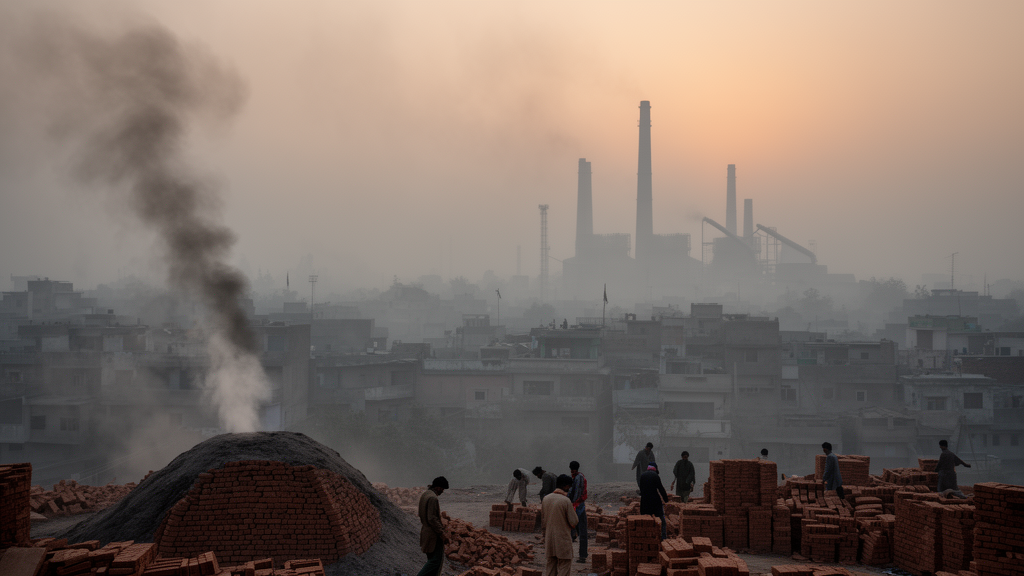
The power sector is only one thread in a dense web of sources. Industrial boilers and textile factories, particularly in cities such as Faisalabad, emit substantial flue gases whose composition depends heavily on fuel type. Brick kilns in Lahore and elsewhere release particulates and carbonaceous pollutants, with emission profiles varying by kiln technology and fuel choice. Transportation contributes NOX, CO and VOCs from a rapidly growing vehicle fleet, with studies documenting rising vehicle counts and deteriorating air quality in Islamabad. Residential biomass and coal burning for cooking and heating releases PM2.5 and black carbon indoors and outdoors. Agriculture adds emissions from crop residue burning, enteric methane from livestock and rice cultivation, while municipal solid waste disposal sites generate methane and leachate profiles documented through models such as LandGEM.
What makes the review technically significant is its insistence on secondary pollutant formation as a critical knowledge gap. NOX and VOCs react photochemically to form ozone; SO2 and NOX oxidize to sulfate and nitrate aerosols that constitute secondary inorganic PM2.5. The authors note that Pakistan’s understanding of these mechanisms remains inadequate, meaning that controlling primary emissions alone may not reduce secondary pollutants proportionally. Atmospheric oxidation capacity, photochemical loss of VOCs and regime shifts in secondary aerosol formation are all processes that require Pakistan-specific research rather than extrapolation from other regions.
The review also exposes stark monitoring deficiencies. Continuous emission monitoring systems (CEMS) are largely absent from Pakistani industrial facilities, meaning regulators often lack real-time data on what stacks are actually releasing. Ambient air quality monitoring near major sources is insufficient, and Pakistan-specific emission factors are limited, forcing reliance on default factors from the EMEP/EEA guidebook or other international sources that may not reflect local fuel quality, technology or operating conditions. Satellite retrievals such as TROPOMI NO2 v2.2 help fill spatial gaps, but ground-truthing remains weak.
Health evidence synthesized in the review underscores the stakes. Studies across Pakistani cities document PM2.5 concentrations exceeding World Health Organization guideline values, with geospatial modelling linking ambient pollutants to chronic obstructive pulmonary disease at regional scale. Biomagnetic characterization of air pollution particulates in Lahore and source apportionment studies during intense haze episodes reveal the complexity of urban pollution. Winter smog in Lahore, driven by meteorological inversions, crop residue burning and vehicular and industrial emissions, has become a recurring public health crisis. Black carbon emissions inventories and scenario analyses for Pakistan highlight co-benefits of air pollution control and climate change mitigation strategies.
The authors frame their recommendations around four pillars: urgent adoption of advanced control technologies, improvement in fuel quality, expansion of real-time monitoring networks and stricter enforcement of environmental regulations. Advanced control technologies include flue gas desulfurization for SO2, selective catalytic reduction for NOX, electrostatic precipitators and fabric filters for particulates, and activated carbon injection for mercury. Fuel quality improvement means shifting from high-sulfur coal and oil toward cleaner natural gas and renewables, with studies documenting the potential of solar, wind and biomass-based power generation in Pakistan. Real-time monitoring requires deploying CEMS across industrial facilities and expanding ambient networks in urban areas near major sources. Stricter enforcement means closing the gap between Pakistan’s national ambient air quality standards and their implementation, a gap documented in comparative assessments with other Asian countries and WHO benchmarks.
The review’s cross-sector view also highlights priority areas for research and monitoring. Comparing sectoral contributions reveals that no single source dominates everywhere; coastal coal plants, industrial estates, urban transport fleets, household stoves and agricultural burning each matter in different regions and seasons. This heterogeneity means mitigation planning must be evidence-based and spatially targeted rather than uniform. The integration of emission sources with monitoring deficiencies and policy shortcomings provides a roadmap for reducing exposure, protecting public health and supporting sustainable development in Pakistan.
As Pakistan continues to industrialize and its population grows, the review serves as both a warning and a guide. The country’s air pollution challenge is severe but tractable, provided that policymakers act on the evidence assembled here. The urgent adoption of advanced control technologies, improvement in fuel quality, expanded real-time monitoring networks and stricter enforcement of environmental regulations are not optional; they are essential for reducing exposure, protecting public health and supporting sustainable development in Pakistan. The review’s synthesis of plant-level data, inventory estimates and satellite observations offers a template that other data-scarce countries could follow to build their own cross-sector emission pictures.
Subject of Research: Air pollution and sectoral anthropogenic emissions in Pakistan: a comprehensive review
Article Title: Air pollution and sectoral anthropogenic emissions in Pakistan: a comprehensive review
Article References: Rasheed, M. H., Guo, S., Wang, S., & Yao, Z. (2026). Air pollution and sectoral anthropogenic emissions in Pakistan: a comprehensive review. Air Quality, Atmosphere & Health, 19(11), Article 239. https://doi.org/10.1007/s11869-026-02132-z
Image Credits: AI Generated
DOI: 10.1007/s11869-026-02132-z
Keywords: pollution, sectoral, anthropogenic, emissions, Pakistan, comprehensive, review, scientific research
Cite Scienmag News
Russell Cooper. (October 19, 2026). Pakistan’s air pollution crisis mapped from power plants to brick kilns. Scienmag. https://scienmag.com/pakistans-air-pollution-crisis-mapped-from-power-plants-to-brick-kilns/
Russell Cooper. "Pakistan’s air pollution crisis mapped from power plants to brick kilns." Scienmag, 19 October 2026, https://scienmag.com/pakistans-air-pollution-crisis-mapped-from-power-plants-to-brick-kilns/. Accessed 19 October 2026.
Russell Cooper. "Pakistan’s air pollution crisis mapped from power plants to brick kilns." Scienmag. October 19, 2026. https://scienmag.com/pakistans-air-pollution-crisis-mapped-from-power-plants-to-brick-kilns/


